The vapour-compression refrigeration cycle
Engineering · Second- and third-year engineering · about 12 min
Fridges, freezers, air conditioners and heat pumps all use the same idea: make a refrigerant boil at a low temperature so it soaks up heat, then compress it so it can dump that heat somewhere warmer. The coefficient of performance (COP) says how much cooling you get for each unit of work you pay for.
The key idea
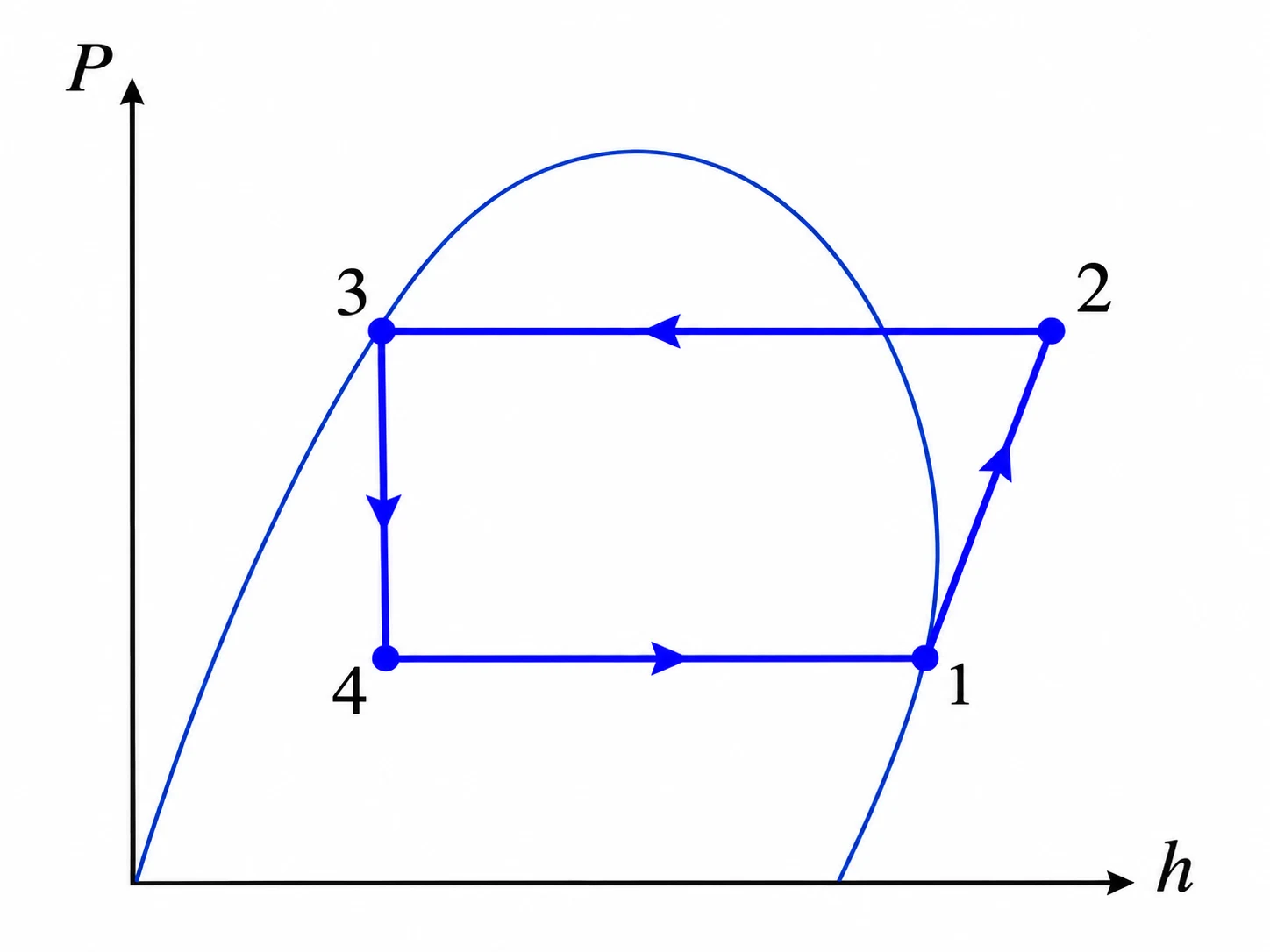
For the ideal cycle, with enthalpies at the four states (in kJ/kg):
The heat rejected in the condenser is .
The four components
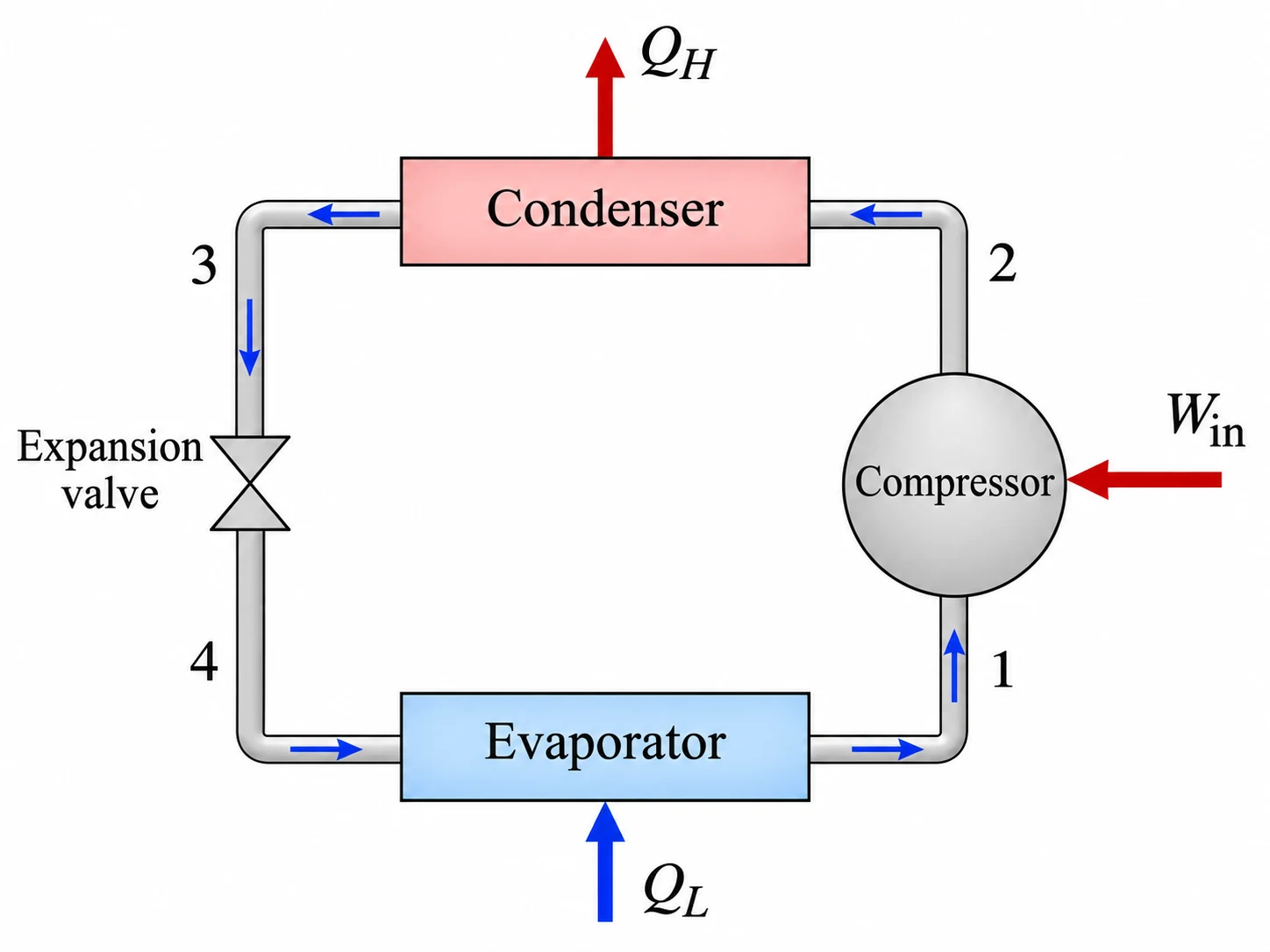
- Compressor (state 1 to 2): saturated vapour is compressed to high pressure and temperature. This is where the work goes in.
- Condenser (2 to 3): the hot vapour gives heat to the surroundings and condenses to liquid.
- Expansion valve (3 to 4): the liquid's pressure drops suddenly. No work or heat is exchanged, so ; it leaves as a cold, mostly liquid mixture.
- Evaporator (4 to 1): the cold refrigerant boils, absorbing heat from the space being cooled.
Why the COP is usually bigger than 1
A refrigerator doesn't create cold; it moves heat. Moving heat takes much less energy than producing it, so a typical fridge removes to kJ of heat for every kJ of electrical work. The ideal limit, from the Carnot cycle in reverse, is
with temperatures in kelvin.
Worked example: COP and refrigerant flow rate
In an ideal vapour-compression cycle using R-134a, the property tables give kJ/kg leaving the evaporator, kJ/kg leaving the compressor, and kJ/kg leaving the condenser. Find the COP, and the refrigerant mass flow rate needed for kW of cooling.
Show the solution
The expansion valve doesn't change enthalpy, so kJ/kg.
Refrigerating effect: kJ/kg
Compressor work: kJ/kg
Mass flow for kW of cooling:
Common mistakes
Forgetting that the expansion valve keeps enthalpy constant
Throttling is isenthalpic: . That's often the missing value.
Using the heat rejected instead of the heat absorbed
A refrigerator's COP uses the cooling, . A heat pump's COP uses the heating, .
Thinking a COP above 1 breaks energy conservation
The work isn't turned into cooling; it moves heat that was already there. Energy still balances: .
Check your understanding
1. Which component is the work input in a vapour-compression cycle?
2. A fridge removes W of heat using W of work. What is its COP?
3. Across the expansion valve, which property stays the same?
Still not sure? Talk it through.
Waypoint Mentor's tutor explains this out loud, works through your own problems on a whiteboard, and checks you've got it. Free to start.