Part III: Flow Analysis and Applications · Topic 8 of 8 · 27 min read
External Flow, Boundary Layers and Forces
Estimate boundary-layer thickness, skin friction, drag and lift.
What you'll learn
Explain the wall boundary layer and no-slip condition.
Evaluate approximate laminar flat-plate thickness and friction drag.
Distinguish pressure drag from skin-friction drag.
Use supplied lift and drag coefficients with correct areas.
Understand the concepts
Why a boundary layer forms
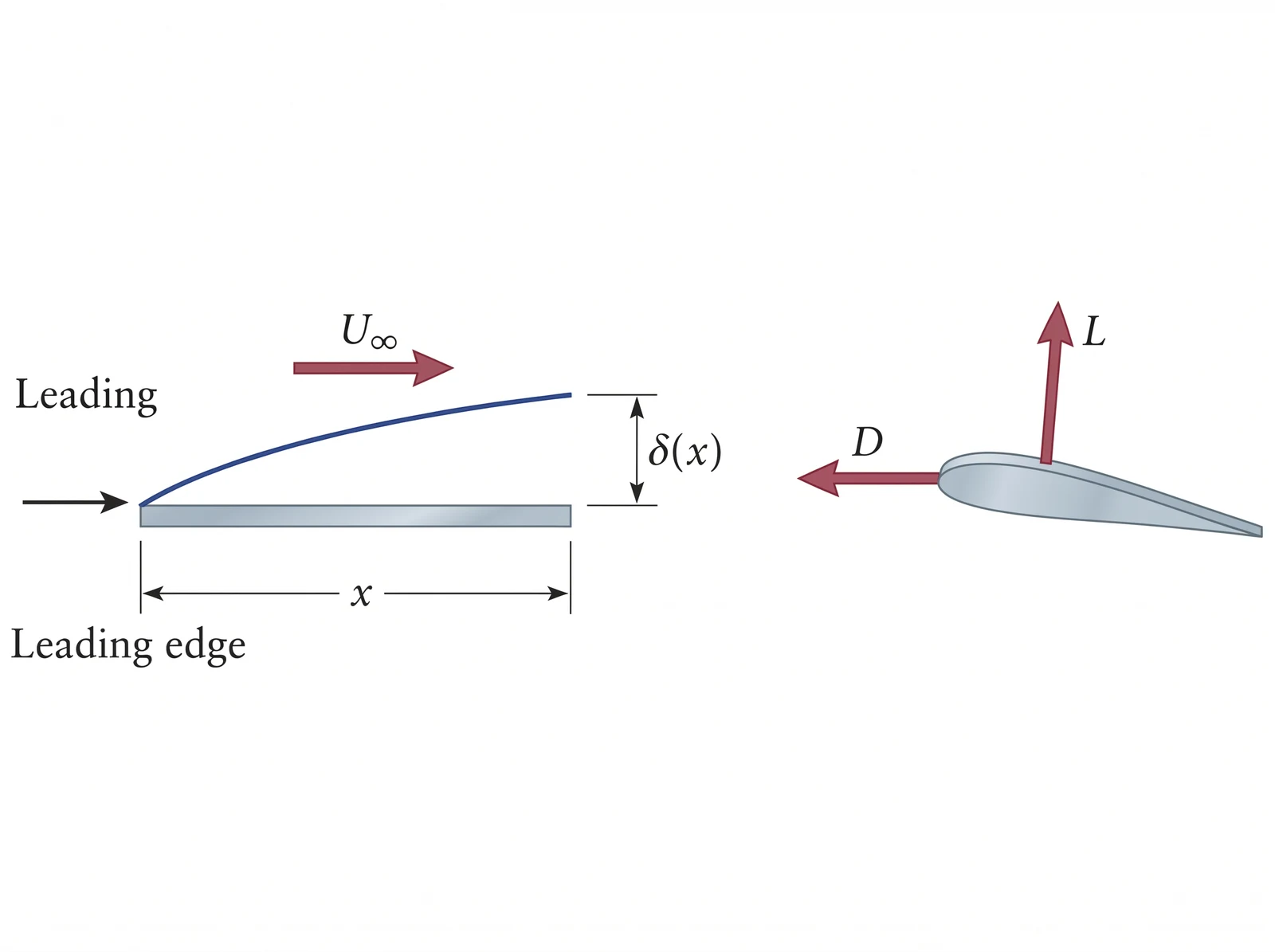
Fluid immediately adjacent to a fixed wall satisfies the no-slip condition. Viscosity transfers momentum between this slow fluid and the faster outer stream, generating a boundary layer. Its thickness generally increases downstream.
Laminar flat-plate estimates
For a smooth flat plate in zero streamwise pressure gradient, standard laminar formulas give approximate thickness and average skin-friction coefficient. They require flow that remains laminar over the modelled length. State the leading-edge reference and the selected characteristic length.
Skin friction versus pressure drag
Skin friction acts tangentially because of wall shear. Pressure drag arises from the pressure distribution, often strongly affected by flow separation. Their sum is the overall drag, but the appropriate coefficient must correspond to the drag mechanism and reference area.
Lift and drag coefficients
Forces can be expressed with dimensionless coefficients multiplying dynamic pressure and a reference area. Lift is conventionally perpendicular to the oncoming velocity and drag is parallel and opposite to it. A coefficient depends on geometry and flow condition, so do not assume an arbitrary universal value.
Transitional and turbulent flow
Boundary-layer transition depends on disturbances, pressure gradients and surface conditions as well as Reynolds number. Laminar correlations should not be applied beyond their assumed regime without discussion. A provided turbulent correlation has its own restrictions.
Interpreting predictions
The dynamic pressure makes aerodynamic or hydrodynamic loads particularly sensitive to speed. Doubling speed roughly quadruples coefficient-based force only if the coefficient is unchanged. Check whether the reference area means frontal projection, planform area or wetted surface.
Assumptions and sign conventions
Incompressible steady outer flow with uniform free-stream speed.
Laminar flat-plate formulas require a smooth plate and negligible pressure gradient.
Coefficients and their reference areas are specified in each problem.
Ignore structural deformation and free-surface effects unless otherwise stated.
Equations that matter
Step-by-step method
Identify stream direction, body geometry and the correct reference or wetted area.
Calculate the relevant Reynolds number and check the stated flow regime.
Choose boundary-layer or coefficient-based force relations with matching assumptions.
Compute the dynamic pressure and apply the requested thickness or force relation.
Check speed scaling, flow-direction conventions and whether one or two sides were counted.
Worked example: Drag estimate on a submerged sensor cover
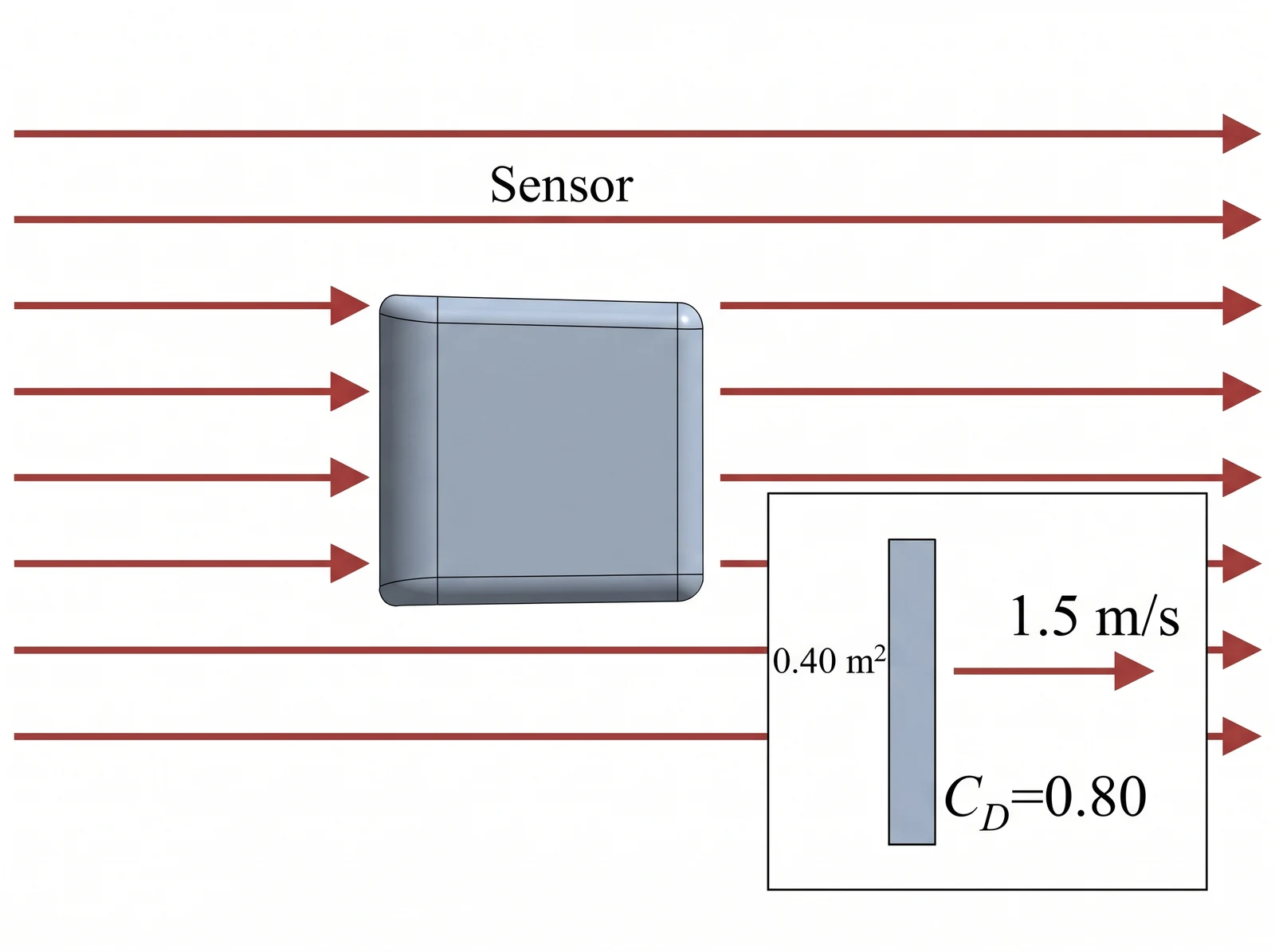
A submerged cover has projected frontal area and operates in water with at relative speed . Its measured drag coefficient is based on frontal area. Estimate the drag magnitude.
Common mistakes
Using wetted area when the supplied coefficient uses frontal area.
Applying a laminar plate formula to a turbulent boundary layer.
Forgetting to count both faces when both are exposed.
Treating lift as a forward force rather than normal to the relative stream.
Check yourself
Why does skin-friction drag depend on wetted area?
What conditions limit laminar flat-plate formulas?
How does drag scale with speed if the coefficient is constant?
Ready to try it yourself?
Independent Waypoint Mentor learning material. Not affiliated with or endorsed by any university.