Part III: Flow Analysis and Applications · Topic 7 of 8 · 27 min read
Internal Flow and Pipe Losses
Predict viscous pressure losses and flow through pipe systems.
What you'll learn
Distinguish fully developed laminar and turbulent pipe models.
Calculate laminar flow rate from a pressure gradient.
Use Darcy friction factor consistently in loss calculations.
Combine distributed and local losses in an energy balance.
Understand the concepts
Developing and developed flow
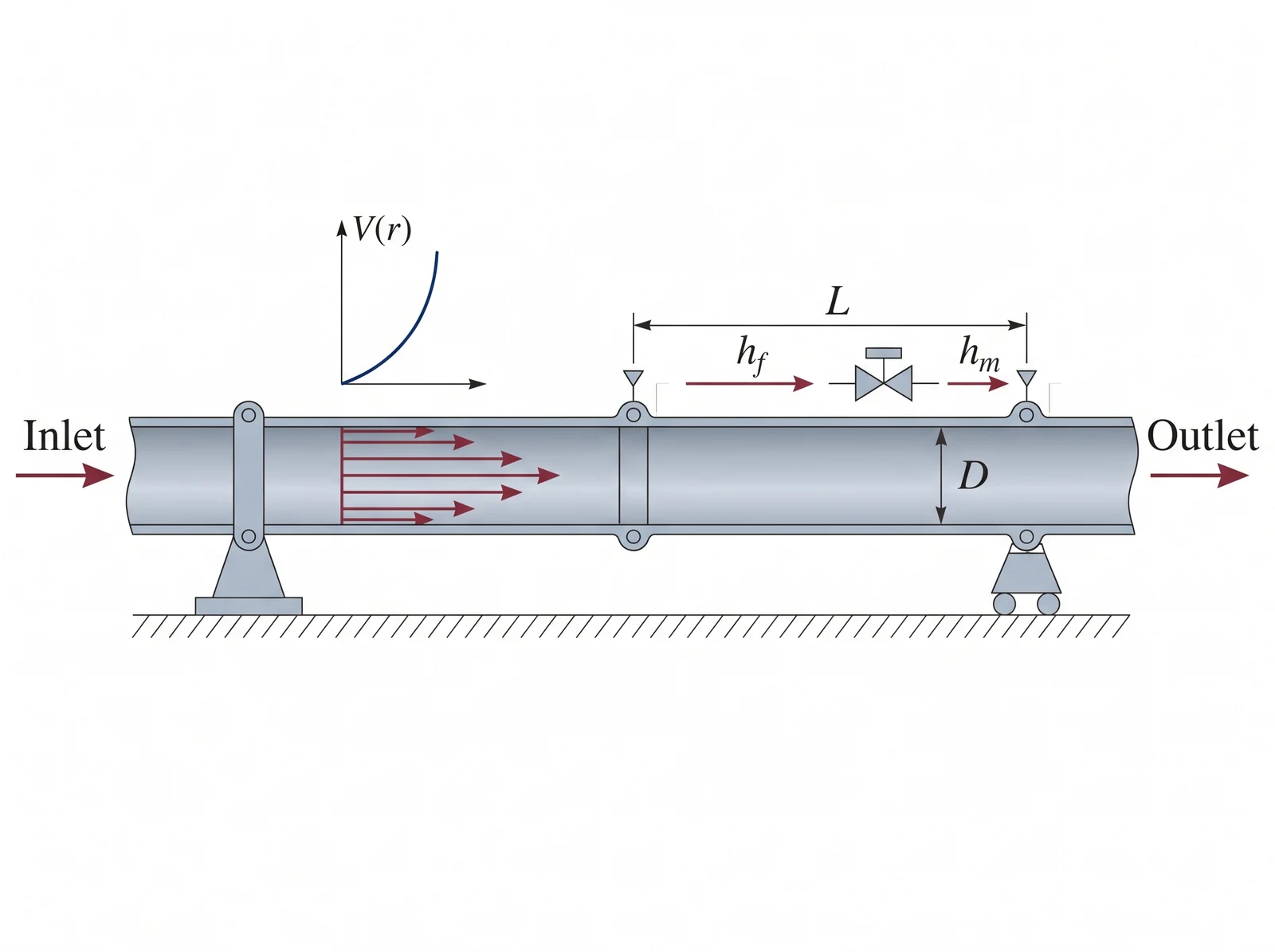
Near a pipe entrance, the wall boundary layers grow and the velocity profile changes downstream. In fully developed flow the profile shape no longer changes with distance, although pressure continues to decrease. An entrance region should not be treated as fully developed without justification.
Laminar pipe solution
For a straight circular pipe carrying Newtonian fluid in steady, fully developed laminar flow, flow rate is proportional to pressure drop and the fourth power of diameter. The sensitivity to diameter makes unit conversion particularly important. This model should be checked against Reynolds number.
Turbulent friction losses
In turbulent pipe flow the Darcy friction factor depends on Reynolds number and relative roughness. It may be supplied or estimated from appropriate correlations and charts. Do not interchange Darcy and Fanning conventions because they differ by a factor of four.
Major versus minor losses
Wall friction distributed along straight pipe length produces major loss. Bends, contractions, valves and other fittings produce local losses represented by coefficients. Their effects add as positive dissipations when the stated reference velocity is the same.
Pipe systems and available head
A reservoir elevation difference can supply the head consumed by pipe losses. For constant loss coefficients and friction factor, discharge can be obtained from a quadratic speed relation. If friction factor depends on Reynolds number, an iterative calculation may be needed.
Assumptions and sign conventions
Steady incompressible flow of constant-property Newtonian fluid.
Round circular pipes unless stated otherwise.
Fully developed laminar theory only when Reynolds number and entrance assumptions support it.
Use Darcy, not Fanning, friction factors.
Equations that matter
For laminar flow, a small increase in diameter greatly increases discharge at fixed pressure drop.
Use it: For steady fully developed laminar flow through a circular pipe.
Step-by-step method
Sketch the pipe route and identify straight lengths and local fittings.
Compute section areas and mean speed or discharge using continuity.
Select the appropriate flow-regime model and Darcy friction factor.
Add major and minor losses using their stated reference velocities.
Check Reynolds number, flow direction, energy decrease and units before reporting a result.
Worked example: A slow-flow dosing line
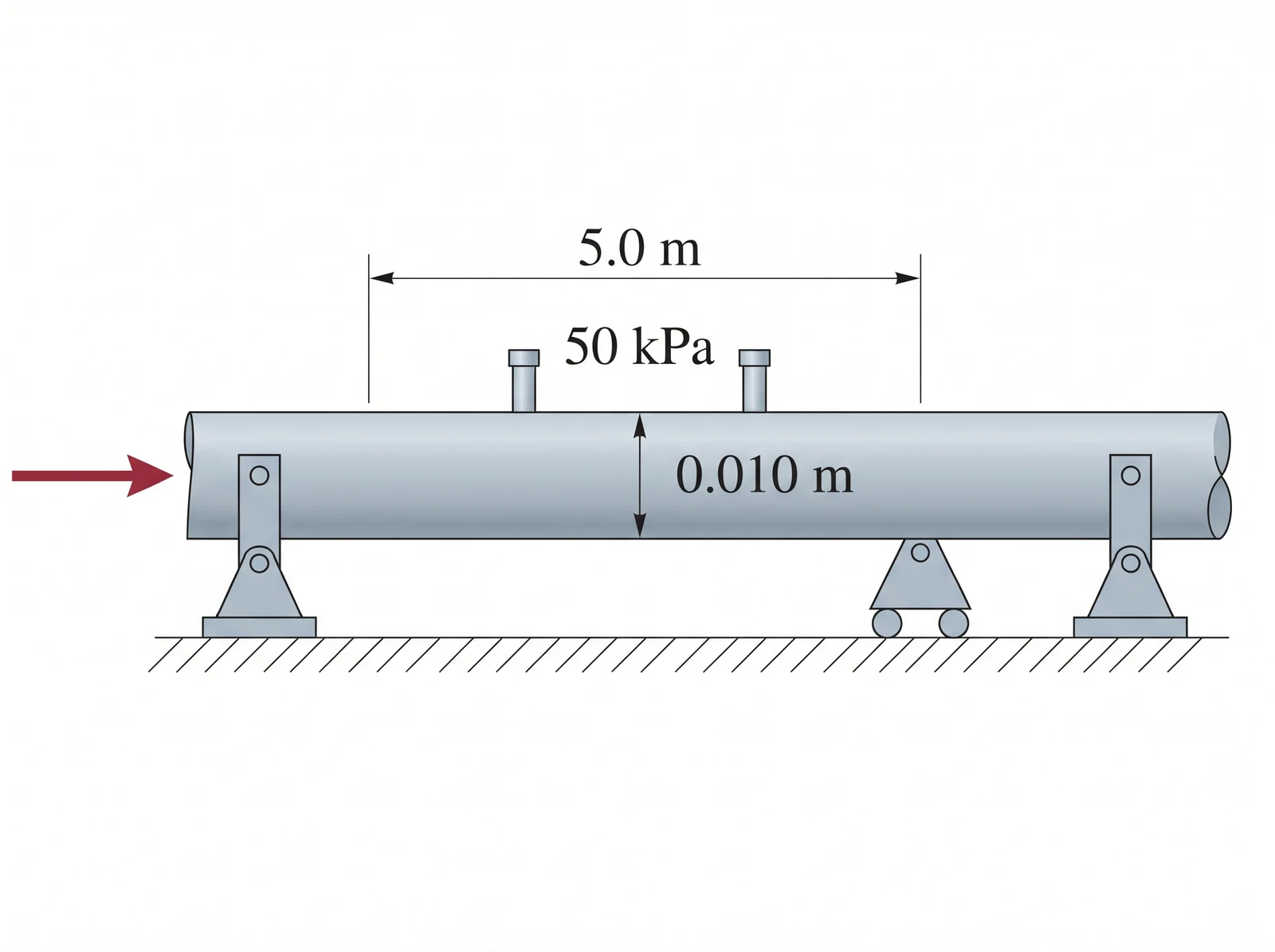
A viscous liquid moves in steady, fully developed laminar flow through a horizontal circular tube of diameter and length . The pressure drop is and . Calculate the discharge.
Common mistakes
Using centimetres or millimetres directly in a fourth-power formula.
Confusing Darcy and Fanning friction factors.
Forgetting fitting loss when summing total head losses.
Using a laminar relation after a high calculated Reynolds number.
Check yourself
Why is laminar discharge very sensitive to pipe diameter?
What is the difference between distributed and local losses?
Why should Reynolds number be checked after assuming laminar flow?
Ready to try it yourself?
Independent Waypoint Mentor learning material. Not affiliated with or endorsed by any university.