Bernoulli's equation
Engineering · Senior school and first-year engineering · about 10 min
When water speeds up through a narrow section of pipe, its pressure drops. Bernoulli's equation explains why: it is conservation of energy for a flowing fluid. It's behind Venturi meters, carburettors and part of the story of how wings make lift.
The key idea
Along a streamline in steady, incompressible flow with negligible friction:
is the pressure, the kinetic energy per unit volume, and the potential energy per unit volume. If one goes up, the others must come down.
Continuity: why the fluid speeds up
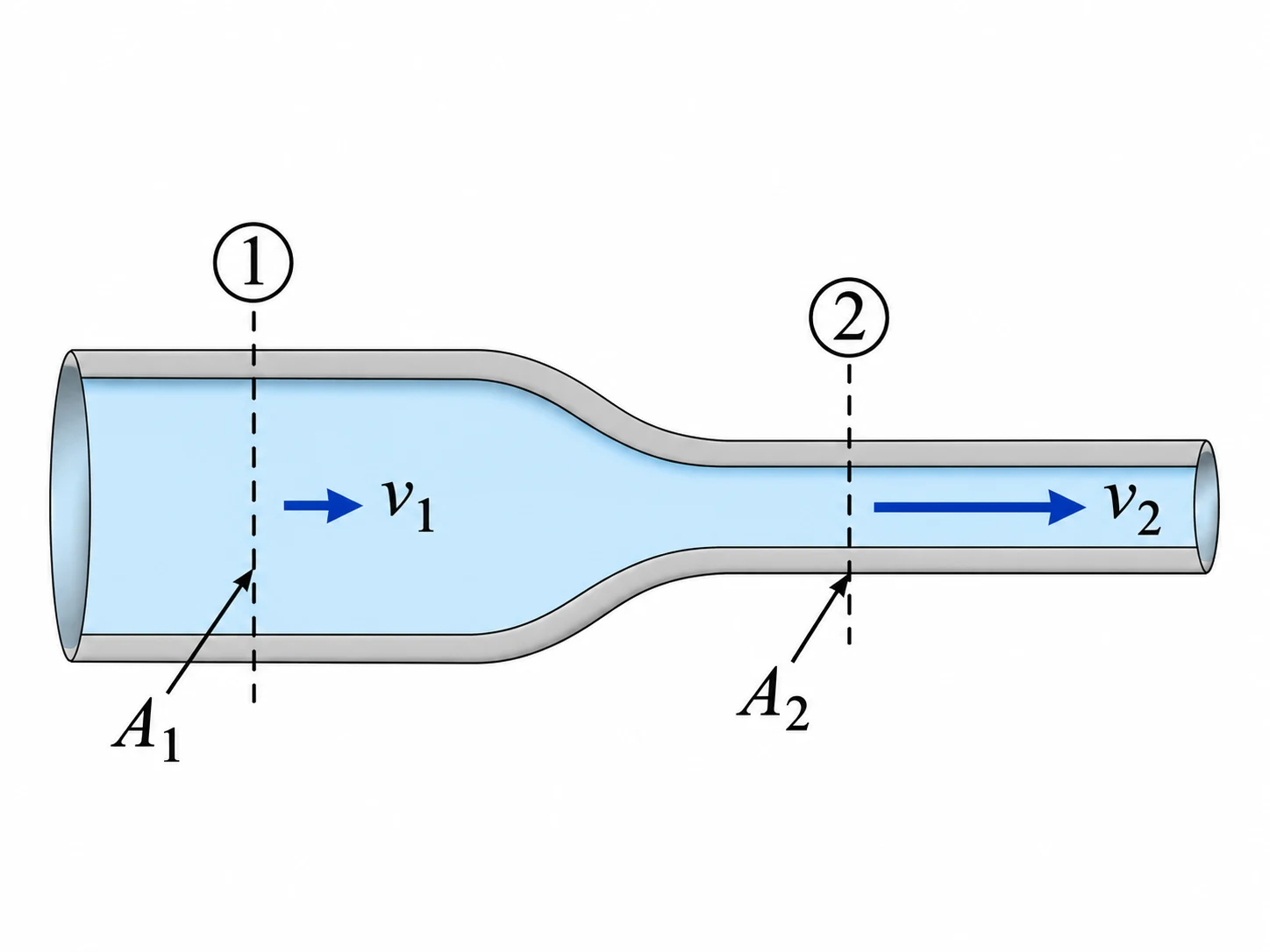
Fluid can't pile up inside a pipe, so the volume flow rate is the same at every section:
Halve the diameter and the area drops to a quarter, so the speed goes up four times. Bernoulli then tells you what that does to the pressure.
When you can use it
Bernoulli's equation assumes:
- steady flow (not changing with time),
- incompressible fluid (liquids, or gases at low speed),
- negligible friction (no viscous losses),
- points on the same streamline, with no pump or turbine between them.
Real pipes have friction, so engineers add a head-loss term; the ideal version is the starting point.
Worked example: water through a narrowing pipe
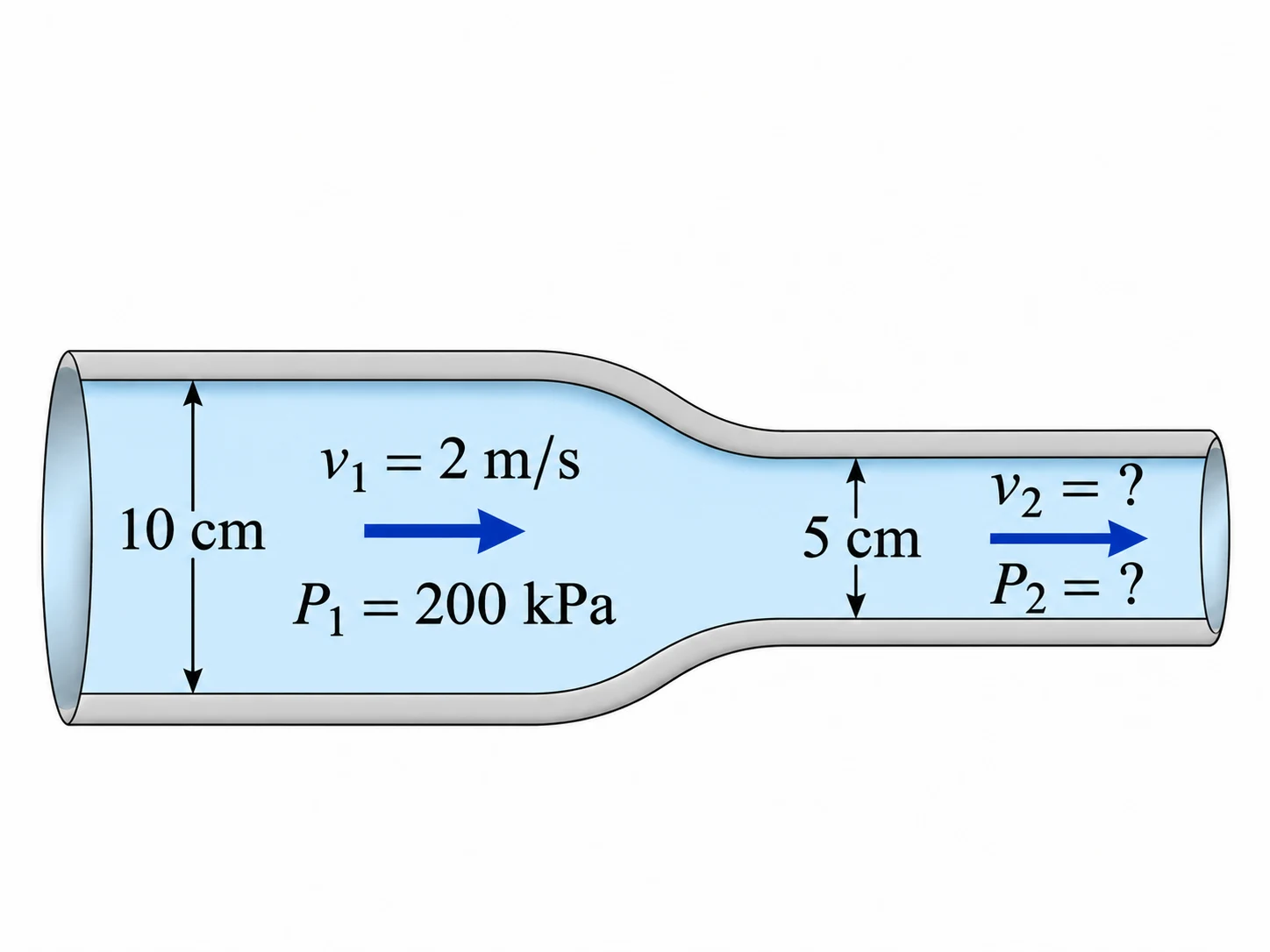
Water ( kg/m) flows through a horizontal pipe that narrows from cm to cm in diameter. In the wide section the speed is m/s and the pressure is kPa. Find the speed and pressure in the narrow section.
Show the solution
Continuity. The area ratio is , so
Bernoulli, with (horizontal pipe):
The water speeds up four times and the pressure drops by kPa.
Common mistakes
Scaling speed with the diameter instead of the area
Speed scales with area, which goes with diameter squared: half the diameter means four times the speed.
Using it across a pump or a long rough pipe
A pump adds energy and friction removes it. Plain Bernoulli only holds where neither happens.
Mixing kPa and Pa
Work in pascals: with in kg/m and in m/s comes out in Pa.
Check your understanding
1. In a horizontal pipe, where the fluid speeds up, the pressure...
2. A pipe's diameter is reduced to one third. The flow speed becomes...
3. Which of these breaks the assumptions of Bernoulli's equation?
Still not sure? Talk it through.
Waypoint Mentor's tutor explains this out loud, works through your own problems on a whiteboard, and checks you've got it. Free to start.