Newton's second law
Physics · Senior school physics · about 8 min
Newton's second law connects force and motion: push something and it accelerates. It's the most-used equation in mechanics, from car design to rocket launches, and the key is always the net force, not just the biggest one.
The key idea
The net force on an object equals its mass times its acceleration:
Force is in newtons, mass in kilograms and acceleration in m/s. The acceleration points the same way as the net force.
Always use the net force
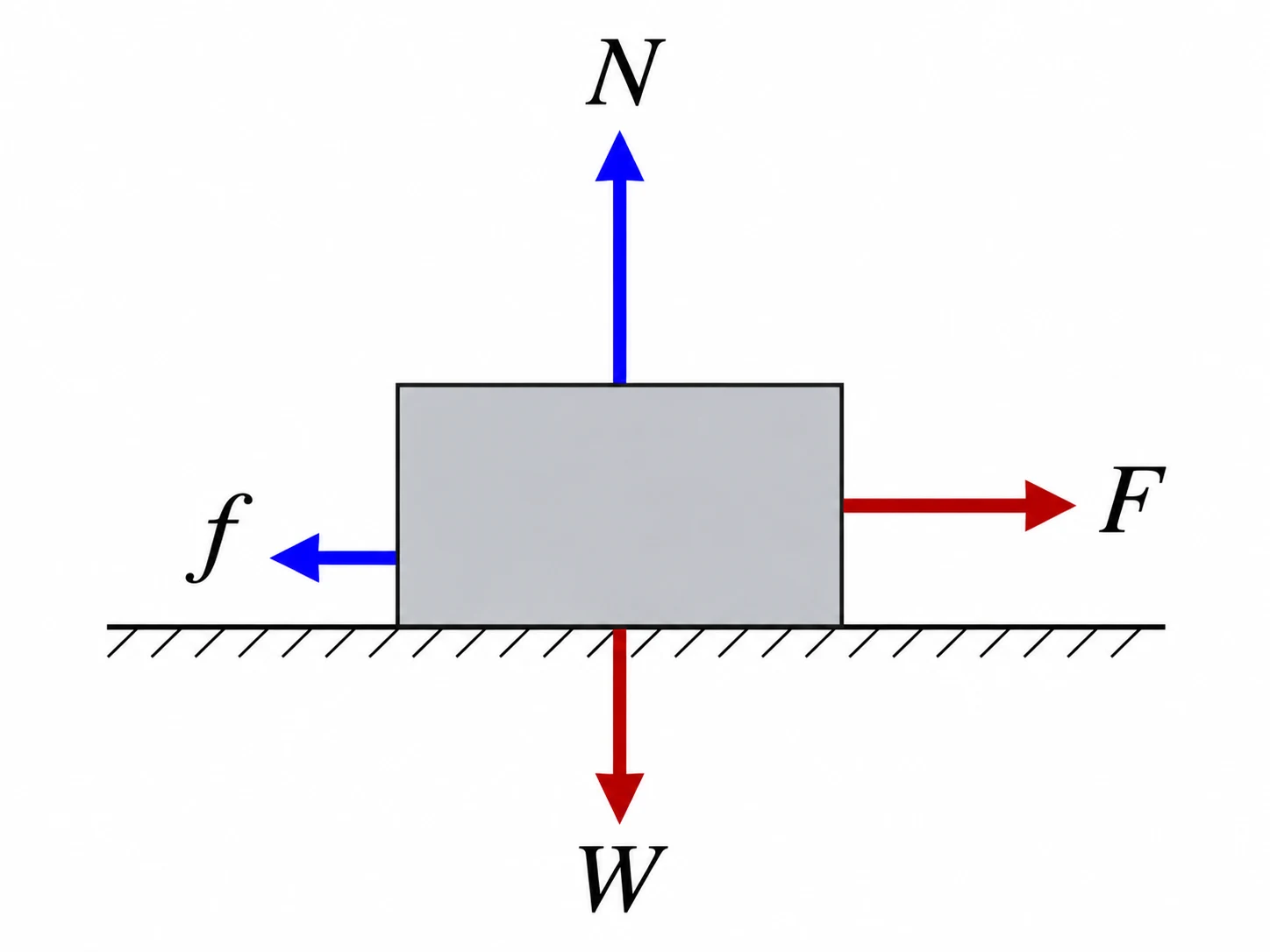
Draw a free-body diagram showing every force on the object: weight, normal force, friction, drag, tension, thrust. Add them as vectors (taking direction into account). Only the resultant causes acceleration.
If the net force is zero, the object doesn't speed up or slow down: it stays still or keeps moving at constant velocity (Newton's first law).
Mass and weight are different
Mass (, in kg) is how much matter there is, and it's the same everywhere. Weight is the force of gravity on it, , in newtons. On Earth m/s, so a kg object weighs about N; on the Moon it would weigh about N.
Worked example: a car accelerating against drag
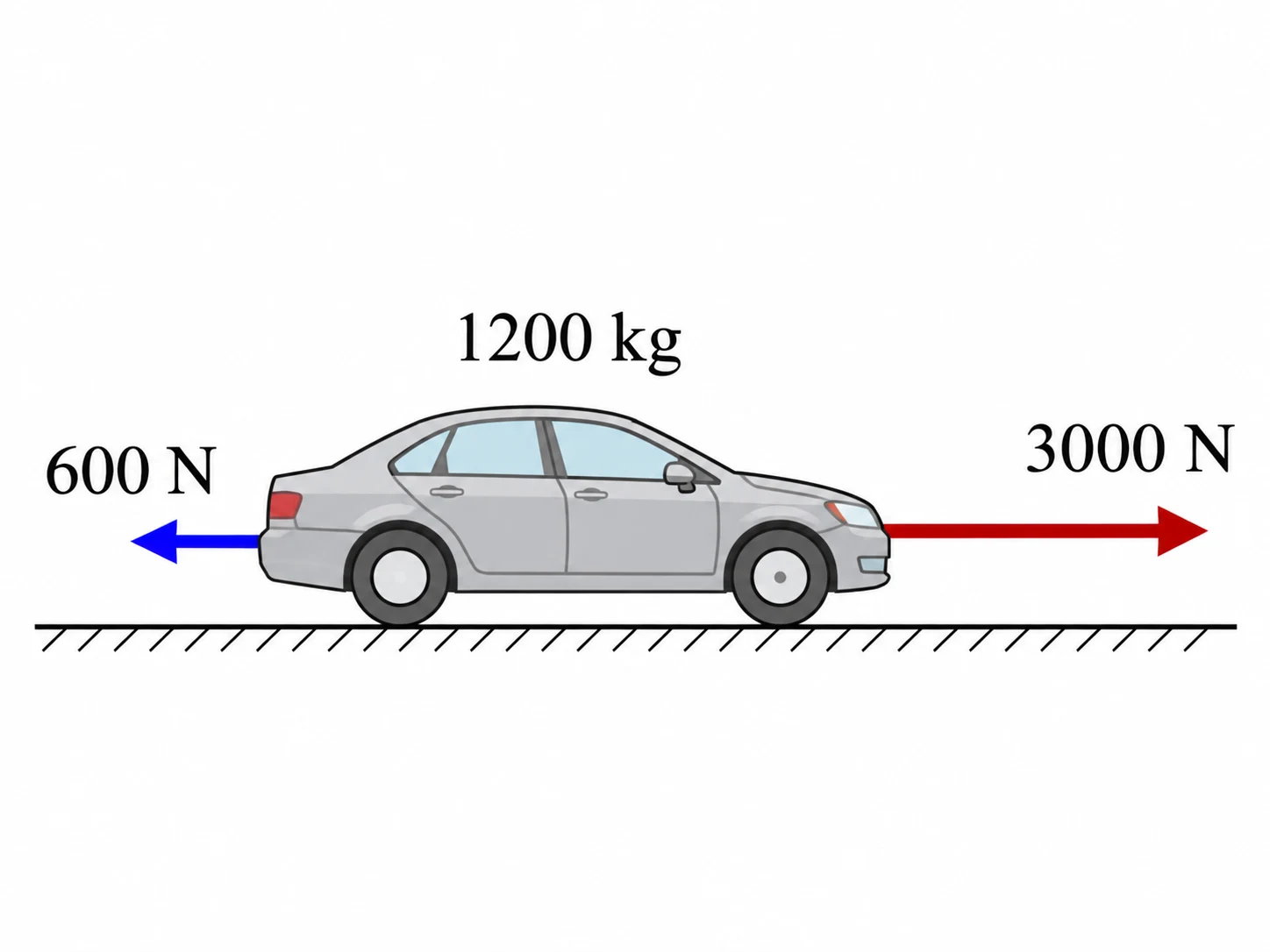
A kg car's engine provides a driving force of N, while air resistance and rolling friction total N. Find its acceleration and how long it takes to reach m/s from rest (assuming the forces stay constant).
Show the solution
Net force: N forwards
Acceleration:
Time to reach m/s (from with ):
Common mistakes
Using one force instead of the net force
Here m/s would be wrong; subtract the resistance first.
Thinking a moving object needs a net force to keep moving
Constant velocity needs zero net force. Force changes motion; it doesn't sustain it.
Using weight in newtons where mass is needed
In , is the mass in kg. Divide a weight by to get mass.
Check your understanding
1. A N net force acts on a kg box. What is its acceleration?
2. A car drives at a steady 60 km/h on a straight road. The net force on it is...
3. What is the weight of a kg person on Earth ( m/s)?
Still not sure? Talk it through.
Waypoint Mentor's tutor explains this out loud, works through your own problems on a whiteboard, and checks you've got it. Free to start.