Friction on an inclined plane
Physics · Senior school and first-year physics · about 10 min
A block on a ramp is one of the most common problems in mechanics, because it brings together free-body diagrams, resolving forces at an angle, and friction. Once you can do this one, most force problems follow the same pattern.
The key idea
Tilt your axes to line up with the slope. For a block of mass on an incline at angle :
It slides if , that is, if .
Try it yourself
Why tilt the axes
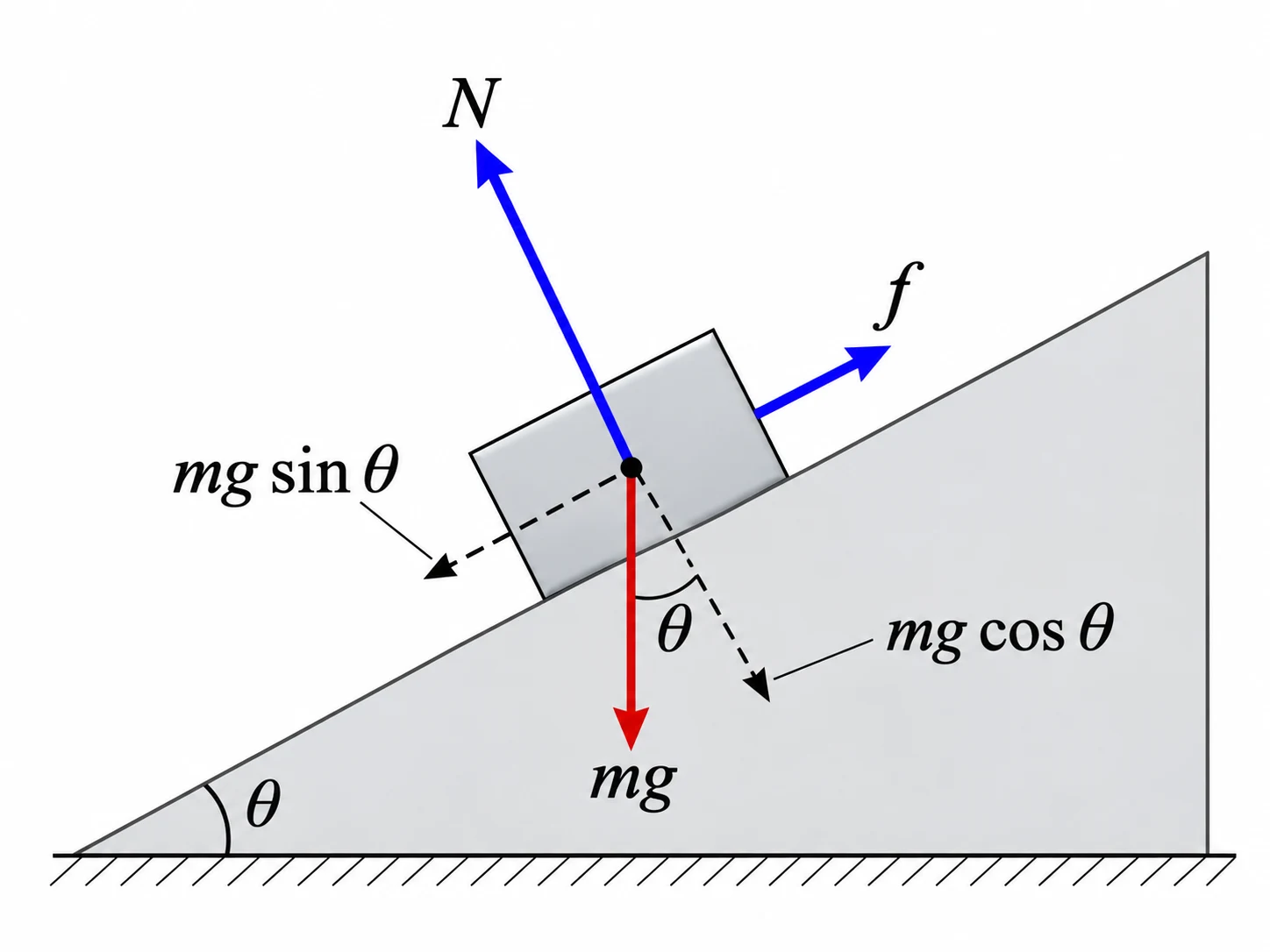
The block can only move along the slope, so put one axis along it and one perpendicular to it. Then the normal force and friction each lie on an axis, and only gravity needs splitting:
- along the slope, down:
- into the slope:
Nothing moves perpendicular to the slope, so .
Static and kinetic friction
- Static friction holds the block still. It can be anything up to , just enough to stop it moving.
- Once it slides, kinetic friction acts, , opposite to the motion. is usually a bit smaller than .
So first check whether it moves at all ( against ), then use for the acceleration.
Worked example: does it slide, and how fast does it speed up?
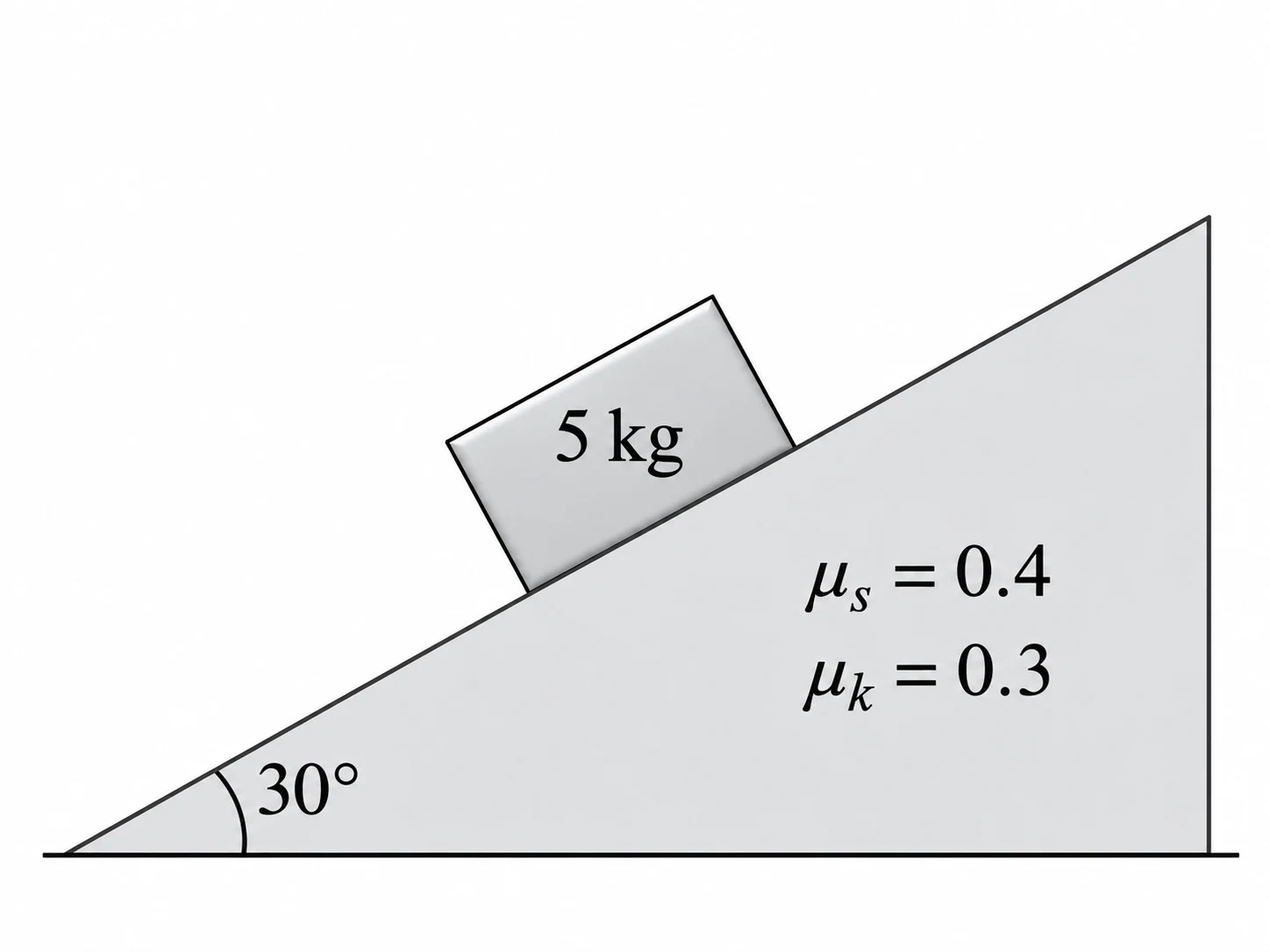
A kg block sits on a slope. The coefficients of friction are and . Take m/s. Does it slide? If so, what is its acceleration?
Show the solution
Does it slide? , which is greater than , so static friction can't hold it: it slides.
Normal force: N
Kinetic friction: N, acting up the slope.
Acceleration along the slope:
down the slope.
Common mistakes
Writing on a slope
On an incline only the part of gravity into the slope is balanced: .
Swapping and
Check with an extreme: at (flat) the force along the slope must be , so it's .
Using the kinetic coefficient to decide whether it starts moving
Starting is decided by static friction, . Use once it's already sliding.
Check your understanding
1. A block rests on a slope. What is the normal force for a kg block ()?
2. A block just stays put on a slope with . What is the steepest angle before it slides?
3. Which way does kinetic friction act on a block sliding down a slope?
Still not sure? Talk it through.
Waypoint Mentor's tutor explains this out loud, works through your own problems on a whiteboard, and checks you've got it. Free to start.