Heat conduction through walls
Engineering · Second-year university engineering · about 10 min
Heat conduction transfers energy through a solid when one region is warmer than another. For a wall, the heat loss depends on its thickness, face area, temperature difference and thermal conductivity. A simple conduction model is a quick way to estimate a heat-transfer rate and to compare insulation options.
The key idea
For steady, one-dimensional conduction through a plane wall with constant conductivity,
Here is heat-transfer rate, is thermal conductivity, is wall area, is thickness and the two temperatures are the wall surface temperatures.
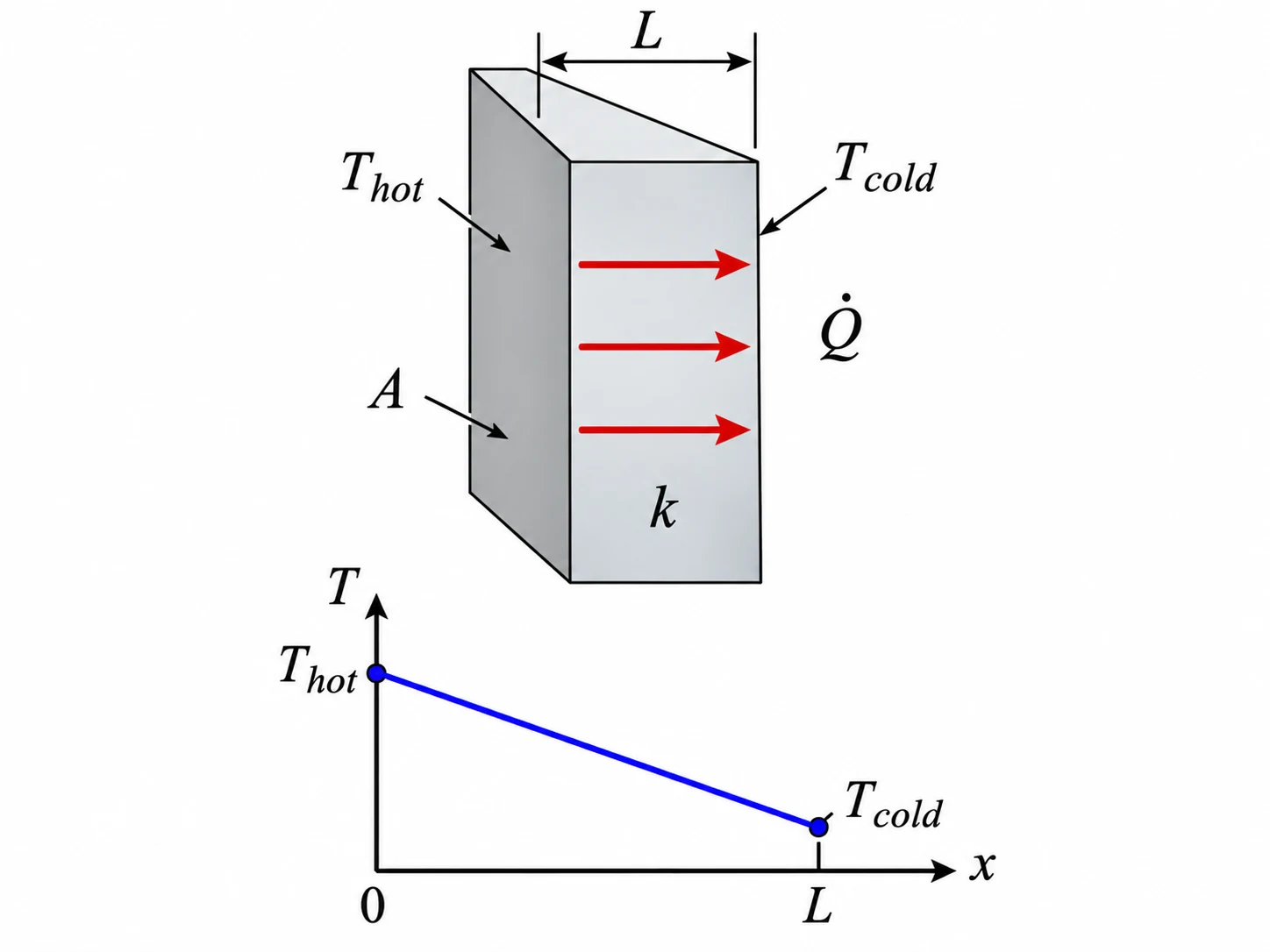
Temperature gradient and direction
Fourier's law states that heat flows from higher temperature to lower temperature: . In a uniform plane wall with no internal heat generation, the temperature profile is linear and the heat-transfer rate is constant across each section. The minus sign is a direction rule, not a reason to report a negative heat-loss magnitude. A temperature difference of has the same size as a difference of , but use consistent units for conductivity and wall geometry. The boundary temperatures in the simple equation must be surface temperatures rather than room-air temperatures.
Thermal resistance
Rearrange the wall equation using the conduction resistance , measured in . Then . A thicker wall has higher resistance and a lower heat-transfer rate. A material with larger conducts heat more readily and has lower resistance. Watch the difference between total rate , in watts, and heat flux , in watts per square metre. The flux is convenient for comparing walls of different face areas.
Several layers and real walls
For layers in series with a common area and steady one-dimensional flow, add their conduction resistances: , then use . Every layer carries the same steady heat rate if there is no side loss or internal source. Real walls may also need convection resistances at the air-facing surfaces, contact resistances and corrections for thermal bridges. Do not include those effects implicitly when a problem supplies only solid-surface temperatures; state what the model includes.
Worked example: Heat loss through a brick wall
A uniform wall has surface area and thickness . Its thermal conductivity is . The inner and outer wall surface temperatures are and . Assuming steady, one-dimensional conduction, find the heat-loss rate and the energy conducted in .
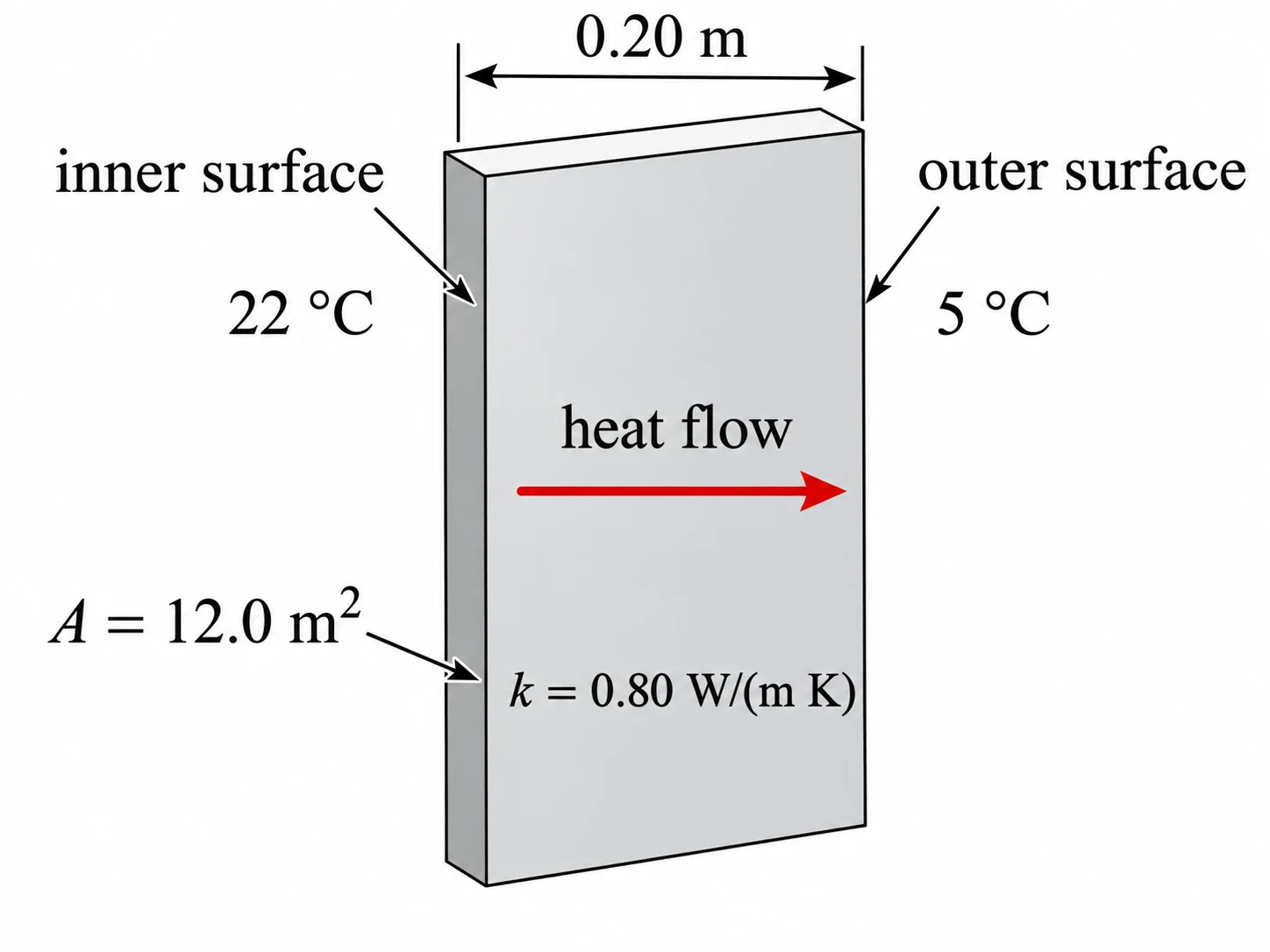
Show the solution
1. Find the wall temperature difference.
2. Find the conduction resistance.
3. Compute the heat-loss rate.
4. Convert the duration and find the energy.
Answer: of heat loss and conducted over .
Common mistakes
Using the temperature of the room air as the wall surface temperature without justification.
Identify whether temperatures are air temperatures or specified solid-surface temperatures, and add convection if required.
Omitting the wall thickness from the calculation.
Use , so increasing thickness increases resistance.
Confusing heat rate with heat energy.
Report in watts; multiply by elapsed seconds to obtain energy in joules.
Adding layer conductivities directly.
For series layers, add thermal resistances rather than conductivity values.
Check your understanding
1. For the same uniform wall and surface temperatures, what happens to the steady heat-transfer rate if thickness doubles?
2. A wall has , , and a surface temperature difference of . What is ?
3. Two wall layers have series resistances of and . What heat rate is driven by a surface difference?
Still not sure? Talk it through.
Waypoint Mentor's tutor explains this out loud, works through your own problems on a whiteboard, and checks you've got it. Free to start.