Moles and stoichiometry
Chemistry · Senior school chemistry · about 10 min
Chemical equations describe particles reacting in fixed ratios, but laboratory measurements are usually masses. The mole connects these two descriptions. Stoichiometry then uses the balanced equation to predict how much reactant is needed or how much product can form.
The key idea
Convert mass to amount of substance using
Here is amount in , is mass in , and is molar mass in . Balanced equation coefficients give mole ratios.
Convert between quantities
One mole contains exactly specified entities. If the sample contains entities, then , where is the Avogadro constant. For mass calculations, find the molar mass from the chemical formula, then divide the measured mass by it. The mass and molar mass units must agree. For example, using grams with grams per mole gives moles. A subscript in a chemical formula counts atoms inside one molecule; a coefficient in a balanced equation counts the relative numbers of whole molecules or moles.
Follow the balanced ratio
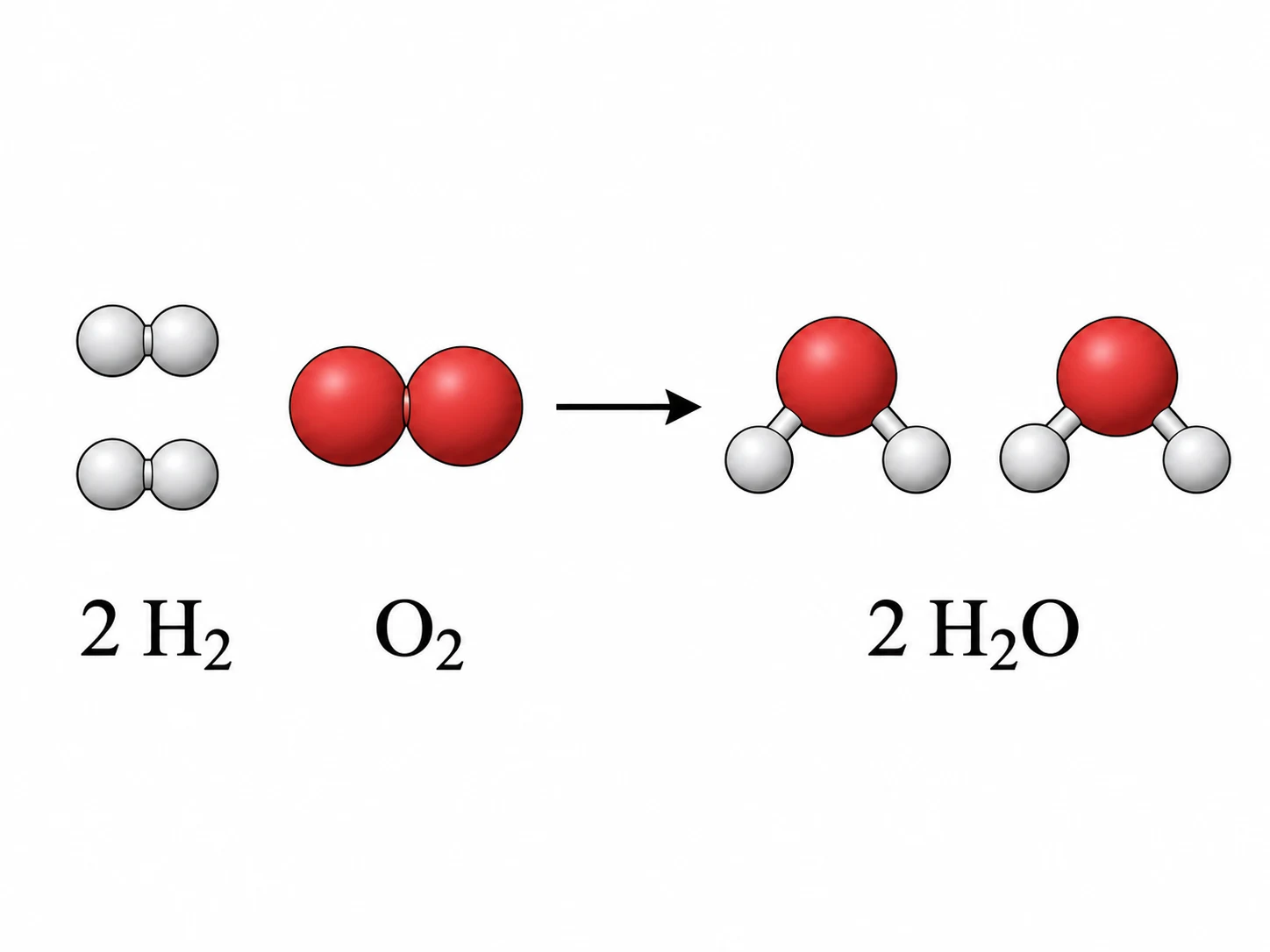
Balance the reaction before calculating anything. For , two moles of hydrogen react with one mole of oxygen to form two moles of water. A reliable calculation route is mass to moles, mole ratio, then moles to the required final unit. Never use a mass ratio taken directly from equation coefficients. The coefficients represent amounts of substance, not masses. Keep extra digits until the end so a small rounding error does not change the final answer.
Find the limiting reactant
When more than one starting reactant amount is given, determine the maximum product each could make. The reactant giving the smaller maximum product amount runs out first and limits the reaction. You can also divide each available mole amount by its coefficient; the smaller ratio identifies the limiting reactant for the stated reaction. Use that reactant to calculate theoretical yield. If an actual product mass is supplied, percentage yield is . This yield can be below because of incomplete reaction or product loss.
Worked example: Carbon dioxide from methane combustion
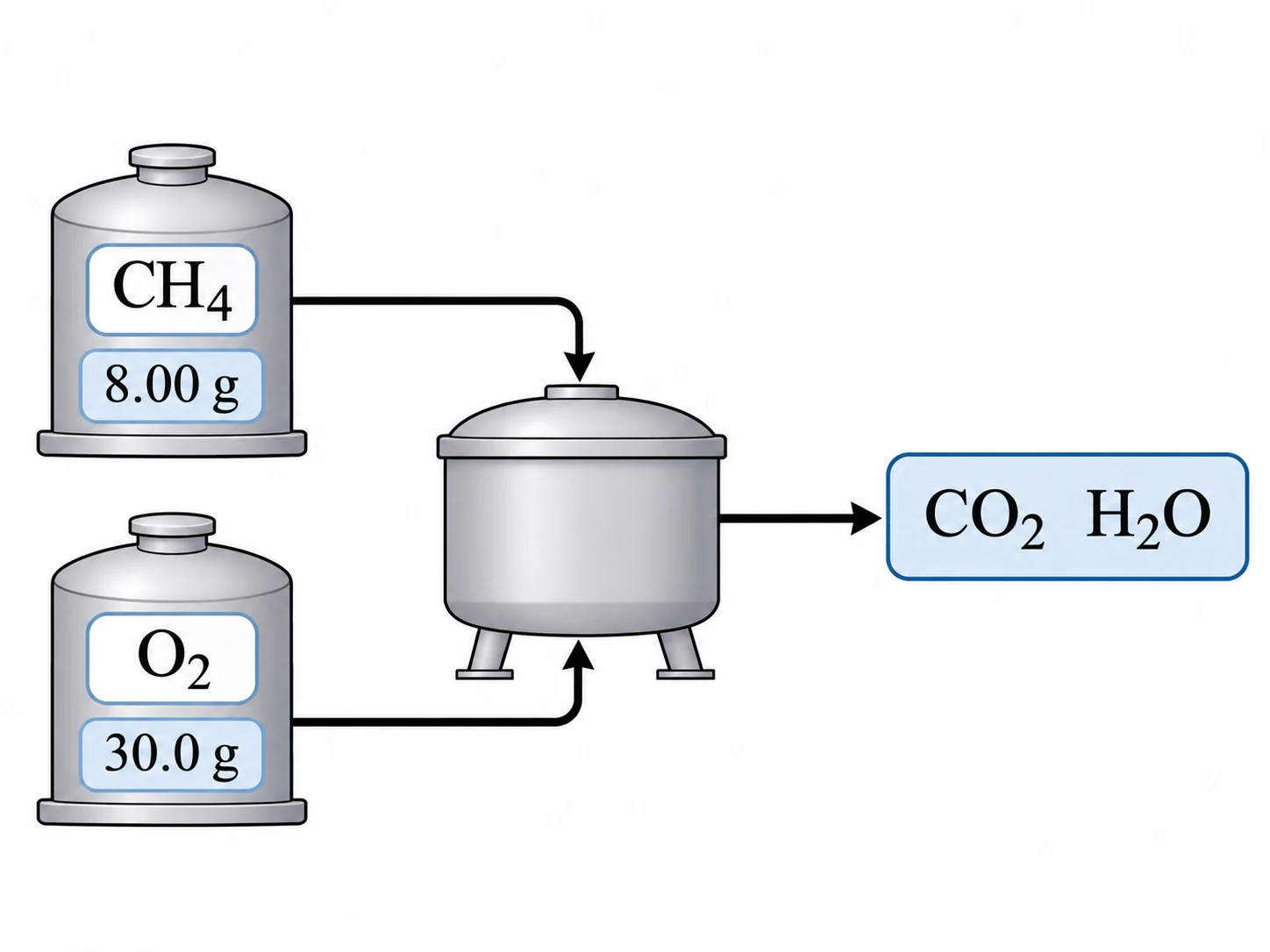
Methane reacts completely with oxygen according to . A reaction starts with of methane and of oxygen. Determine the limiting reactant and the theoretical mass of carbon dioxide. Use , and .
Show the solution
- Convert both reactant masses to moles:
-
Each mole of methane needs two moles of oxygen. Consuming all the methane would require of oxygen, more than is available. Oxygen is limiting.
-
The equation forms one mole of carbon dioxide for every two moles of oxygen:
- Convert the product amount to mass:
Answer: oxygen is the limiting reactant; the theoretical carbon dioxide mass is (3 significant figures).
Common mistakes
Using an unbalanced equation
Balance atoms on both sides before taking mole ratios.
Comparing reactant masses directly
Convert each mass to moles, then account for the balanced coefficients.
Using the excess reactant for product yield
Calculate theoretical product from whichever reactant is limiting.
Rounding too early
Retain intermediate precision and round only the final result to suitable significant figures.
Check your understanding
1. How many moles are in of if ?
2. For , how much water can form from of oxygen with excess hydrogen?
3. Approximately how many molecules are in of a molecular substance?
Still not sure? Talk it through.
Waypoint Mentor's tutor explains this out loud, works through your own problems on a whiteboard, and checks you've got it. Free to start.