Momentum and collisions
Physics · Senior school physics · about 10 min
Momentum describes how much motion an object carries in a particular direction. During a short collision, the forces between the objects can be very large, yet their combined momentum stays constant if the external impulse is negligible. This makes it possible to calculate an unknown final velocity without knowing the complicated contact force.
The key idea
For a system with negligible external impulse, total momentum is conserved:
Here is mass in and is signed velocity in . Momentum has units .
Try it yourself
Direction and impulse
Momentum is a vector. In a one-dimensional problem, select a positive direction before doing any arithmetic. Motion in the opposite direction has negative velocity, even when the object is moving quickly. A change in momentum comes from an impulse:
Impulse has units , equivalent to . The equation refers to the net force on the chosen object. When a ball rebounds, its velocity reverses sign, so the momentum change can be larger than either its initial or final momentum magnitude. Do not replace velocity with speed.
Types of collision
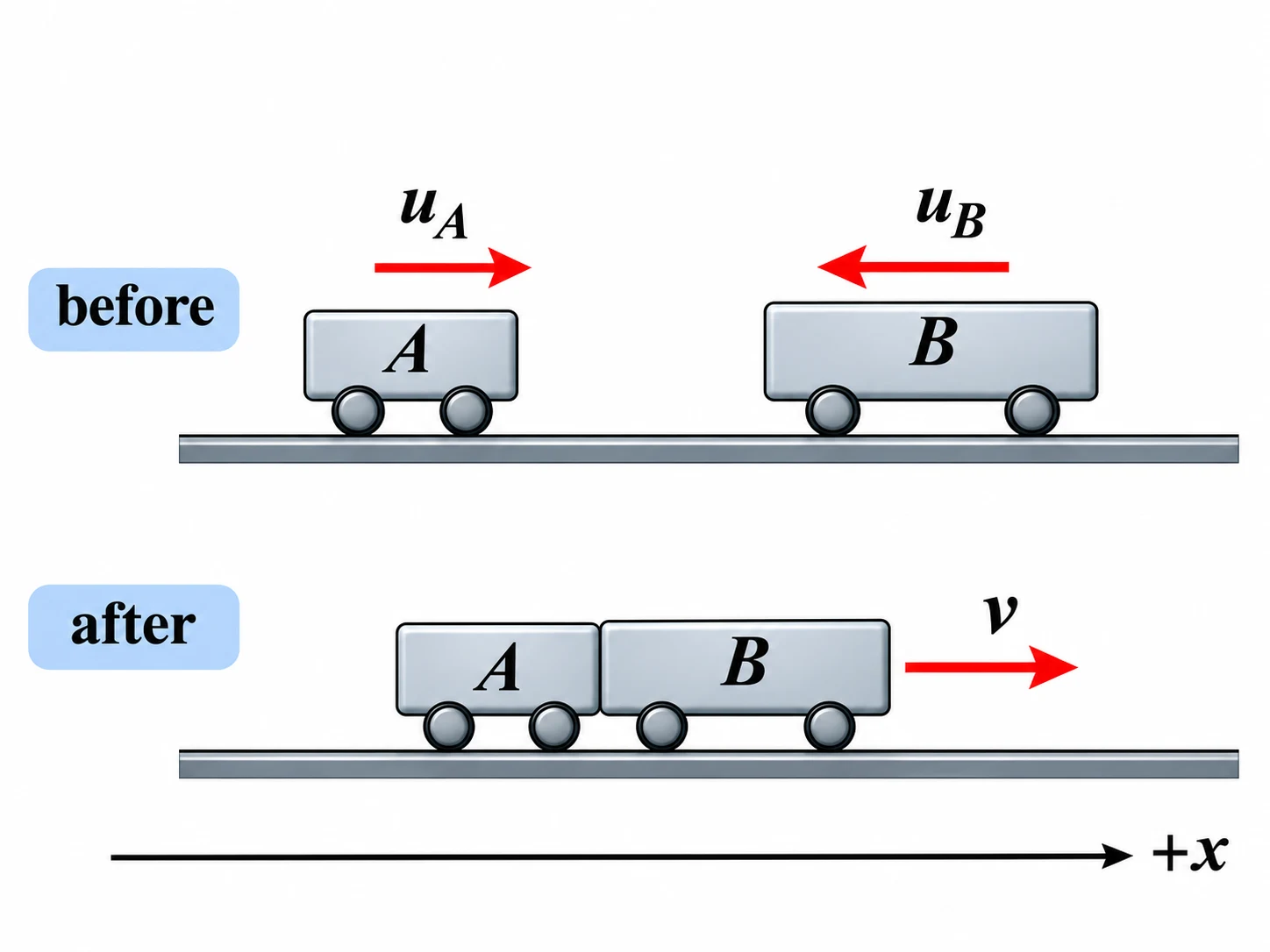
For two objects moving along one line, conservation gives
The letters and mean velocities before and after impact. In a perfectly inelastic collision, the objects stick and share one final velocity. In an elastic collision, total kinetic energy is conserved as well as momentum. In other collisions, some kinetic energy becomes sound, heat or deformation. Momentum conservation still applies to the complete isolated system, but kinetic energy conservation generally does not. Internal collision forces cancel when the two objects are treated as one system.
A reliable solving method
Sketch the objects before and after contact, mark a positive axis and assign a signed velocity to each object. Write the momentum equation before inserting values. If the bodies join, use a common final velocity and their combined mass. A negative result means movement opposite to your chosen axis; it does not mean an impossible velocity. When the question also asks about energy, calculate kinetic energy separately with . The square removes the velocity sign. Finally, check that total momentum has the same units and value on both sides.
Worked example: Two trolleys that lock together
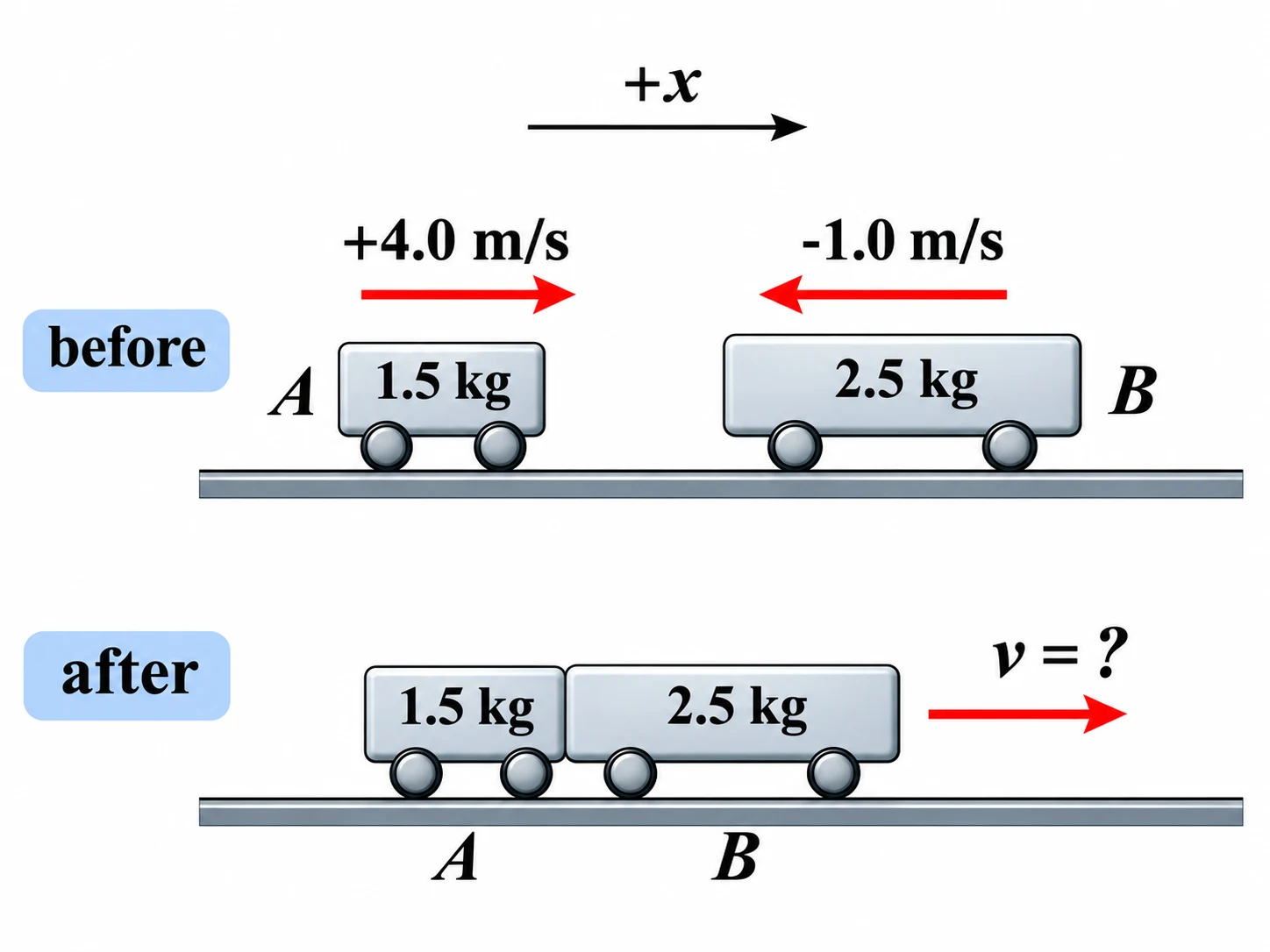
On a straight, nearly frictionless track, trolley A of mass moves right at . Trolley B of mass moves left at . They collide and lock together. Find their common velocity and the kinetic energy lost in the collision.
Show the solution
Step 1: Choose right as positive. The signed initial velocities are and .
Step 2: Conserve momentum. The joined trolleys have a common velocity :
(1.5)(4.0)+(2.5)(-1.0)&=(1.5+2.5)v\\ 6.0-2.5&=4.0v\\ v&=\frac{3.5}{4.0}=0.875\,\mathrm{m/s}. \end{aligned}$$ The positive sign means that the combined trolley moves right. **Step 3: Calculate kinetic energy before and after.**K_i=\frac12(1.5)(4.0)^2+\frac12(2.5)(1.0)^2=13.25,\mathrm{J}.
K_f=\frac12(4.0)(0.875)^2=1.53125,\mathrm{J}.
K_{\mathrm{lost}}=13.25-1.53125=11.71875,\mathrm{J}\approx11.72,\mathrm{J}.
**Answer: $0.875\,\mathrm{m/s}$ right, with $11.72\,\mathrm{J}$ of kinetic energy lost.**Common mistakes
Using positive speeds for both approaching objects
Choose an axis and make one initial velocity negative when it points opposite the axis.
Conserving kinetic energy when the objects stick
Conserve momentum, then calculate the change in kinetic energy separately.
Forgetting that impulse is a change, not a final momentum
Use with signed velocities and units of .
Treating a negative final velocity as an error
Interpret its sign as the direction of motion relative to the axis you selected.
Check your understanding
1. A ball initially travels at and rebounds at . What is its change in momentum?
2. A trolley moving at sticks to a stationary trolley. What is their common velocity?
3. For an isolated pair of objects, which quantities are conserved in an elastic collision?
Still not sure? Talk it through.
Waypoint Mentor's tutor explains this out loud, works through your own problems on a whiteboard, and checks you've got it. Free to start.