Trusses: the method of joints
Engineering · First-year engineering · about 12 min
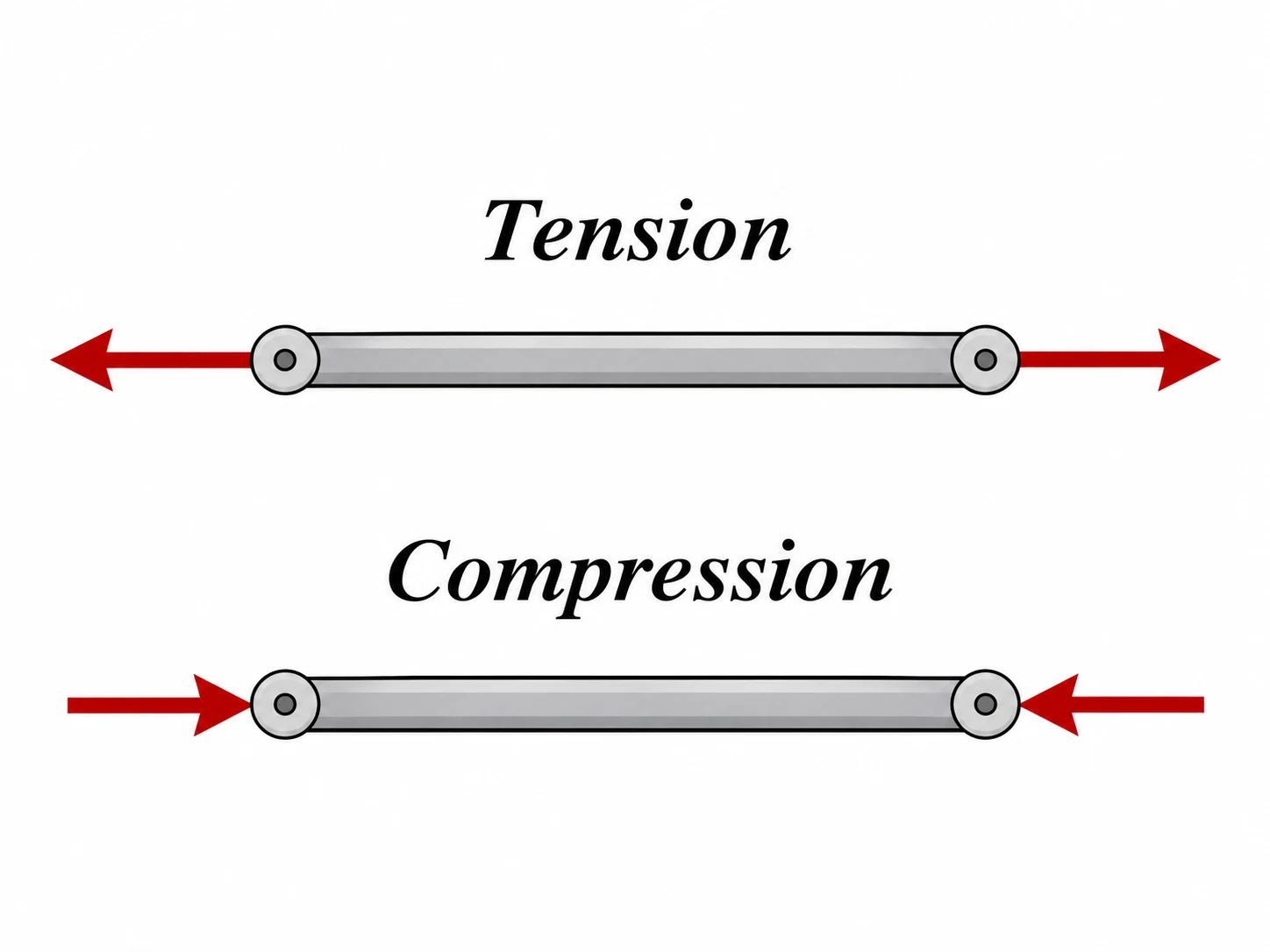
A truss is a frame made of straight members joined at their ends, like a bridge or roof frame. Each member is only pulled (tension) or pushed (compression) along its length. The method of joints finds the force in every member by treating each joint as a point in equilibrium.
The key idea
At every joint, the member forces and any loads balance in both directions:
Two equations per joint means you can solve a joint with at most two unknown member forces. Start at one of those, then move from joint to joint.
Try it yourself
Tension and compression
Assume every unknown member force is tension, pulling away from the joint. Solve the equations:
- a positive answer means the member really is in tension;
- a negative answer means it's in compression, pushing on the joint.
Assuming tension everywhere means you never have to guess directions.
The method, step by step
- Find the support reactions for the whole truss first (moments and equilibrium, as for a beam).
- Pick a joint with no more than two unknown members, usually a support.
- Resolve each member force into and parts using the member's geometry: a member rising m over m has length m, so its force has components and .
- Solve and .
- Carry the known forces to the next joint and repeat.
Zero-force members
At a joint where only two non-parallel members meet and there's no load, both members carry zero force. At a joint where three members meet, two of them in a straight line, and there's no load, the third member carries zero force. Spotting these first saves a lot of work.
Worked example: a simple triangular truss
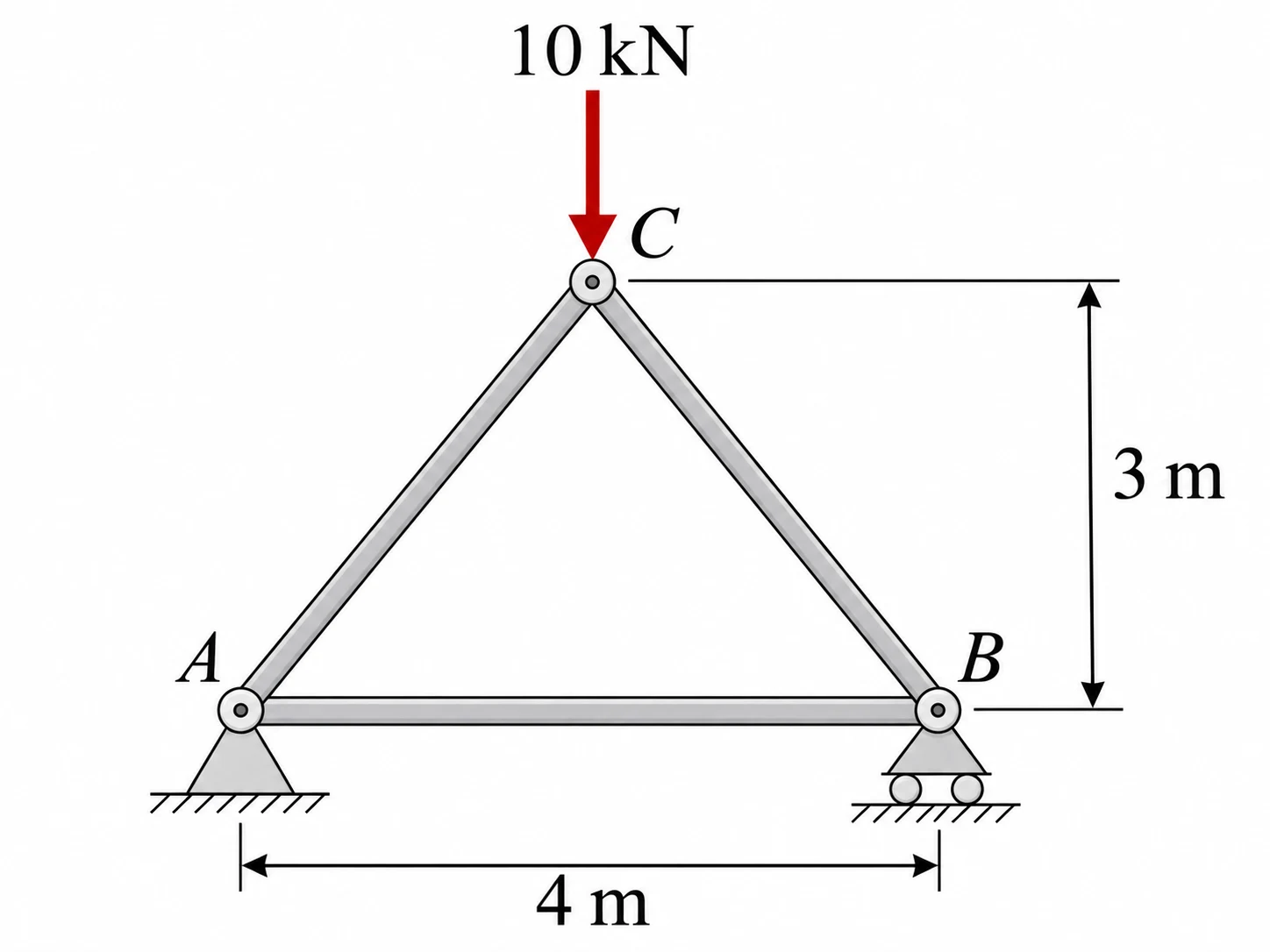
A triangular truss has a pin at , a roller at and its apex at , in metres. A kN load acts downwards at . Find the forces in members and .
Show the solution
Reactions. The load is central, so kN (and ).
Joint . Member rises m over m, so its length is m. Assume both members in tension.
Answer: carries kN in compression (negative), and carries kN in tension. By symmetry, is also kN in compression.
Common mistakes
Using the member length instead of its components
Resolve each force with the ratios and from the member's own geometry.
Starting at a joint with three unknowns
Two equations can only solve two unknowns. Start at a support or any joint with two unknown members.
Reading a negative answer as a mistake
A negative force just means compression when you assumed tension. Keep the sign when you carry it to the next joint.
Check your understanding
1. You assume a member is in tension and get a negative force. What does that mean?
2. How many unknown member forces can you solve at a single joint?
3. A member rises m over a horizontal run of m and carries kN. What is the vertical component of its force?
Still not sure? Talk it through.
Waypoint Mentor's tutor explains this out loud, works through your own problems on a whiteboard, and checks you've got it. Free to start.