Beam support reactions
Engineering · First-year engineering · about 10 min
A beam sits on supports, and those supports push back. Finding how hard each one pushes, the support reactions, is the first step in almost every beam problem: you need them before you can draw a shear force or bending moment diagram, size the beam, or check a bearing.
The key idea
A beam that isn't moving is in equilibrium, so the forces balance and the moments balance:
Take moments about one support to find the other reaction in one line, then use vertical equilibrium for the first.
Try it yourself
Pin and roller supports
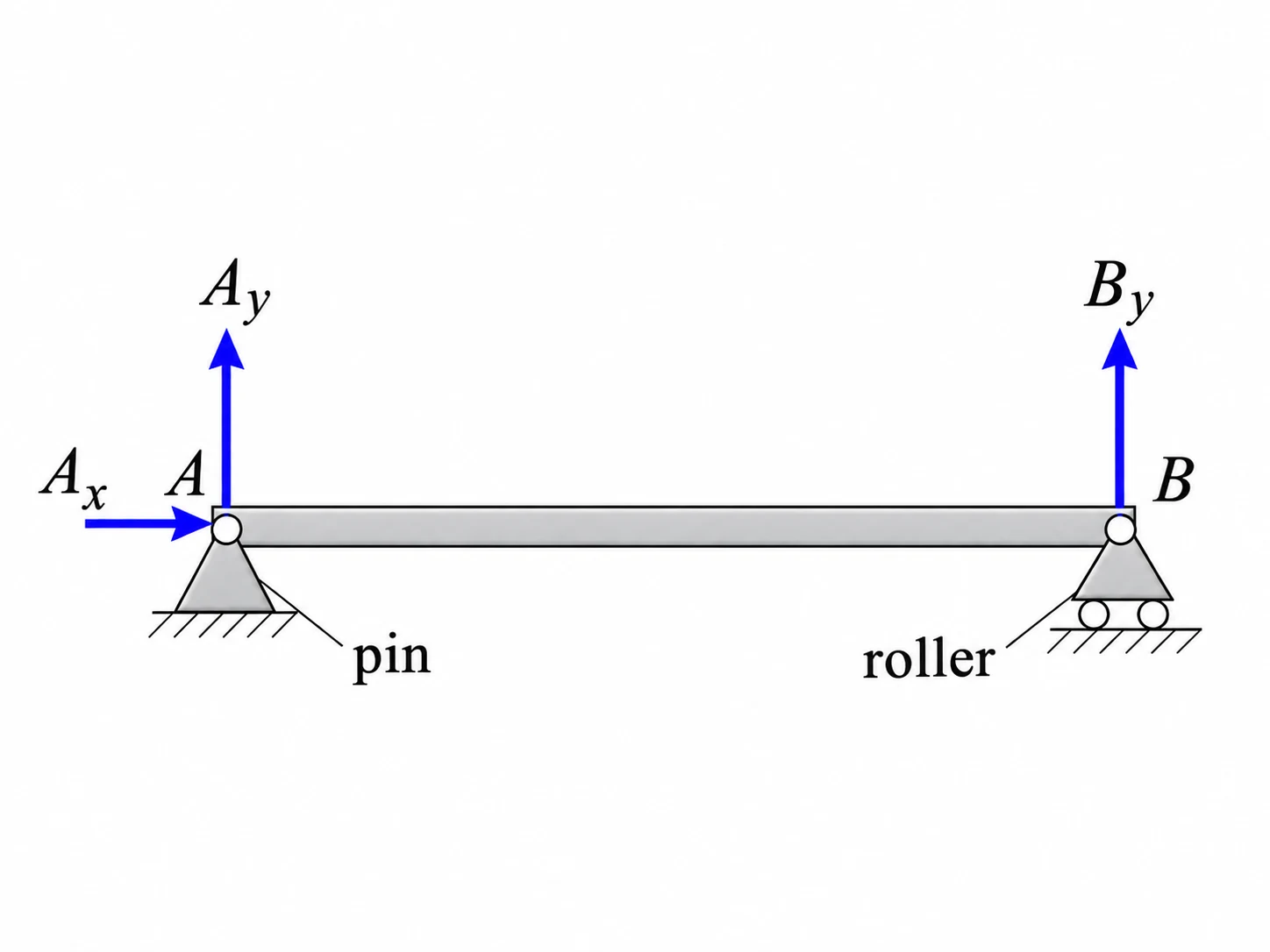
A simply supported beam has a pin at one end and a roller at the other.
- The pin stops the beam moving up, down and sideways, so it can push in two directions: and .
- The roller only stops vertical movement, so it gives one vertical reaction, .
With only vertical loads, , which leaves two unknowns and two equations. That's what makes the problem solvable.
Handling a distributed load
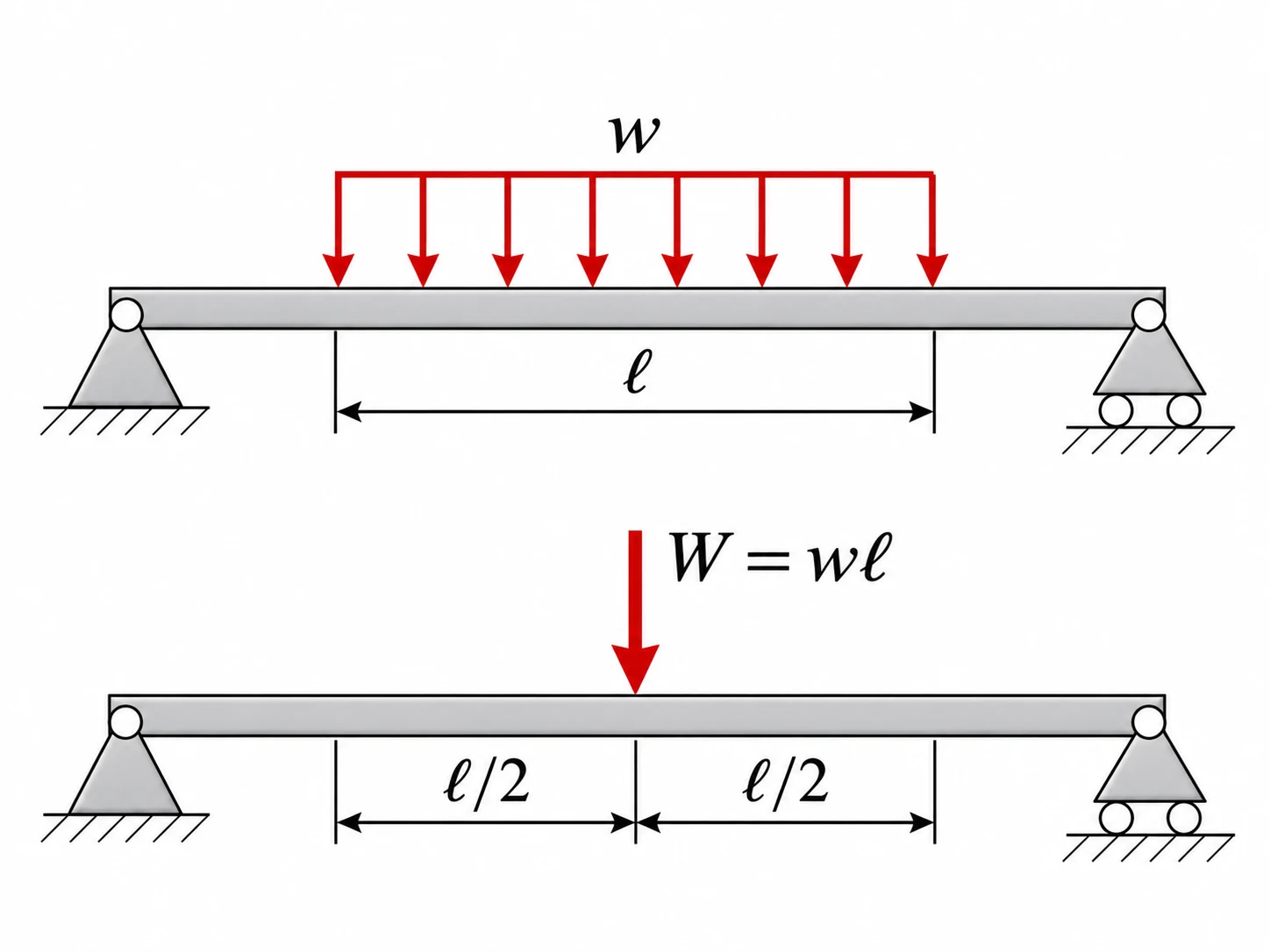
A uniformly distributed load (UDL) of kN/m over a length acts like a single force
placed at the middle of the length it covers. Replace it with that one force when you take moments; never multiply by the beam length if the load only covers part of it.
The method, step by step
- Draw a free-body diagram: the beam, every load, and the unknown reactions as arrows.
- Turn each distributed load into its resultant force at its centre.
- Take moments about support (anticlockwise positive, or your own convention, just stay consistent). The unknown passes through the point, so it drops out and you solve for directly.
- Use to find .
- Check by taking moments about : you should get the same .
Worked example: a point load and a UDL
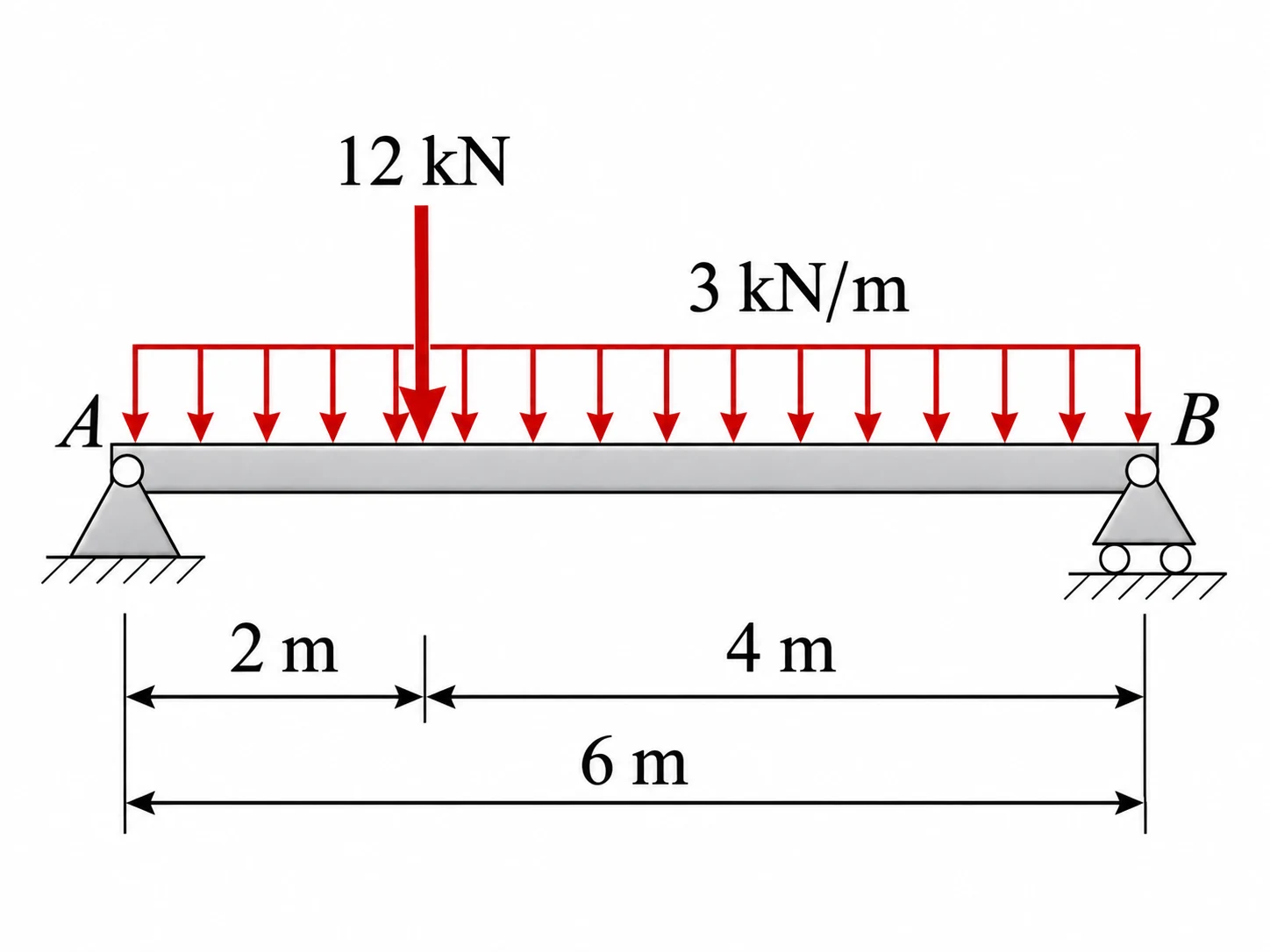
A simply supported beam is m long. It carries a point load of kN at m from , and a uniformly distributed load of kN/m over its whole length. Find the reactions at and .
Show the solution
The UDL's resultant is kN, acting at the middle, m from .
Moments about (clockwise loads, anticlockwise reaction):
Vertical equilibrium:
Check, moments about : , so kN. It matches.
Common mistakes
Putting a distributed load's force at the end of the beam
The resultant acts at the centre of the loaded length. For a full-span UDL on a m beam that's m from either end.
Mixing up which support gets the bigger reaction
The support closer to a load carries more of it. A load at m from on a m beam puts of it on .
Forgetting to check the answer
Taking moments about the other support takes ten seconds and catches almost every sign or arithmetic slip.
Check your understanding
1. A kN point load sits at the middle of a simply supported beam. What is each reaction?
2. A UDL of kN/m covers the whole of an m beam. What single force replaces it, and where?
3. Why take moments about a support rather than some other point?
Still not sure? Talk it through.
Waypoint Mentor's tutor explains this out loud, works through your own problems on a whiteboard, and checks you've got it. Free to start.