Part II: Dynamics · Topic 8 of 8 · 20 min read
Mass Moments & Rigid-Body Dynamics
Link mass distribution, external torque and rotational response.
What you'll learn
Calculate mass moment of inertia and use the parallel-axis theorem.
Relate applied moments to angular acceleration about the mass centre or a fixed axis.
Apply angular impulse and rotational work-energy.
Analyse pure rolling with both translational and rotational equations.
Understand the concepts
Inertia depends on the axis
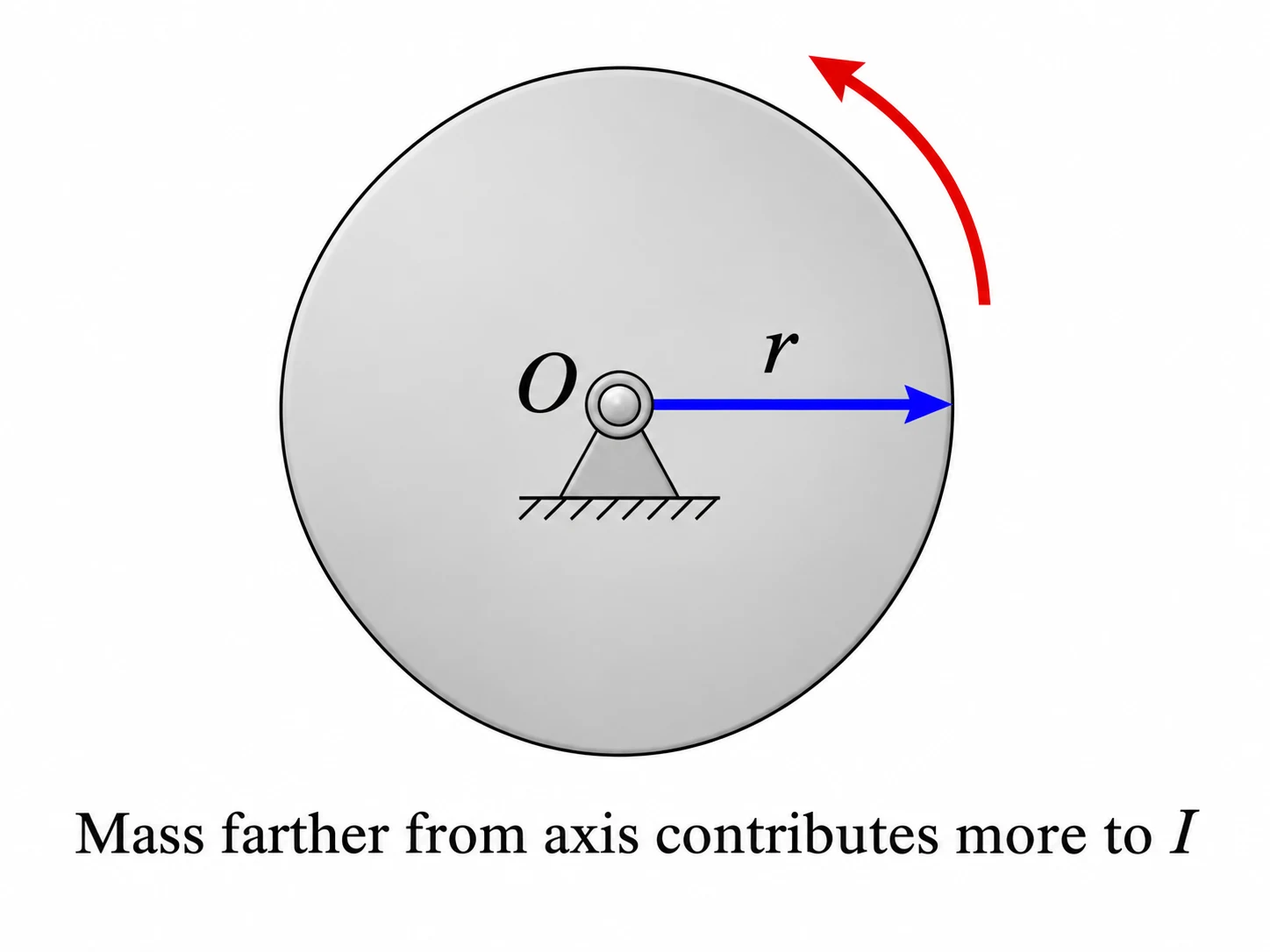
Mass alone does not determine resistance to angular acceleration. Each mass element contributes , so material farther from the chosen rotation axis contributes disproportionately.
Be precise about the axis
For a rigid body rotating about a stationary axis through its mass centre, . For an arbitrary moving point, a direct substitution is generally unsafe; use the mass centre or a verified fixed-axis formulation.
Assumptions and sign conventions
Rigid body with constant mass and stated geometry.
Moment-of-inertia formulas assume a specified axis and uniform mass distribution when appropriate.
An ideal fixed bearing can react forces without work for a fixed-axis frictionless rotation.
For pure rolling on a fixed plane, the contact relative speed is zero.
Equations that matter
Rotational inertia is a weighted mass distribution, not simply mass.
Use it: For composite sections or derivation of inertia.
Step-by-step method
Identify mass, geometry and the exact rotation axis.
Calculate inertia about the mass centre and use the parallel-axis theorem only when required.
Draw an external-force/torque FBD including friction and bearing reactions.
For fixed-axis rotation, solve moment balance or angular impulse.
For rolling, combine translation, rotation and with consistent signs.
Check units , and any energy balance.
Worked example: Solid flywheel accelerated by a motor
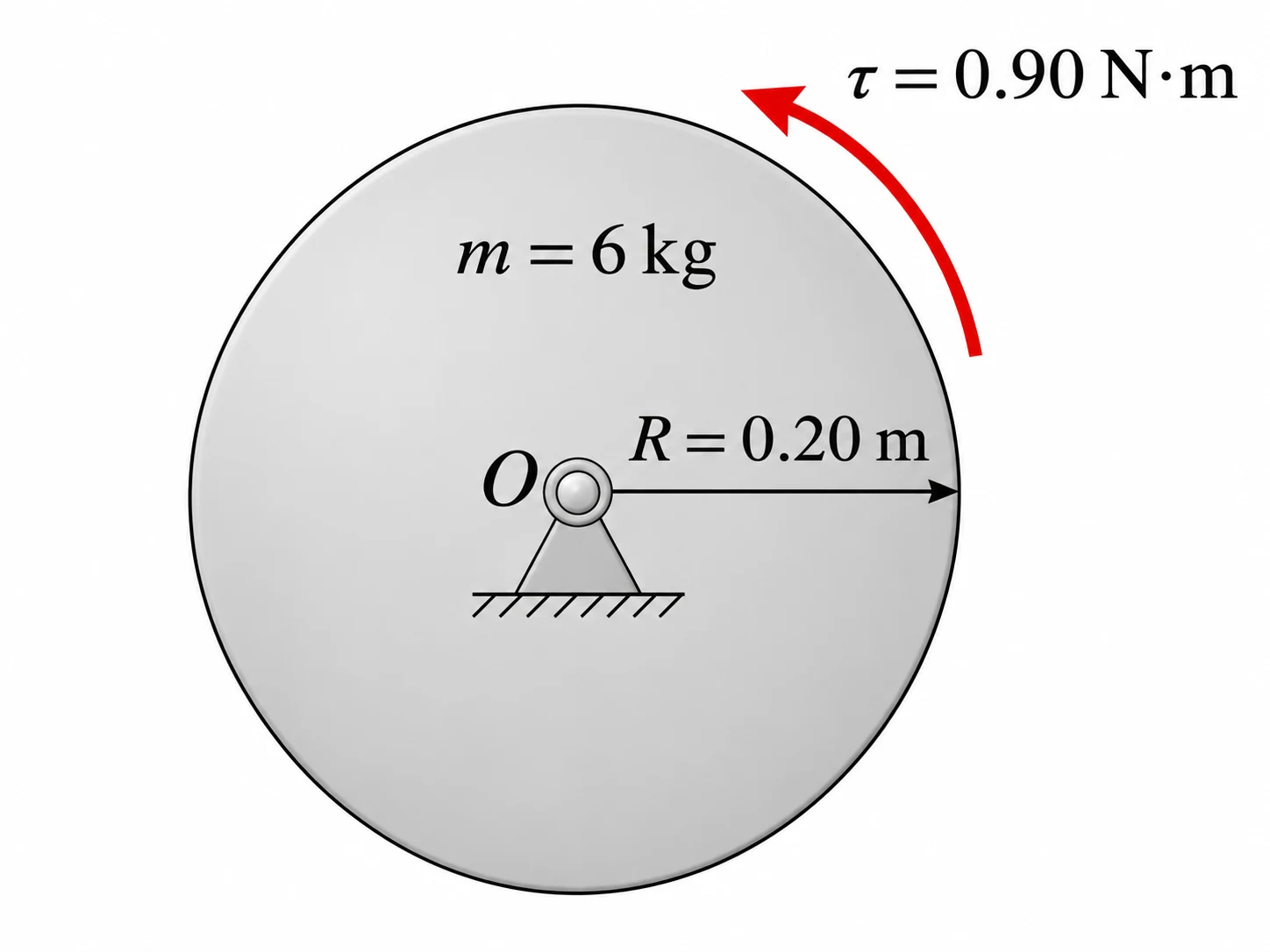
A uniform solid disk with mass and radius rotates on a frictionless fixed bearing. A constant motor torque acts CCW. Starting from rest, find angular acceleration, angular speed and angular displacement after .
Common mistakes
Using for a solid disk (that is the thin-hoop formula).
Applying the parallel-axis theorem without the actual axis separation.
Using a moment about a moving point as though it were a fixed rotation axis.
Assuming rolling friction always dissipates mechanical energy in ideal no-slip rolling.
Check yourself
How does doubling a disk radius change its moment of inertia at fixed mass?
Why is the parallel-axis increment always non-negative?
Can a rolling body have both translational and rotational kinetic energy?
Ready to try it yourself?
Related: Work, Energy, Impulse & Impact
Independent Waypoint Mentor learning material. Not affiliated with or endorsed by any university.