Part II: Dynamics · Topic 7 of 8 · 22 min read
Rigid-Body Kinematics
Track one point, one rotation and geometric constraints.
What you'll learn
Use relative-velocity vectors to analyse rigid planar linkages.
Construct correct tangential and normal relative-acceleration terms.
Apply slider/guide constraints without relying on an instantaneous centre.
Use rolling without slip, and distinguish its velocity and acceleration consequences.
Understand the concepts
All points share one angular velocity
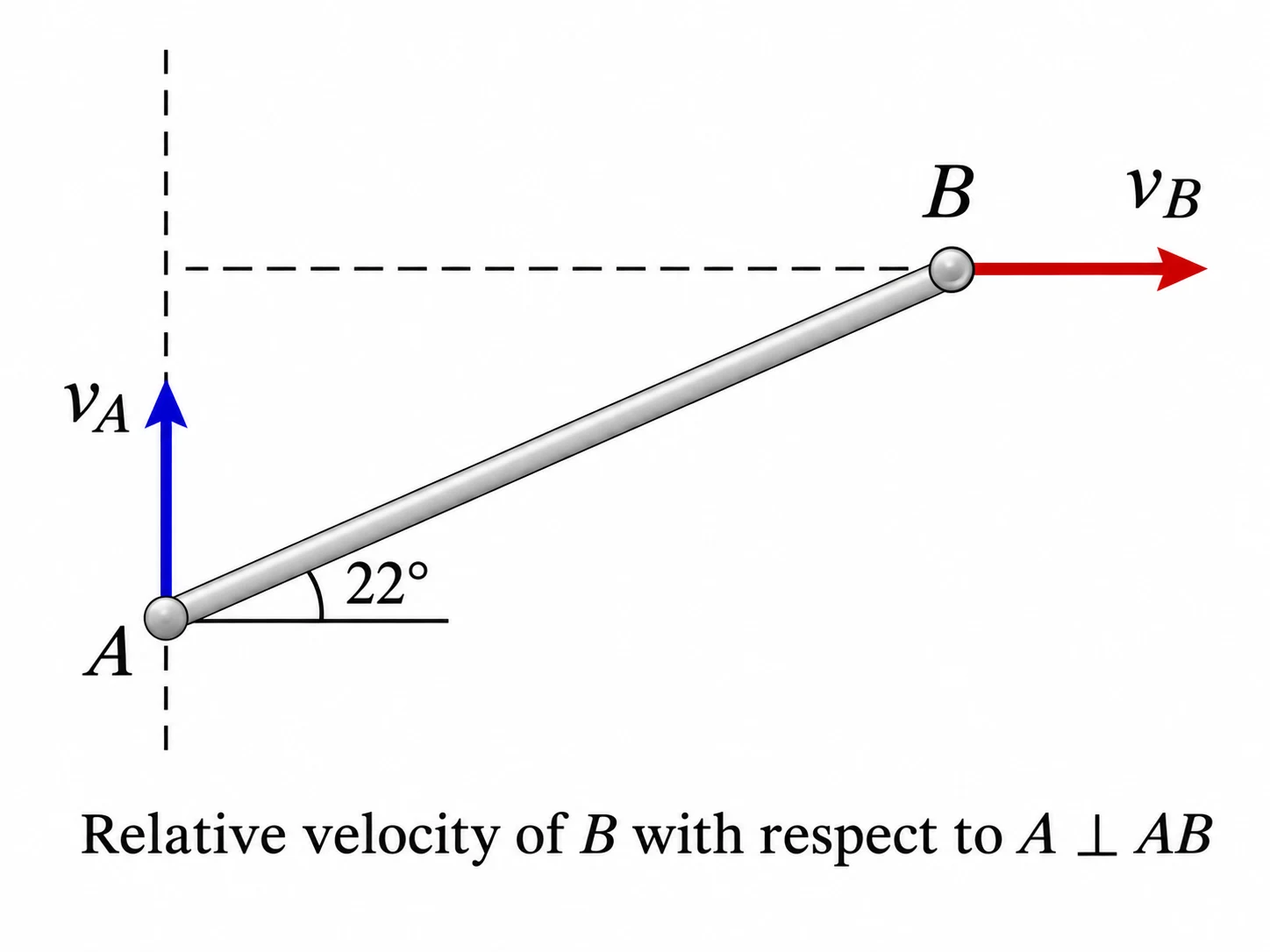
For a planar rigid body, the velocities of points and differ by an angular motion about their relative position. Relative velocity is perpendicular to the line .
Assumptions and sign conventions
Planar rigid body with no deformation.
A, B position vectors must refer to the same instant.
Use right, up, and CCW angular motion positive.
For a slider constrained to a straight stationary guide, normal coordinate velocity and acceleration vanish.
Equations that matter
Step-by-step method
Draw a position diagram and label all instantaneous dimensions and motion constraints.
Choose two points on the same rigid body and form .
Write the full relative-velocity vector equation; project onto x and y.
For acceleration use the already determined angular velocity to compute the term.
Worked example: Rigid bar between perpendicular sliders
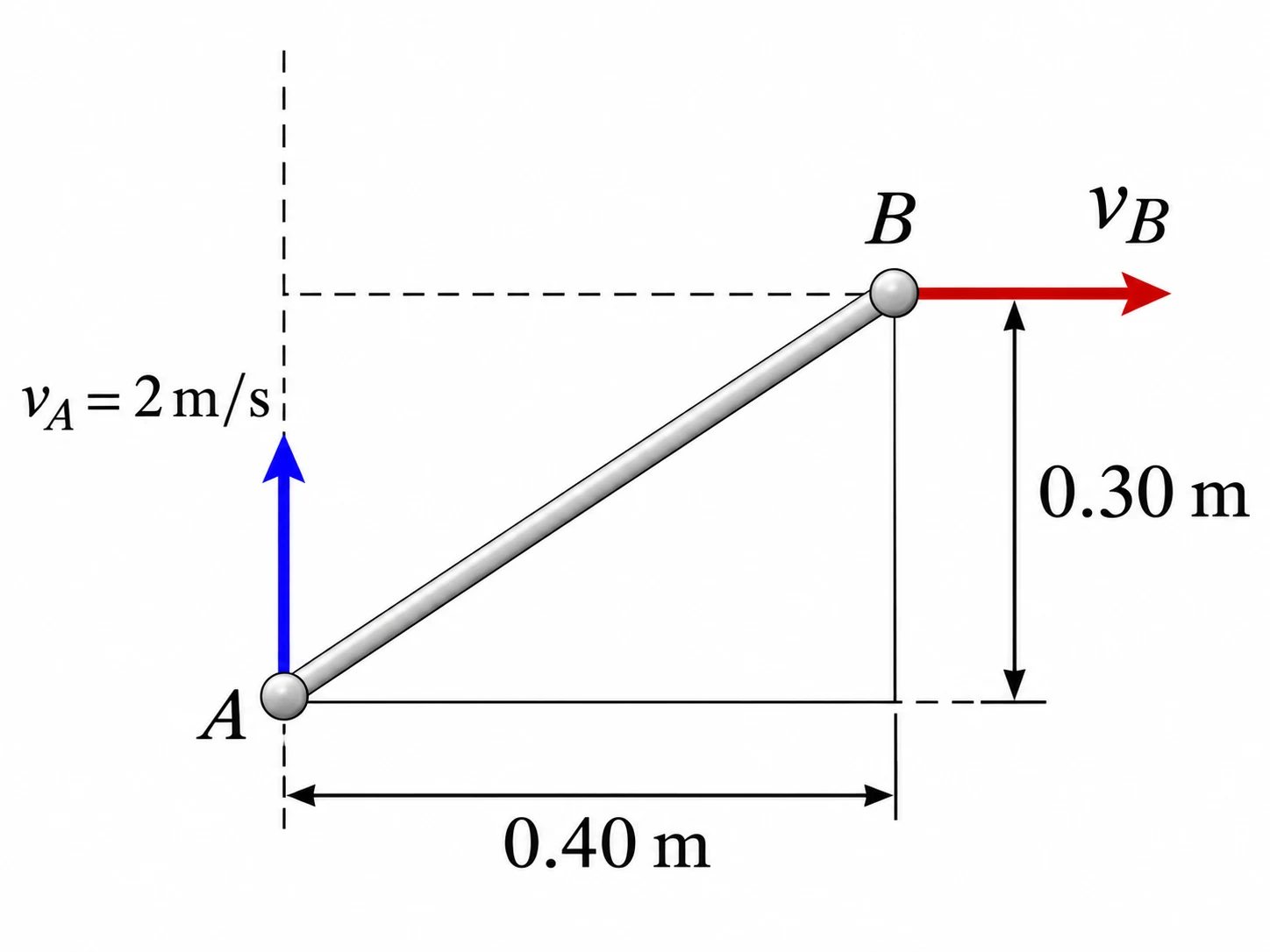
A rigid bar joins slider at and slider at . moves vertically upward with and has . Slider is restricted to a horizontal line. Determine , , and .
Common mistakes
Using the instantaneous centre to compute acceleration as if it were a fixed pin.
Assuming relative acceleration is only perpendicular to a rotating rod.
Applying relative velocity between points that are not on the same rigid body.
Using the wrong direction for normal relative acceleration (it points from B toward A).
Check yourself
Is relative velocity between two rigidly linked points parallel or perpendicular to the link?
Does a point with zero instantaneous velocity necessarily have zero acceleration?
Which term survives when angular velocity is constant but nonzero?
Ready to try it yourself?
Related: Particle Kinematics
Independent Waypoint Mentor learning material. Not affiliated with or endorsed by any university.