Part II: Dynamics · Topic 6 of 8 · 21 min read
Work, Energy, Impulse & Impact
Choose a time interval or two physical states, then track what changes.
What you'll learn
Choose between force/acceleration, work-energy and impulse-momentum approaches.
Compute gravity, friction and spring work correctly.
Use signed linear momentum and coefficient of restitution for 1D impacts.
Interpret a force-time graph as impulse.
Understand the concepts
Kinetics explains why motion changes
Newton’s second law links net force to acceleration. An energy balance is more direct when only initial and final speeds or spring deflections are needed; momentum is useful over short impact intervals.
Work is signed
For a displacement , work is . Kinetic friction usually does negative work relative to actual slip. Gravity work is positive when the centre of mass moves down.
Potential energy and springs
Gravity potential is relative to an arbitrary datum; spring potential is . Differences between states matter more than the selected zero datum.
Try it yourself
Assumptions and sign conventions
Particles/rigid bodies as stated; no energy loss unless included as friction, damping or impact.
Use a single signed axis for direct one-dimensional impacts.
For Coulomb friction, and when sliding.
Equations that matter
Step-by-step method
Choose two physical states or a clearly marked collision interval.
State which forces do work and which forces are conservative.
For friction, determine the actual slipping direction before assigning a sign.
Use an energy balance for speeds/deflections; use impulse-momentum for time-varying contact forces.
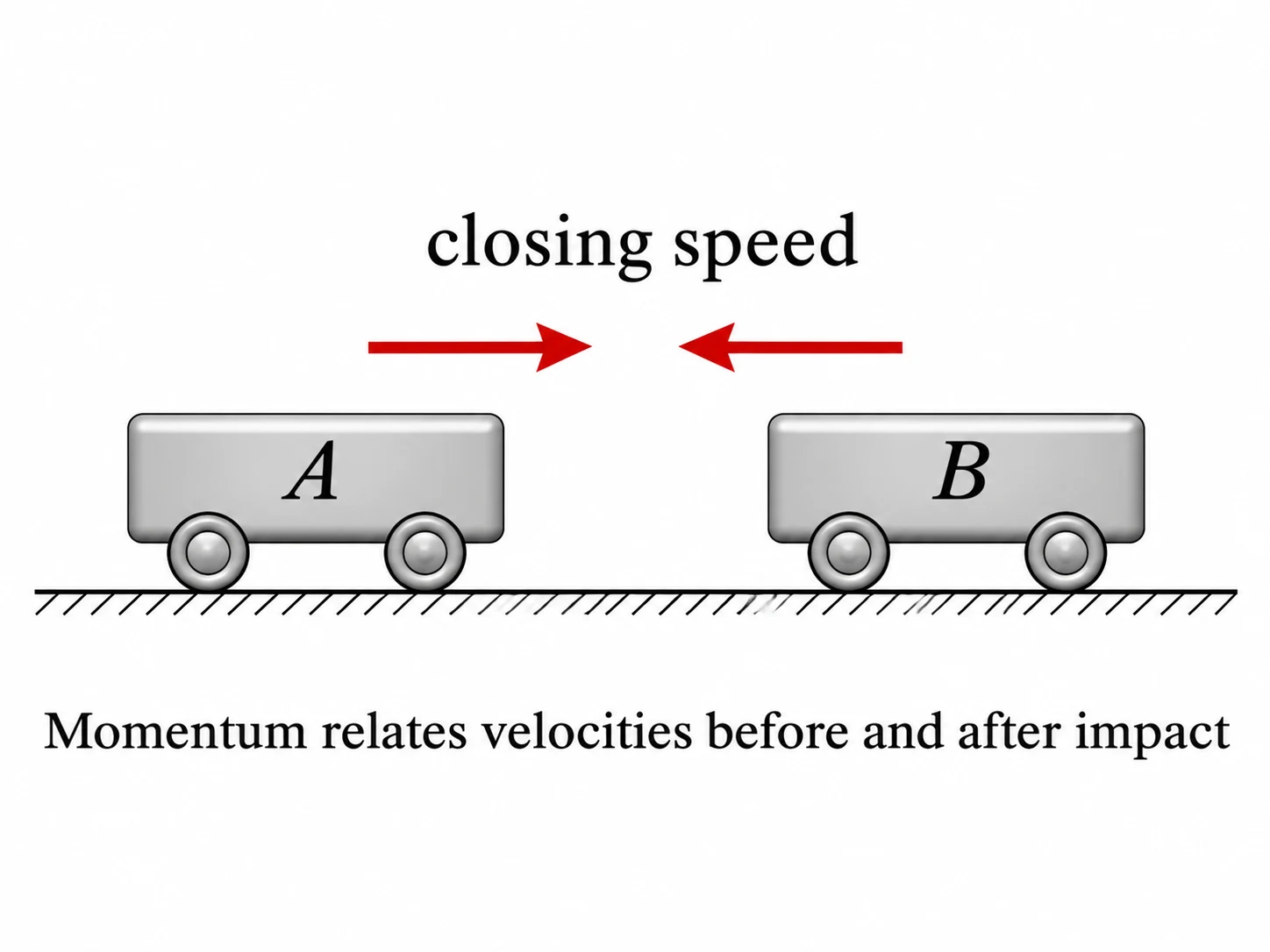
For impacts, write signed momentum and restitution equations and solve together.
Check energy loss and impact direction for physical plausibility.
Worked example: Two carts in a direct impact
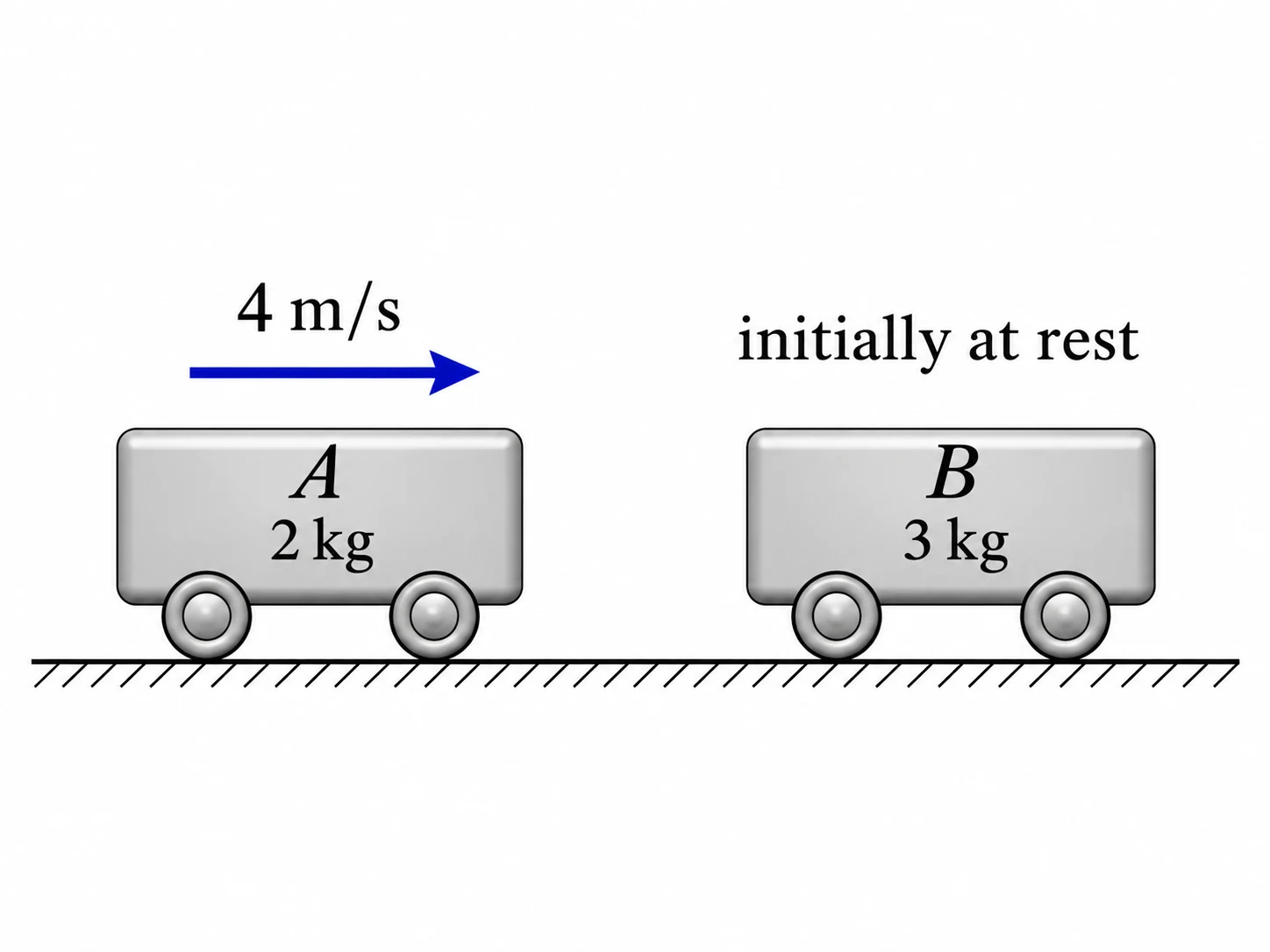
A cart travels right at and collides head-on with a stationary cart . The coefficient of restitution is . Find both post-impact velocities and kinetic-energy loss.
Common mistakes
Assuming momentum conservation means kinetic energy is conserved.
Using force multiplied by time when force varies; integrate or take the area instead.
Using kinetic friction while the system is actually static.
Losing signs in restitution and reversing the relative-speed order.
Check yourself
Which physical conditions permit conservation of impact-axis momentum?
Does a larger peak force necessarily mean a larger impulse?
Why is maximum spring compression a useful choice of state?
Ready to try it yourself?
Related: Mass Moments & Rigid-Body Dynamics
Independent Waypoint Mentor learning material. Not affiliated with or endorsed by any university.