Part III: Flow Analysis and Applications · Topic 6 of 8 · 24 min read
Dimensional Analysis and Similarity
Use dimensions and scaling laws to predict flow behaviour.
What you'll learn
Check the dimensions of a proposed fluid relationship.
Construct dimensionless groups from relevant variables.
Apply Reynolds-number similarity to scaled tests.
Explain what matching one dimensionless number does not guarantee.
Understand the concepts
Dimensions versus units
A dimension is a combination of fundamental types such as mass, length and time; a unit is a measurement convention. Every valid physical equation must have matching dimensions on both sides. A dimensionless coefficient cannot repair an otherwise dimensionally inconsistent formula.
Forming dimensionless products
A dimensionless group has no dependence on the choice of measurement units. Products of powers of repeating variables can cancel the dimensions of a target variable. A successful set of groups is dimensionally independent.
Buckingham Pi reasoning
If a relation involves dimensional quantities and independent fundamental dimensions, it can generally be rewritten using independent dimensionless groups. Selecting repeating variables that span all base dimensions is essential. The resulting relation is a framework rather than a numerical correlation unless data or theory supply its function.
Assumptions and sign conventions
Same fluid properties for Reynolds-matched model tests unless explicitly changed.
Geometrically similar shapes have constant corresponding length ratios.
Neglect surface tension, gravity-wave and compressibility effects when using Reynolds similarity alone.
Equations that matter
Step-by-step method
List the variables and write each in base dimensions .
Select dimensionally independent repeating variables with no unnecessary duplication.
Solve for exponents that cancel all dimensions.
Write the resulting dimensionless groups and explain the physical assumptions.
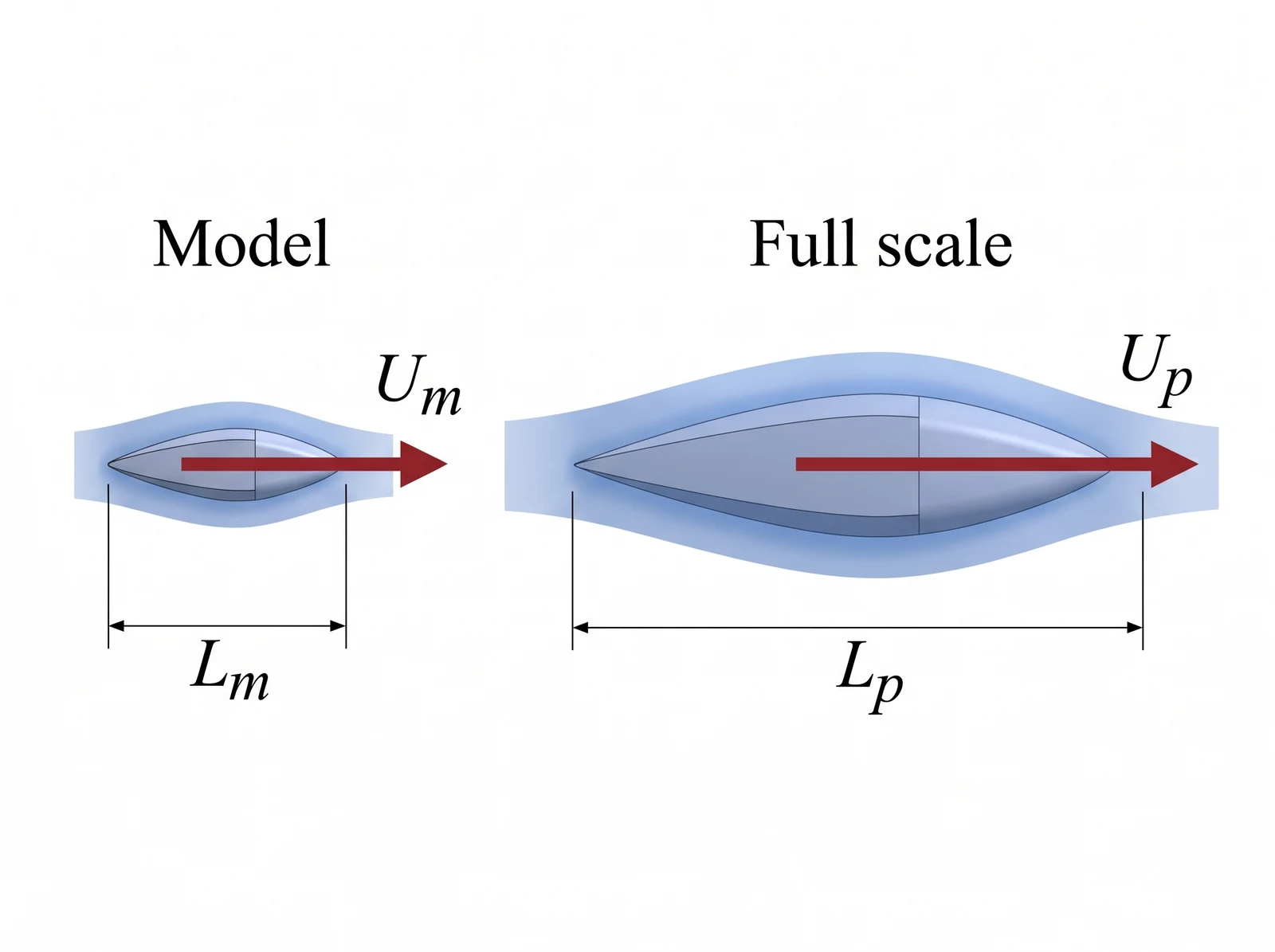
For model-scale problems, set the relevant corresponding groups equal and solve for the unknown ratio.
Worked example: Classify flow in a short test channel
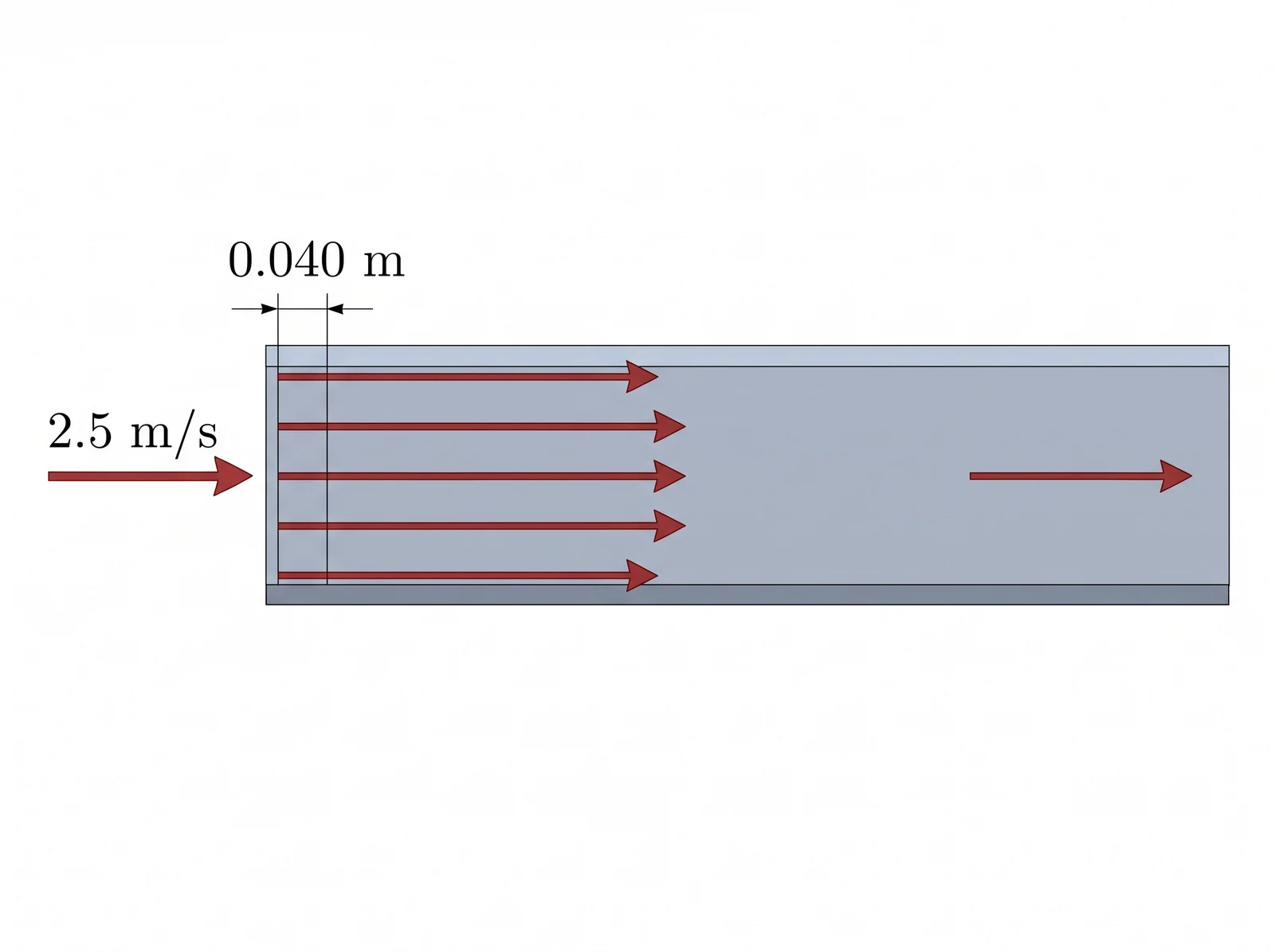
A water stream has , , speed and characteristic width . Find its Reynolds number and explain what the number compares.
Common mistakes
Using inconsistent length scales between a model and prototype.
Applying pipe-transition thresholds to arbitrary external flows.
Assuming geometric similarity automatically guarantees dynamic similarity.
Reporting an unknown Buckingham-Pi function as though it were a known constant.
Check yourself
How many independent groups arise from six variables spanning three base dimensions?
Why might Reynolds similarity fail for an important free-surface problem?
How does speed scale with model length for identical-fluid Reynolds matching?
Ready to try it yourself?
Related: External Flow, Boundary Layers and Forces
Independent Waypoint Mentor learning material. Not affiliated with or endorsed by any university.