Part I: Physical Foundations · Topic 1 of 8 · 22 min read
Fluid Properties and Flow Regimes
Understand what a fluid is and the properties that control its response to motion.
What you'll learn
Relate density, specific weight and relative density without confusing units.
Predict shear force using a Newtonian viscosity model.
Estimate small compression with a bulk modulus.
Use Reynolds and Mach numbers to classify a flow.
Understand the concepts
What makes a material a fluid?
A fluid continues to deform while any sustained shear stress acts on it, unlike an ideal elastic solid that reaches a finite deformation. Liquids and gases both satisfy this idea, although their density responses to pressure differ.
Density and specific weight
Density is mass per unit volume; specific weight is weight per unit volume. Specific gravity compares a liquid density with a stated reference density, so it has no units. Always distinguish mass from weight before substituting.
Viscous shear and wall motion
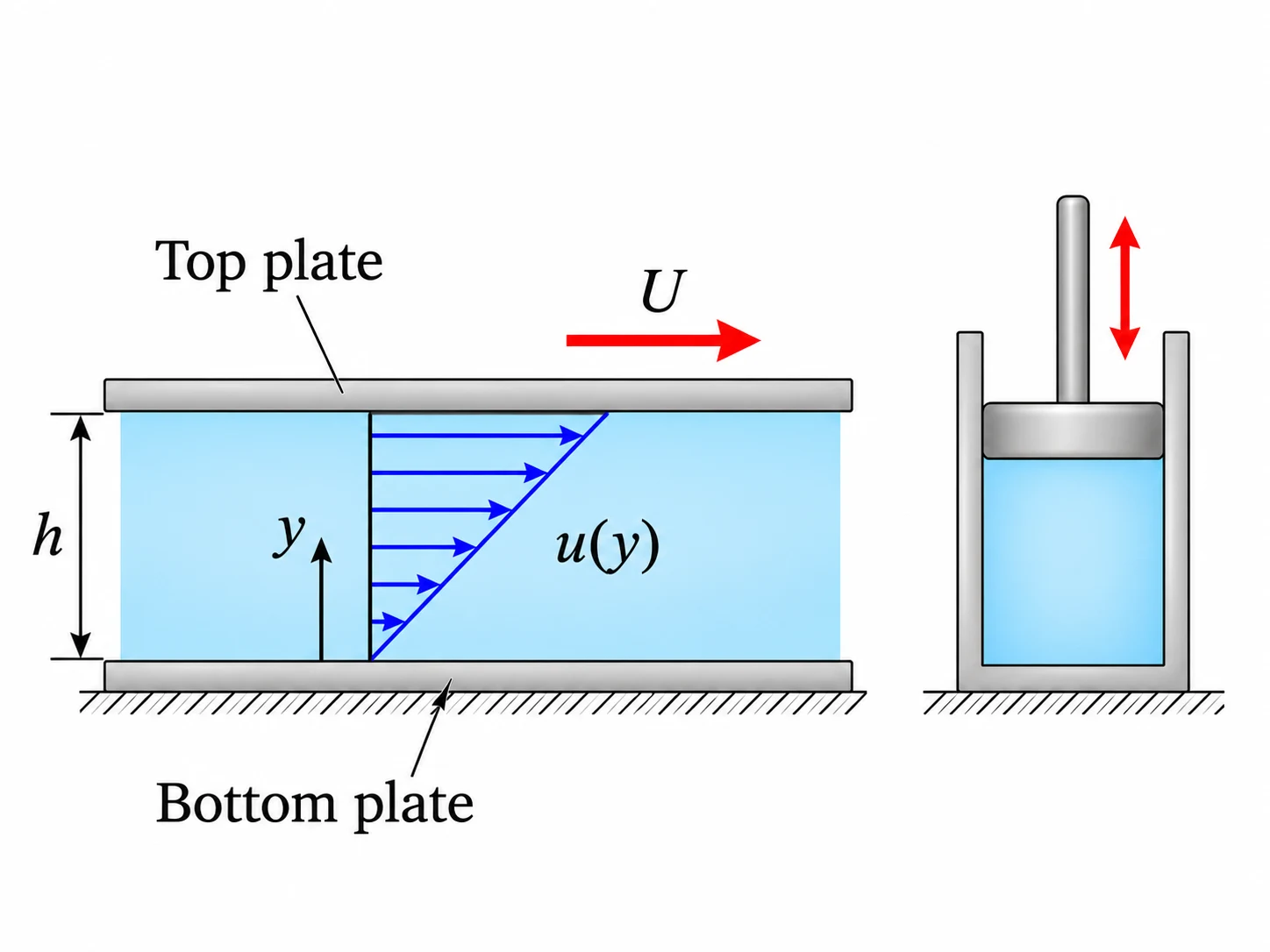
Viscosity measures resistance to the relative motion of adjacent fluid layers. For a Newtonian fluid, shear stress is proportional to the velocity gradient, not to the speed alone. A moving wall can generate a nearly linear profile across a sufficiently thin, steady gap.
Compressibility
Pressure changes can slightly alter the volume of a liquid. A high bulk modulus means a small fractional volume change for a given pressure rise. The small-change formula is an approximation, so report the pressure range over which it is applied.
Flow-regime indicators
Reynolds number compares inertial and viscous effects, while Mach number compares fluid speed with local sound speed. These are different questions: a flow may be turbulent yet behave nearly incompressibly. Pipe-transition thresholds are approximate and are not universal for other geometries.
Units and constitutive laws
The same physical quantity can appear in several unit systems; convert to SI before calculating. Viscosity has units of pascal-seconds, whereas kinematic viscosity has units of square metres per second. Constitutive assumptions must match the material used.
Assumptions and sign conventions
Treat density and viscosity as constant over each numerical calculation unless variation is supplied.
The linear Couette relation requires steady, laminar, one-dimensional motion with negligible pressure gradient.
The small-compression expression assumes a nearly constant bulk modulus.
Equations that matter
Step-by-step method
List the requested properties and choose a clear reference fluid if relative density is involved.
Convert all masses, volumes, gaps, speeds and pressures to SI.
Select a constitutive relation that matches the motion and material assumptions.
Calculate intermediate values with units; verify the resulting scale and sign.
Check whether a dimensionless regime indicator supports the chosen model.
Worked example: Shear resistance in a calibration slide
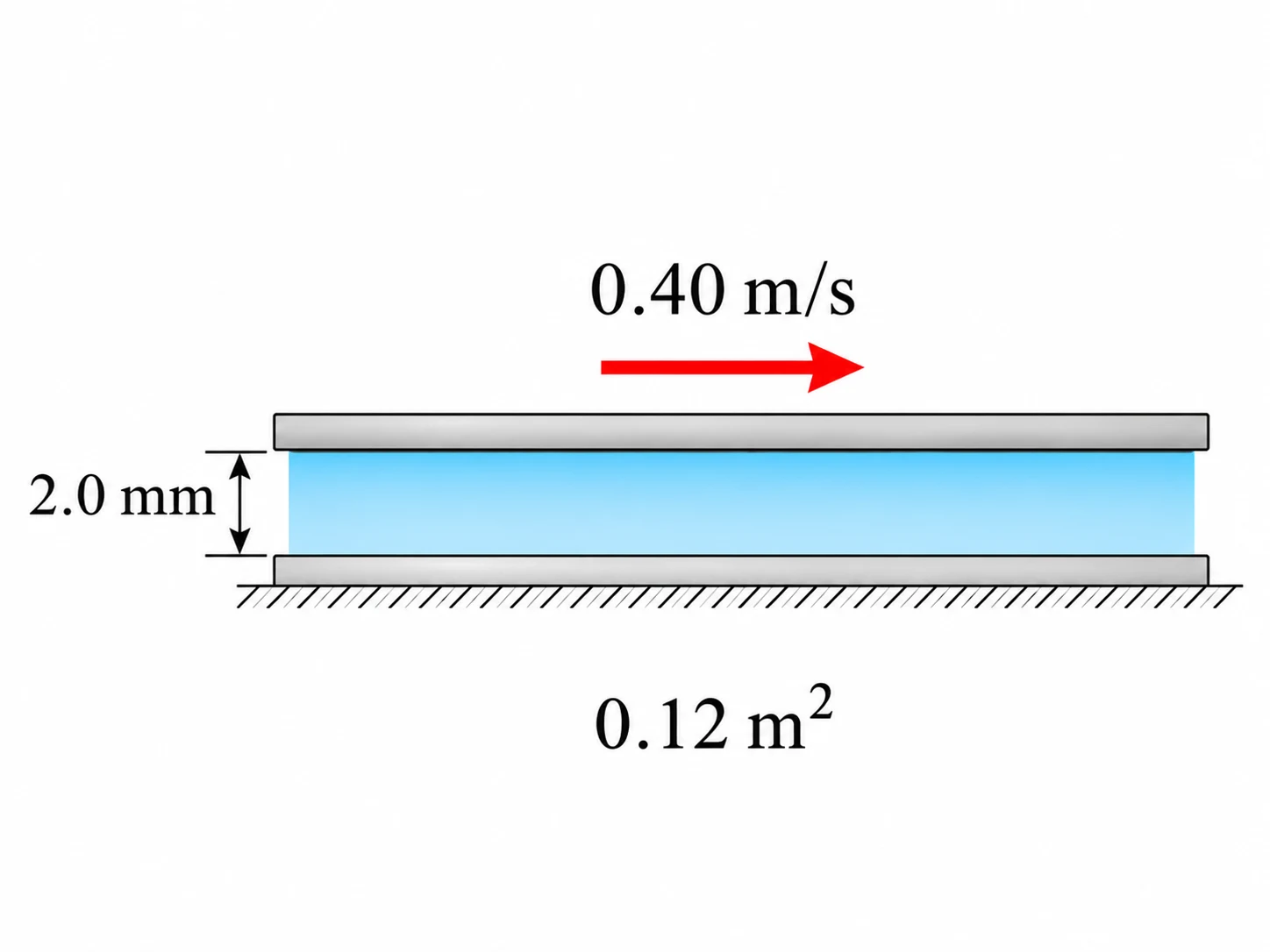
A flat slide of area moves at above a stationary plate. A Newtonian liquid fills a uniform gap and has . Find the shear stress and the required horizontal force, neglecting edge effects.
Common mistakes
Using a millimetre gap as metres.
Treating shear stress and total shear force as the same quantity.
Applying a linear Newtonian profile to an unspecified non-Newtonian fluid.
Assuming Reynolds number alone predicts every geometry’s transition.
Check yourself
What units distinguish dynamic from kinematic viscosity?
Why does the shear direction oppose relative plate motion?
What would doubling the gap do to the shear force at unchanged speed?
Ready to try it yourself?
Related: Flow Kinematics and Continuity
Independent Waypoint Mentor learning material. Not affiliated with or endorsed by any university.