Part I: Physical Foundations · Topic 2 of 8 · 24 min read
Fluid Statics and Hydrostatic Forces
Analyse pressure fields, manometers, submerged surfaces and buoyancy.
What you'll learn
Distinguish absolute, gauge and atmospheric pressure.
Build reliable pressure balances through multiple fluid layers.
Locate the resultant hydrostatic force on a plane surface.
Apply buoyancy and vertical force equilibrium correctly.
Understand the concepts
Why pressure varies with depth
In a stationary, homogeneous fluid, a deeper point supports the weight of more fluid above it. Pressure therefore grows with depth measured below a free surface. Points in the same connected static fluid at the same elevation have equal pressure.
Pressure datum and signs
A gauge reads pressure relative to the local atmosphere, while absolute pressure is measured from zero pressure. When walking downward through static fluid, add ; when walking upward, subtract it. Choose one route and do not change pressure sign conventions midway.
Manometers
A manometer converts a pressure difference into a difference in column heights. At an interface, pressure is continuous even when density changes abruptly. Horizontal steps through the same static fluid change no pressure.
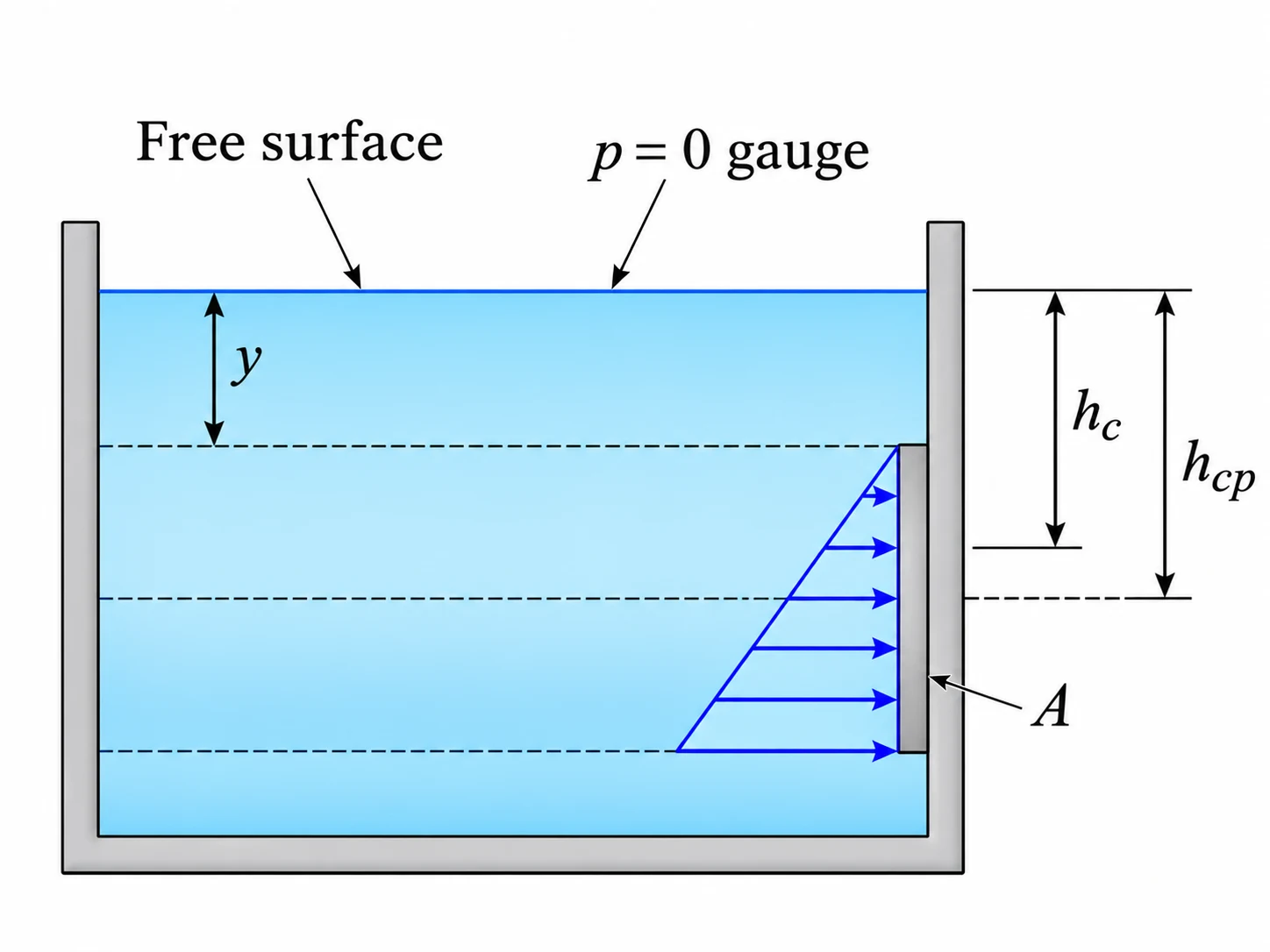
Resultant force on a plane
Pressure varies over a submerged surface, so the resultant is an integral rather than pressure at the top multiplied by area. On a vertical plane in a constant-density liquid, the resultant magnitude is pressure at the centroid times area. The centre of pressure lies below the centroid because deeper regions carry larger pressure.
Buoyancy and displacement
The net upward force from a static fluid equals the weight of fluid displaced by the submerged volume. The displaced volume is not necessarily the total body volume if it is only partly immersed. A tether force must be included in the body free-body diagram.
Assumptions and sign conventions
Static, connected liquids with negligible capillary effects.
Uniform gravitational acceleration.
Constant density in each liquid region.
For plane-surface pressure-centre formulas, the stated depth coordinate is vertical.
Equations that matter
Static pressure rises linearly with depth in a uniform liquid.
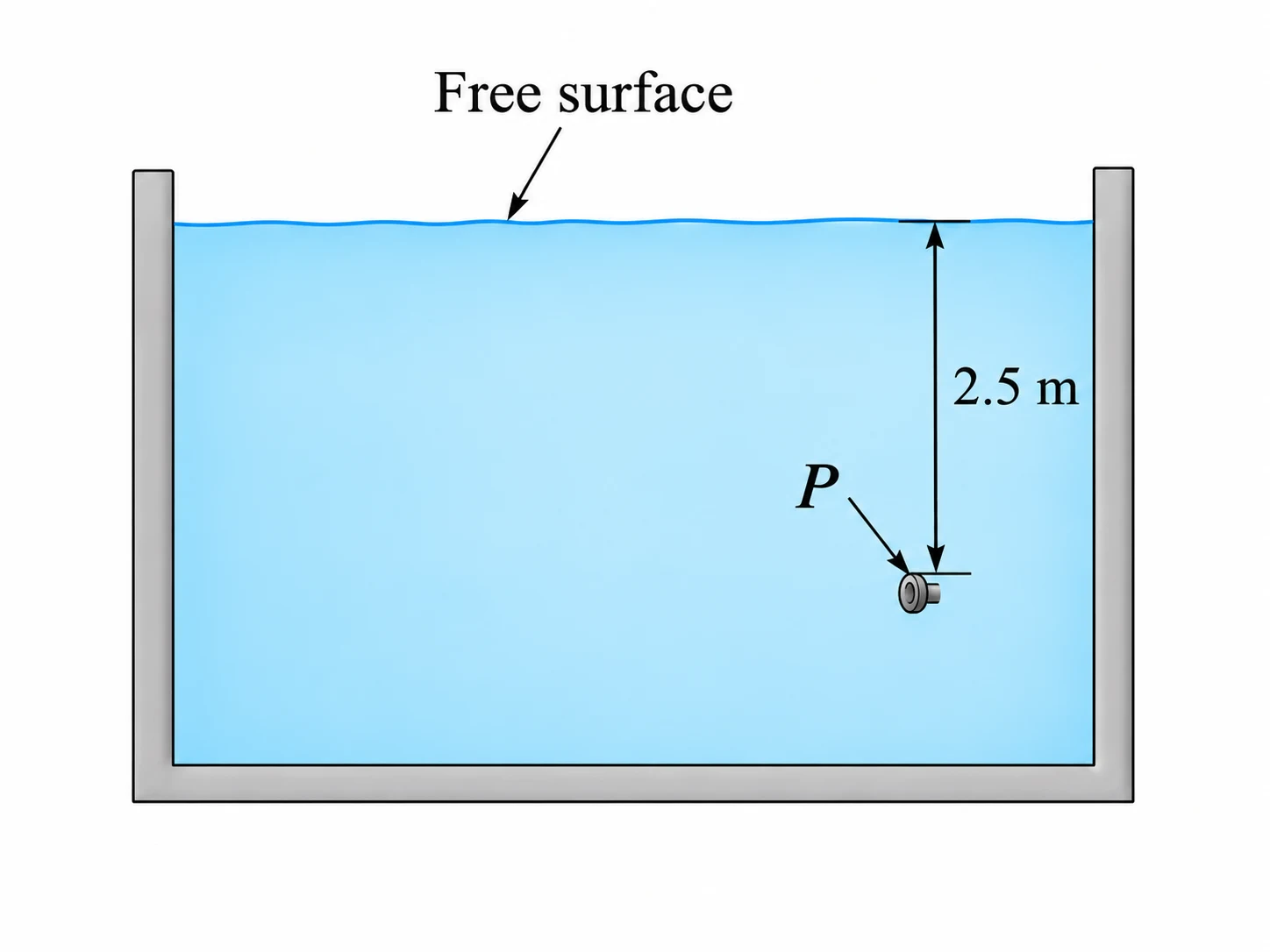
Use it: For pressure at a point below a free surface.
Step-by-step method
Sketch the free surface, taps, interfaces and chosen vertical datum.
Label every density and distinguish gauge from absolute pressure.
Write a pressure walk or integrate pressure over the wetted surface as required.
Apply force or moment equilibrium to the identified body when reactions are requested.
Check units, pressure sign, submergence and centre-of-pressure position.
Worked example: Pressure beneath a service reservoir
A stationary coolant of uniform density has a free surface exposed to the atmosphere. Determine the gauge pressure below the surface using .
Common mistakes
Adding atmospheric pressure to a requested gauge result.
Using horizontal distance instead of vertical depth.
Forgetting fluid-density changes when crossing an interface.
Placing the centre of pressure above the centroid on a vertical plane.
Check yourself
Why is pressure the same at points at equal height in one static connected liquid?
Why is the centre of pressure below the centroid?
What volume determines buoyancy for a half-submerged object?
Ready to try it yourself?
Related: Bernoulli and Mechanical Energy
Independent Waypoint Mentor learning material. Not affiliated with or endorsed by any university.