Part II: Cycles and Fluid Properties · Topic 5 of 8 · 19 min read
Pure Substances and Phase Change
Identify thermodynamic regions and calculate two-phase mixture properties.
What you'll learn
Classify compressed liquid, saturated mixture and superheated vapour states.
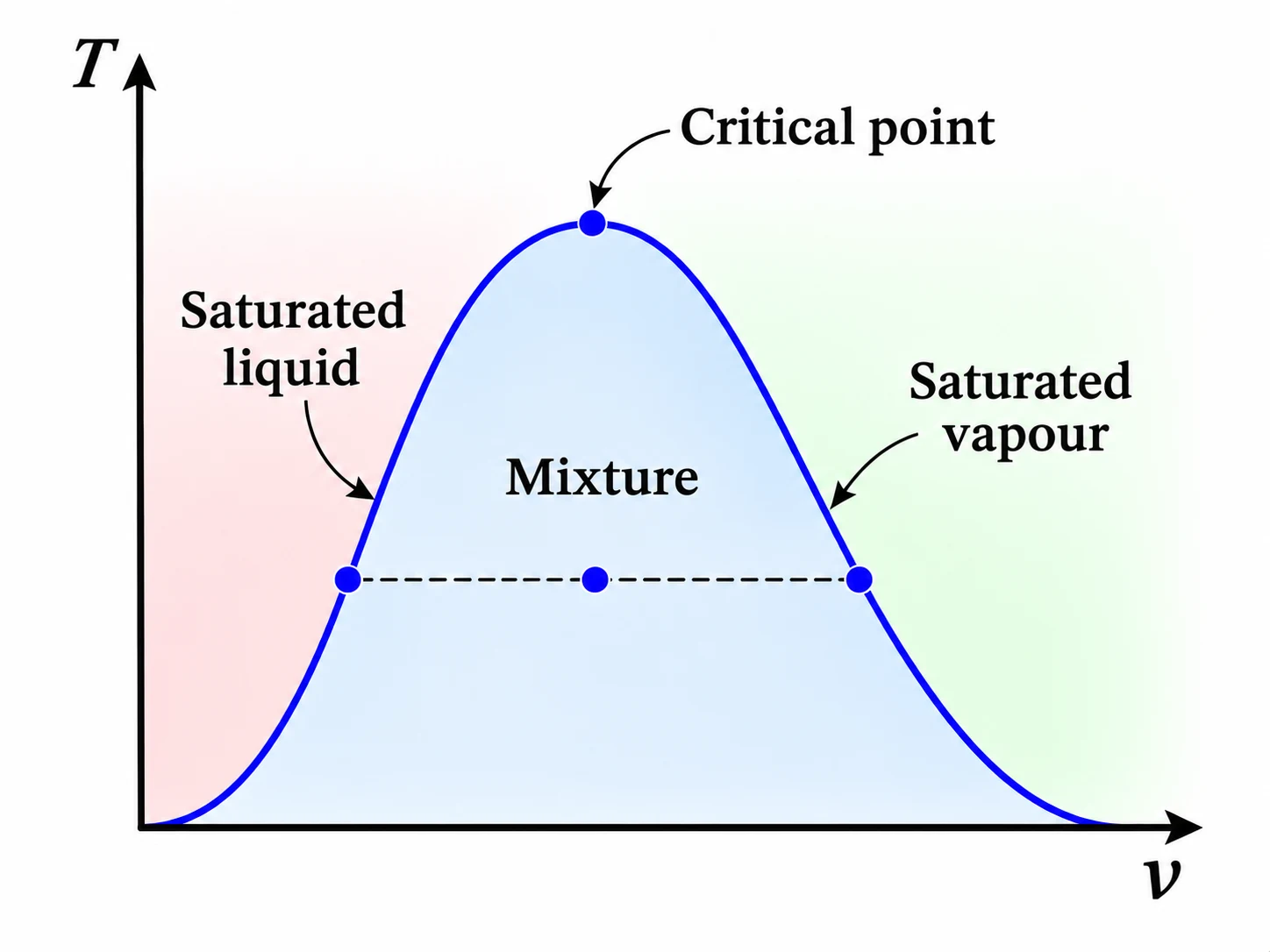
Interpret a saturation dome and quality.
Use supplied saturation property data for mixture calculations.
Interpolate within tabulated property ranges without extrapolating silently.
Understand the concepts
Pure substance and phase
A pure substance has a fixed chemical composition even if liquid and vapour coexist. Its intensive state requires sufficient independent properties to identify the region. Phase-change data must be interpreted with the correct reference pressure or temperature.
Saturation boundary
At a specified saturation pressure, liquid and vapour can coexist at the saturation temperature. A saturated liquid is just about to vaporise; saturated vapour is just about to condense. At the critical point the two saturated states become indistinguishable.
Quality is a mass fraction
For a saturated liquid-vapour mixture, quality is the vapour mass divided by total mass. It lies between zero and one only inside the two-phase dome. Quality cannot be used to label a single-phase superheated vapour.
Mixture interpolation
A specific mixture property varies linearly with mass quality between its saturated-liquid and saturated-vapour values: . This is a mass-weighted relationship, not an assertion that the liquid occupies the same volume as the vapour.
Assumptions and sign conventions
Property values in questions are self-contained, illustrative data for the stated working fluid and state.
Use two-phase interpolation only when the specific volume or energy lies between saturated endpoints.
Ignore vessel deformation and changes in kinetic or potential energy unless included.
Equations that matter
Step-by-step method
Identify the working fluid and its supplied pressure-temperature region.
Compare the known property with the saturated endpoint values to establish phase.
For a mixture, calculate quality from a known specific property.
Use mass-weighted interpolation for other mixture properties.
Apply the appropriate energy balance and check if two-phase.
Worked example: Quality from a supplied property row
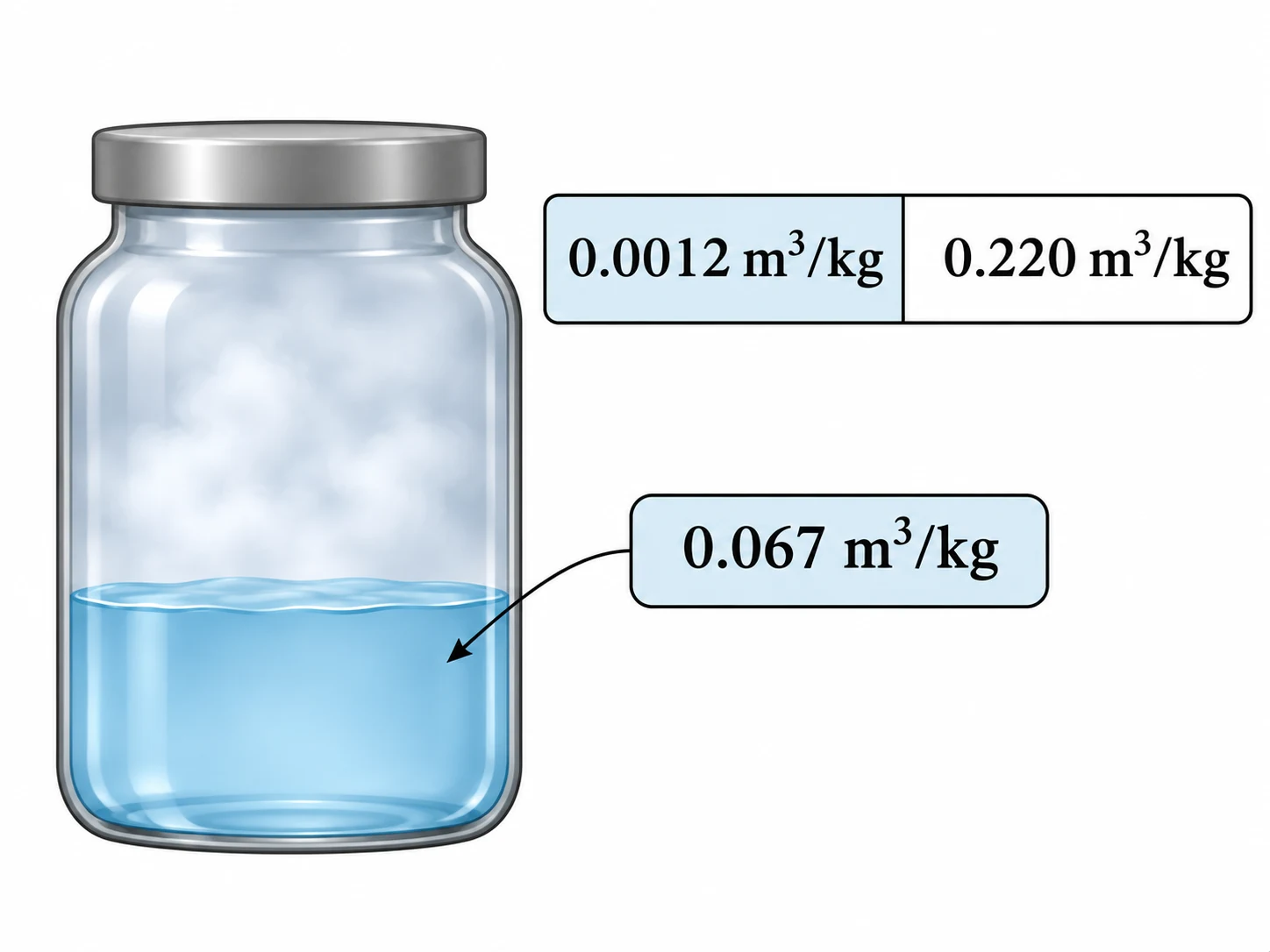
At a stated saturation pressure, a fluid has and . A sample has specific volume . Estimate its quality.
Common mistakes
Treating quality as a volume fraction.
Using mixture interpolation outside the saturation dome.
Comparing properties at different pressures.
Using vapour tables for compressed liquids without checking assumptions.
Check yourself
Why can a small vapour mass occupy most of the vessel volume?
What does mean?
Which properties stay constant in a sealed rigid tank?
Ready to try it yourself?
Independent Waypoint Mentor learning material. Not affiliated with or endorsed by any university.