Part II: Cycles and Fluid Properties · Topic 4 of 8 · 19 min read
Ideal Gas Cycles and Thermal Efficiency
Analyse closed loops, air-standard engine cycles and their performance limits.
What you'll learn
Read a cycle as a closed path of heat and work interactions.
Calculate ideal efficiency and temperature ratios for air-standard cycles.
Distinguish constant-volume and constant-pressure heat addition.
Recognise the limitations of idealised cycle models.
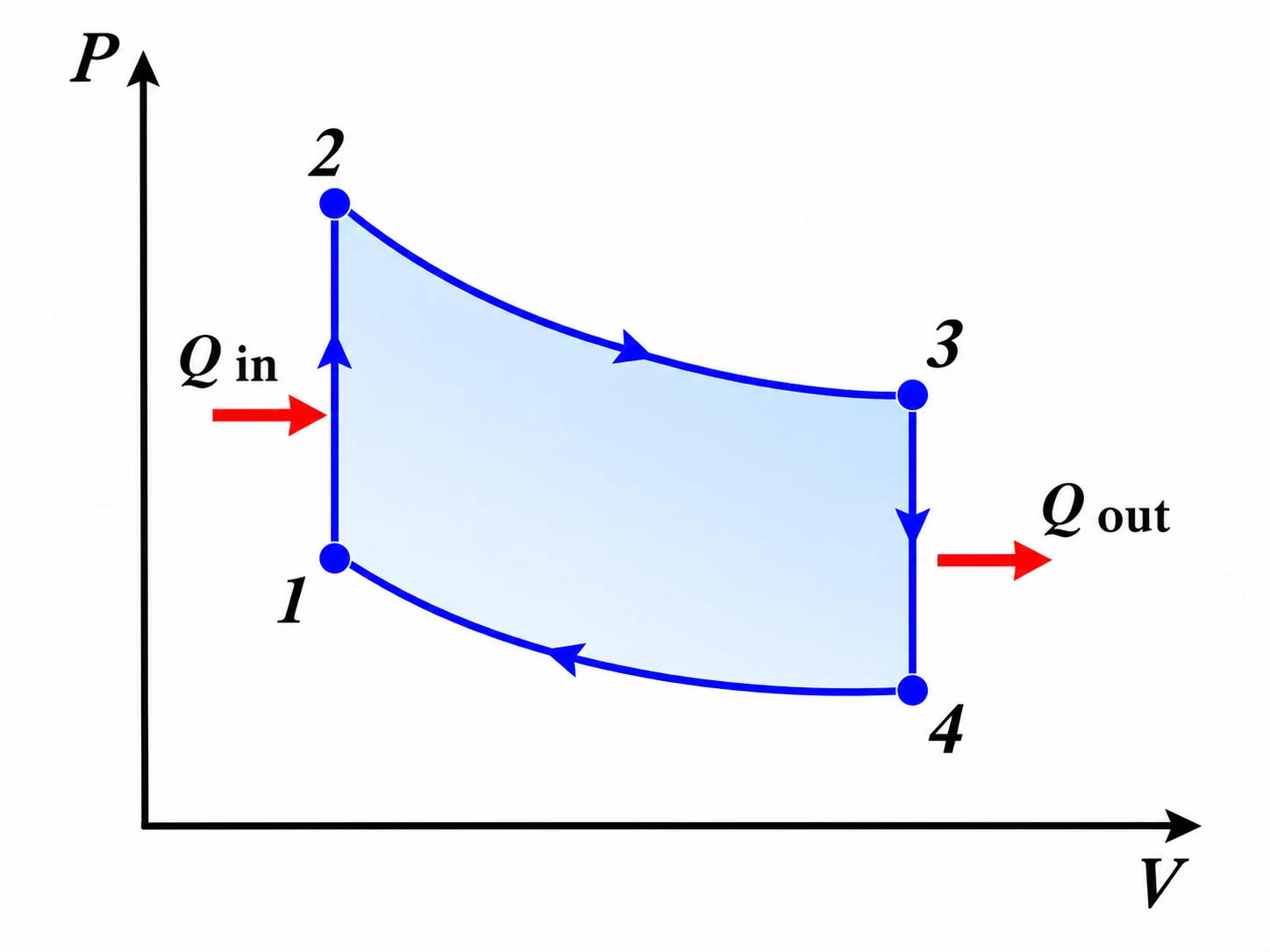
Understand the concepts
Why cycles produce net work
In a cycle, every state property returns to its initial value, so . The first law therefore gives . On a quasistatic - diagram, the enclosed signed area is net boundary work.
Assumptions and sign conventions
Use a constant heat-capacity ratio when analysing ideal-gas isentropic stages.
Ignore friction and heat leakage when an ideal air-standard cycle is specified.
Define as a positive magnitude in efficiency expressions.
Equations that matter
Step-by-step method
Identify the sequence and type of each process on the cycle diagram.
Calculate intermediate temperatures using isentropic and heat-addition relations.
Compute the heat received and rejected using the correct specific heat.
Calculate net work and thermal efficiency.
Check that cyclic energy conservation holds and that efficiency lies between zero and one.
Worked example: Compression ratio and ideal efficiency
An ideal constant-volume heat-addition cycle uses and . Determine its ideal thermal efficiency and the ideal post-compression temperature when the intake temperature is .
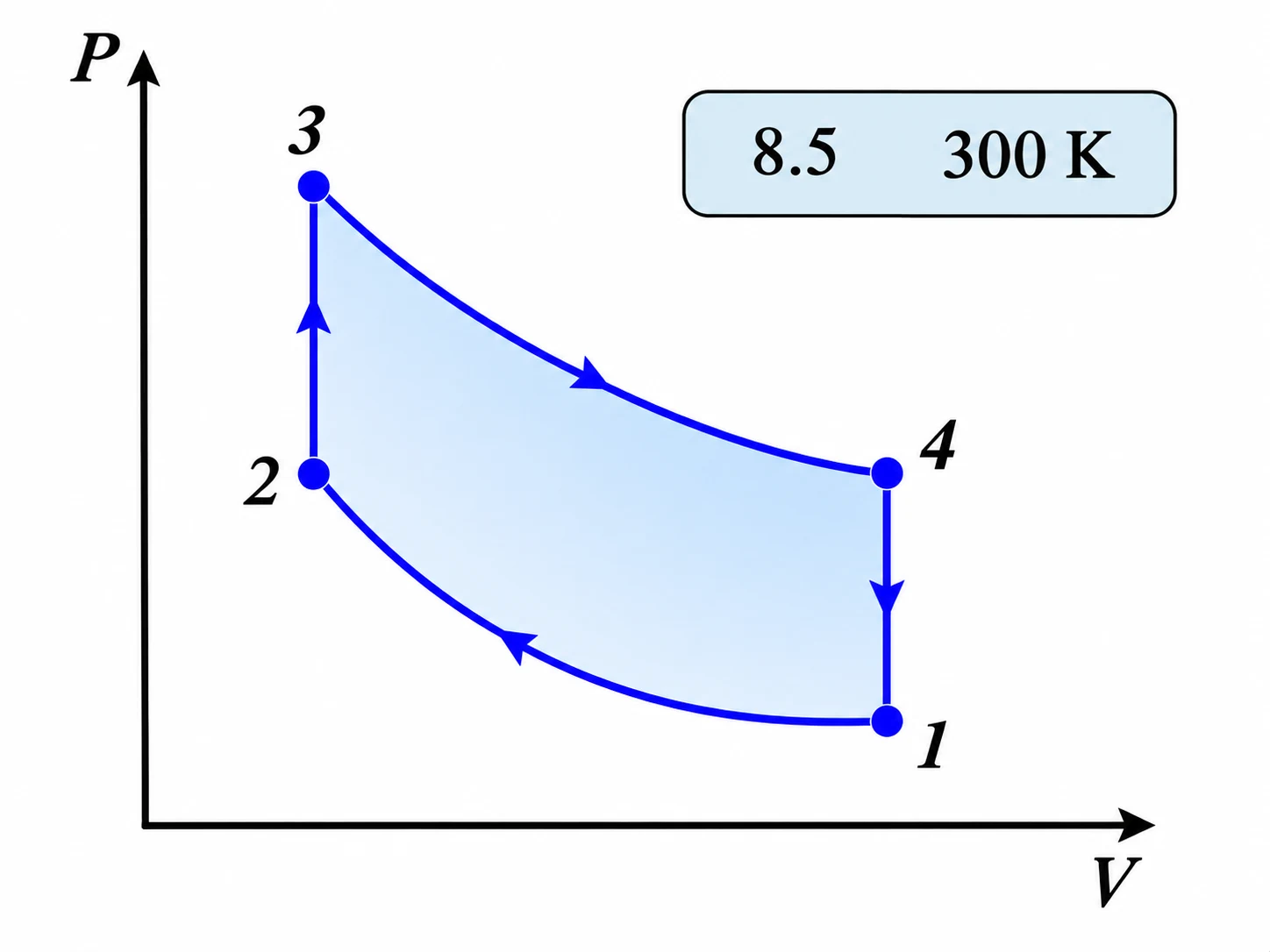
Step 1: Efficiency from the compression ratio
Apply the ideal cycle expression.
Common mistakes
Confusing a pressure ratio with a volume compression ratio.
Using for a constant-volume heat-input stage.
Forgetting to use Kelvin in temperature ratios.
Treating ideal efficiency as guaranteed actual engine efficiency.
Check yourself
Why is the enclosed - loop area equal to net work?
What happens to ideal efficiency as compression ratio rises?
How does constant-pressure heat addition differ from constant-volume heat addition?
Ready to try it yourself?
Related: Power, Refrigeration and Integrated Cycles
Independent Waypoint Mentor learning material. Not affiliated with or endorsed by any university.