Part II: Cycles and Fluid Properties · Topic 6 of 8 · 19 min read
Steady-Flow Energy and Devices
Use control volumes to analyse turbines, compressors, nozzles and mixers.
What you'll learn
Write mass conservation for steady-flow control volumes.
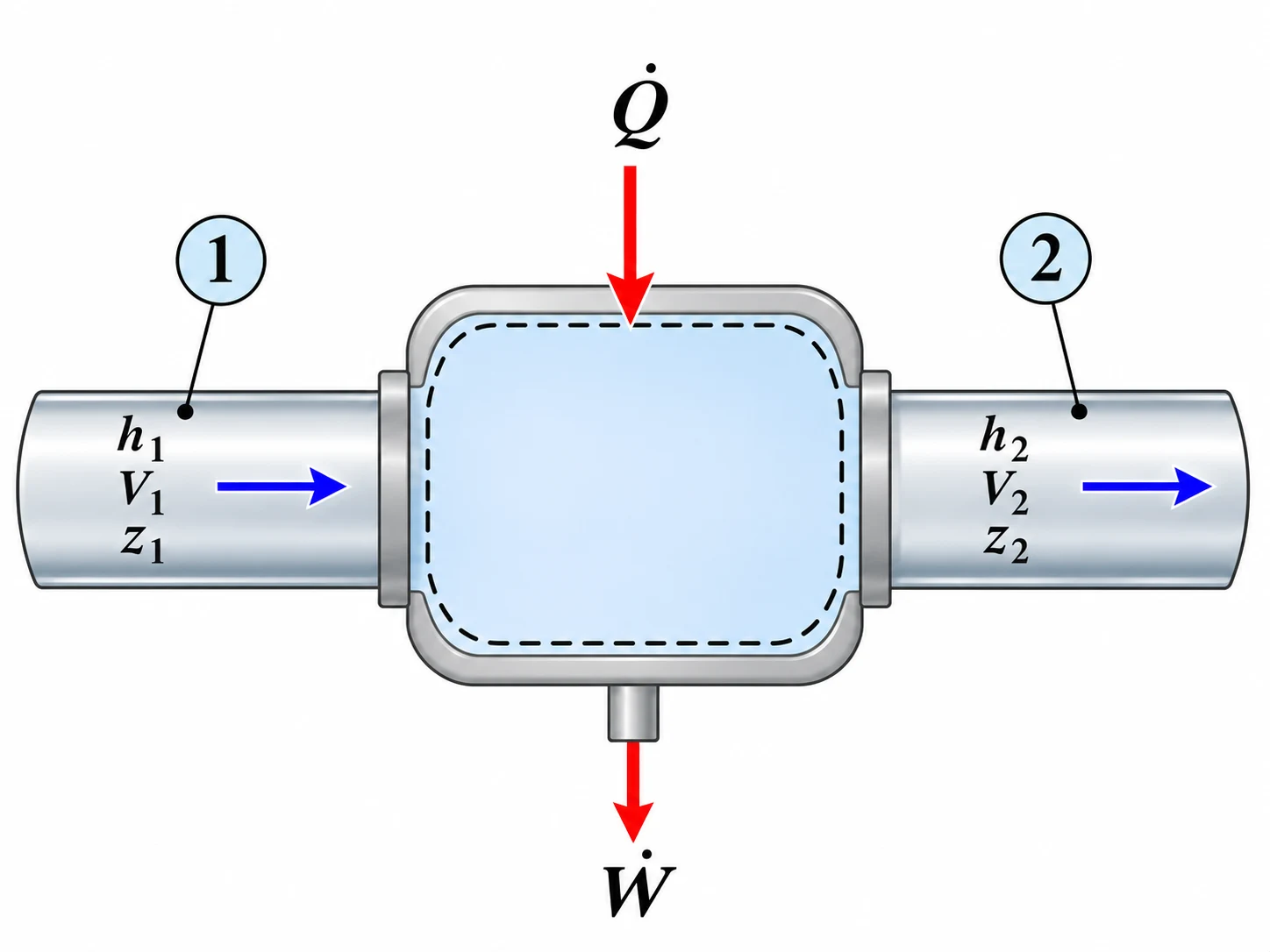
Apply energy conservation with flow work and velocity changes.
Compute shaft power and heat transfer for common devices.
Separate turbine output from compressor input using a consistent sign.
Understand the concepts
Open systems and mass conservation
A control volume is a defined region where mass and energy may cross the boundary. At steady state, mass inside it does not accumulate. Total entering mass flow therefore equals total leaving mass flow.
Why enthalpy appears
Moving fluid carries energy as internal energy, pressure-flow work, kinetic energy and potential energy. Enthalpy combines internal energy with flow work and simplifies bookkeeping. Use consistent specific units such as .
General steady-flow equation
For one inlet and one exit, the steady-flow energy equation relates net heat, shaft work and changes in . Do not discard kinetic or potential terms by habit. Compare their magnitude with the enthalpy difference first.
Assumptions and sign conventions
Steady state means no net accumulation of mass or energy inside the control volume.
Neglect kinetic and potential terms only when justified by the givens or magnitude.
Take shaft work from the control volume as positive.
Equations that matter
Step-by-step method
Draw the control boundary and label inlet, outlet, heat and shaft-work arrows.
Write the steady mass balance and determine unknown flow rates.
Write the energy balance before discarding any term.
Apply device assumptions and calculate the requested transfer.
Check unit conversions between watts, kilowatts and kJ/kg.
Worked example: Power from an insulated expansion device
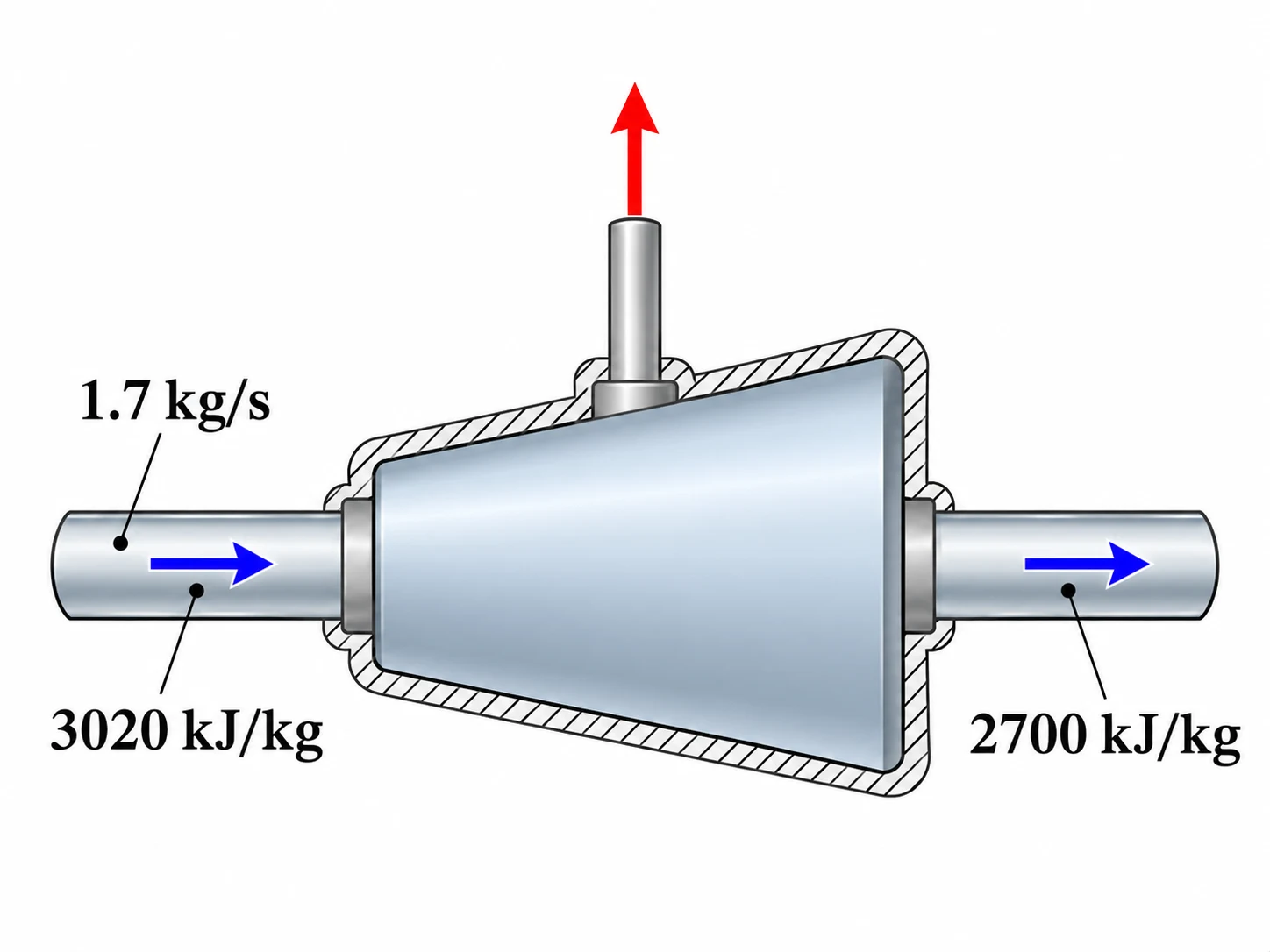
A steady device passes of vapour. Its specific enthalpy falls from to . Neglect velocity and height changes and heat transfer. Determine output power.
Step 1: Choose a control volume
The fluid enters and leaves at steady rate; the device is adiabatic.
Common mistakes
Confusing mass flow rate with total mass.
Ignoring kinetic-energy changes at high-speed outlets.
Interpreting compressor input as turbine output.
Mistaking throttling for an isentropic expansion.
Check yourself
Why is enthalpy more convenient than internal energy in steady flow?
Can a well-insulated nozzle increase outlet speed without work?
How does a mixing chamber satisfy mass conservation?
Ready to try it yourself?
Related: Power, Refrigeration and Integrated Cycles
Independent Waypoint Mentor learning material. Not affiliated with or endorsed by any university.