Part I: Systems and Gas Processes · Topic 1 of 8 · 19 min read
Thermodynamic Systems and Energy
Choose the system, distinguish properties from transfers, and conserve energy.
What you'll learn
Define a system and distinguish closed systems from control volumes.
Use absolute temperature and pressure consistently.
Identify state properties, heat and work.
Apply a first-law balance with a declared sign convention.
Understand the concepts
System, surroundings and boundary
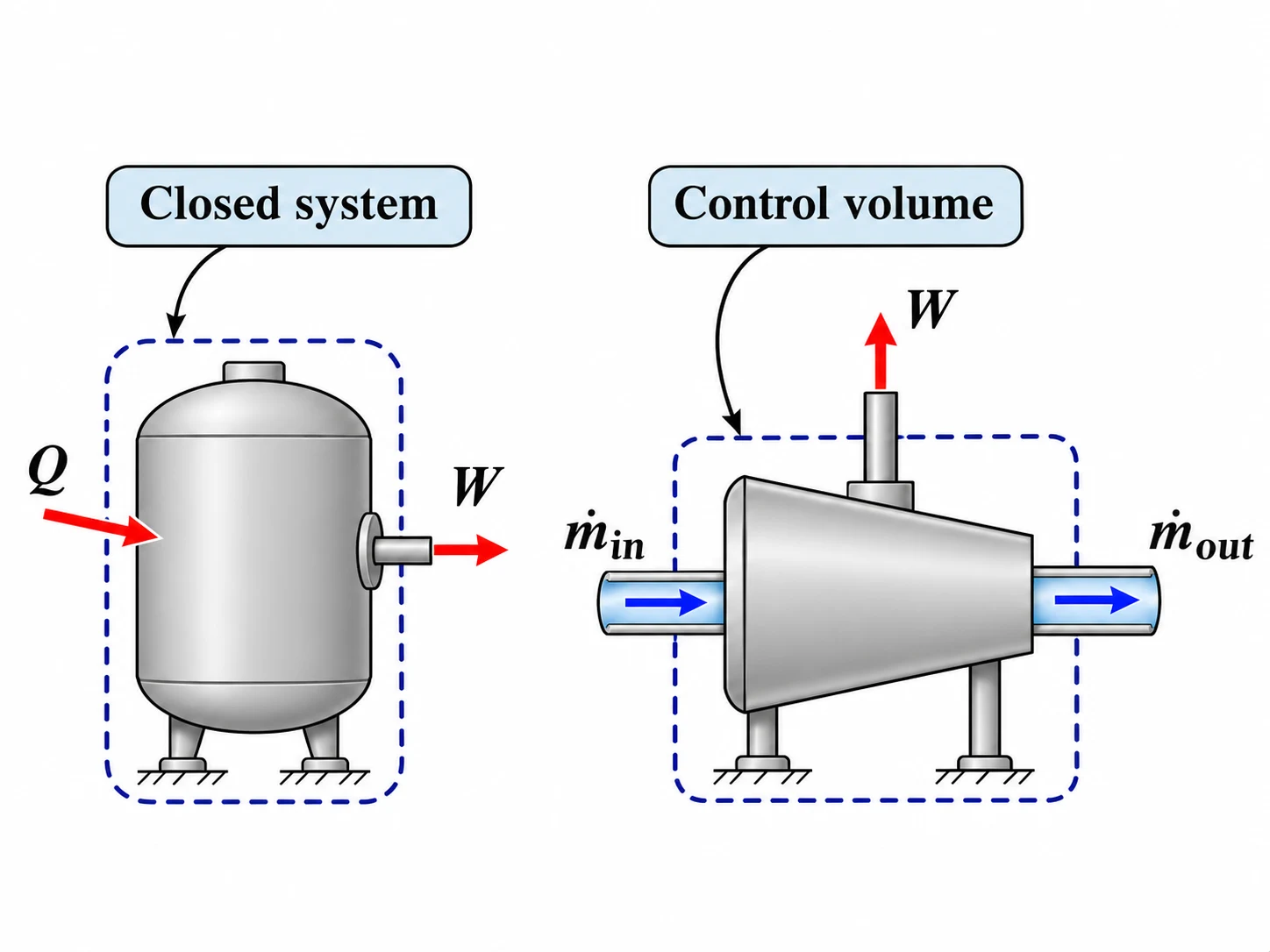
A system is the material or region selected for analysis; the surroundings are everything else. A closed system contains a fixed mass, although heat and work may cross its boundary. A control volume is a selected region through which mass may flow.
State and equilibrium
A state is described by measurable properties such as pressure, temperature and specific volume. At equilibrium these properties do not evolve spontaneously. A process links two states, and a cycle returns the system to its starting state.
Intensive versus extensive properties
Intensive properties such as temperature and pressure do not scale with the quantity of matter. Extensive properties such as mass, total volume and internal energy do scale. Divide an extensive property by mass to obtain its specific counterpart.
Heat and work are transfers
Heat crosses a boundary solely because of a temperature difference, whereas work transfers energy by other organised mechanisms. Neither heat nor work is stored as a state property. Always specify whether work is done by or on the chosen system.
Thermal equilibrium
Two bodies in thermal equilibrium have the same temperature, so there is no net heat transfer caused by a temperature difference. If two bodies are separately in equilibrium with a third, they are also in equilibrium with each other. Thermometers rely on this transitive behaviour.
First-law bookkeeping
For a stationary closed system with negligible changes in kinetic and potential energy, energy conservation gives . With work by the system positive, expansion work is positive and compression work is negative. Label every quantity before calculating.
Assumptions and sign conventions
Unless otherwise stated, use absolute pressure in gas equations.
Take heat entering the selected system as positive and work performed by it as positive.
Neglect changes in kinetic and gravitational potential energies only when explicitly reasonable.
Equations that matter
Step-by-step method
Sketch the chosen system and mark every heat, work and mass interaction.
Write known states, convert units and decide which properties are fixed.
Choose a positive direction for work and heat, then write the complete energy balance.
Substitute values with units and check that the sign makes physical sense.
Worked example: Insulated test vessel with a small shaft
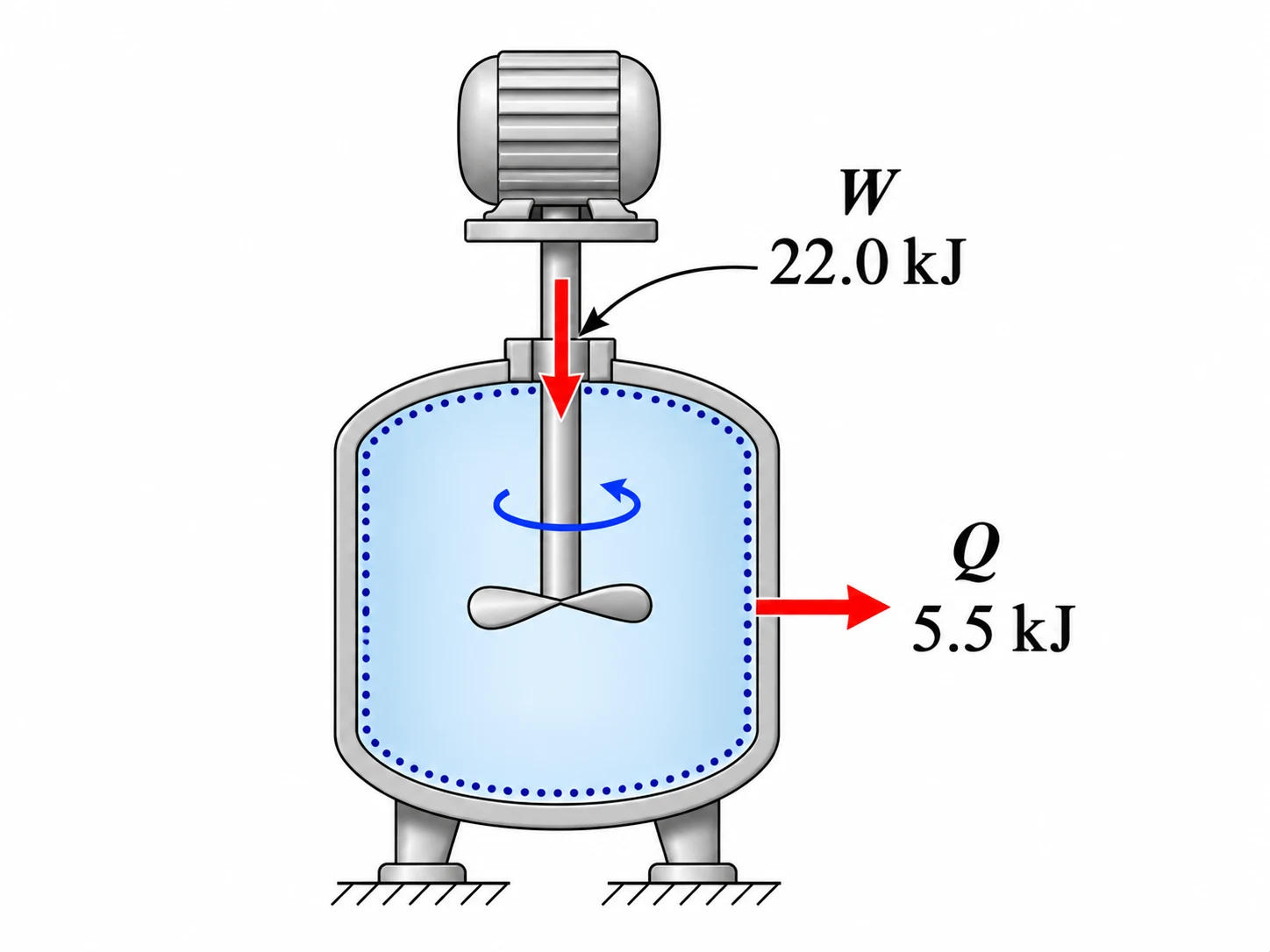
A sealed stationary vessel receives of shaft work and loses of heat. Determine its change in stored energy. Use work by the vessel as positive.
Step 1: Declare the signs
Heat leaves the vessel, so . Work is done on the vessel, so the work by it is negative.
Common mistakes
Treating heat and work as stored properties.
Using gauge pressure in .
Taking work done on the system as positive while using .
Assuming temperature change is always the same as internal-energy change.
Check yourself
If a gas expands and delivers shaft work, what sign does have?
Which property is extensive: temperature or total volume?
Why must a pressure reading be converted to absolute pressure for the ideal-gas law?
Ready to try it yourself?
Related: The First Law in Closed-System Processes
Independent Waypoint Mentor learning material. Not affiliated with or endorsed by any university.