Part I: Systems and Gas Processes · Topic 2 of 8 · 19 min read
Ideal Gases and Property Relations
Relate pressure, volume and temperature to energy and gas behaviour.
What you'll learn
Use the ideal-gas state equation in mass and specific forms.
Relate internal-energy and enthalpy changes to temperature.
Distinguish constant-volume from constant-pressure heating.
Recognise when a simple ideal-gas model is appropriate.
Understand the concepts
Ideal-gas approximation
At sufficiently low densities, many gases are well approximated by . The model becomes less reliable near saturation and at very high pressures. Temperatures must be expressed on an absolute scale.
Specific gas constant
The specific gas constant links mass, temperature and pressure for a chosen gas. The universal gas constant is expressed per mole, whereas here is per unit mass. Keep units consistent, for example .
Assumptions and sign conventions
Assume a calorically perfect ideal gas only when constant heat capacities are supplied.
Use in kelvin and pressures on an absolute scale.
Apply a uniform-state model only after mixing is complete.
Equations that matter
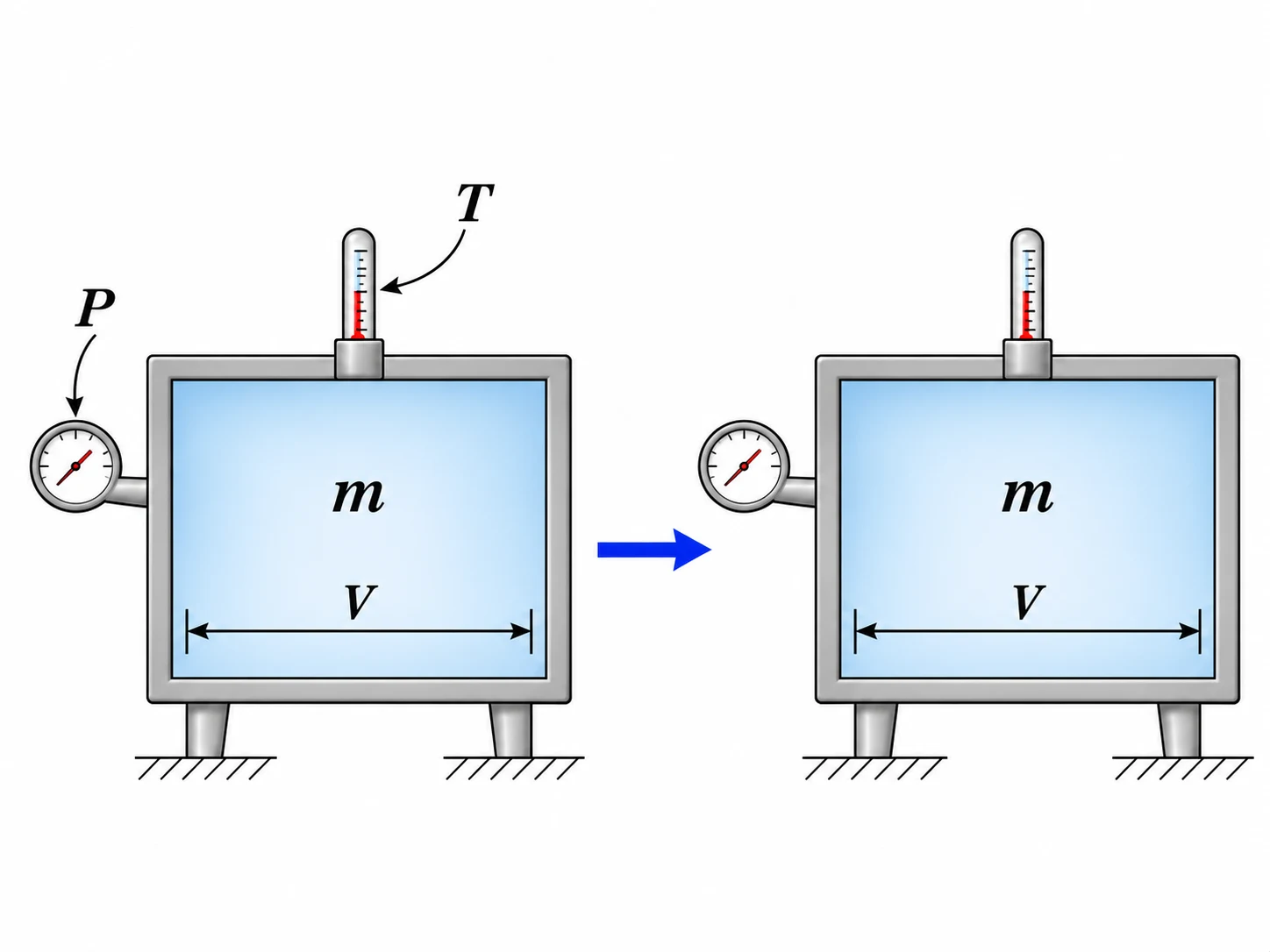
Pressure-volume product is proportional to the amount and temperature of an ideal gas.
Use it: Compute any one unknown state variable from the other four.
- absolute pressure
- specific gas constant
Step-by-step method
Record the gas model, mass status and fixed geometric constraints.
Convert the supplied state to kelvin, kilopascals and cubic metres.
Use to determine the missing property.
Use energy or enthalpy relations only after deciding how heat and work cross the boundary.
Check temperatures, pressures and mass for physical consistency.
Worked example: A sealed nitrogen sample warms
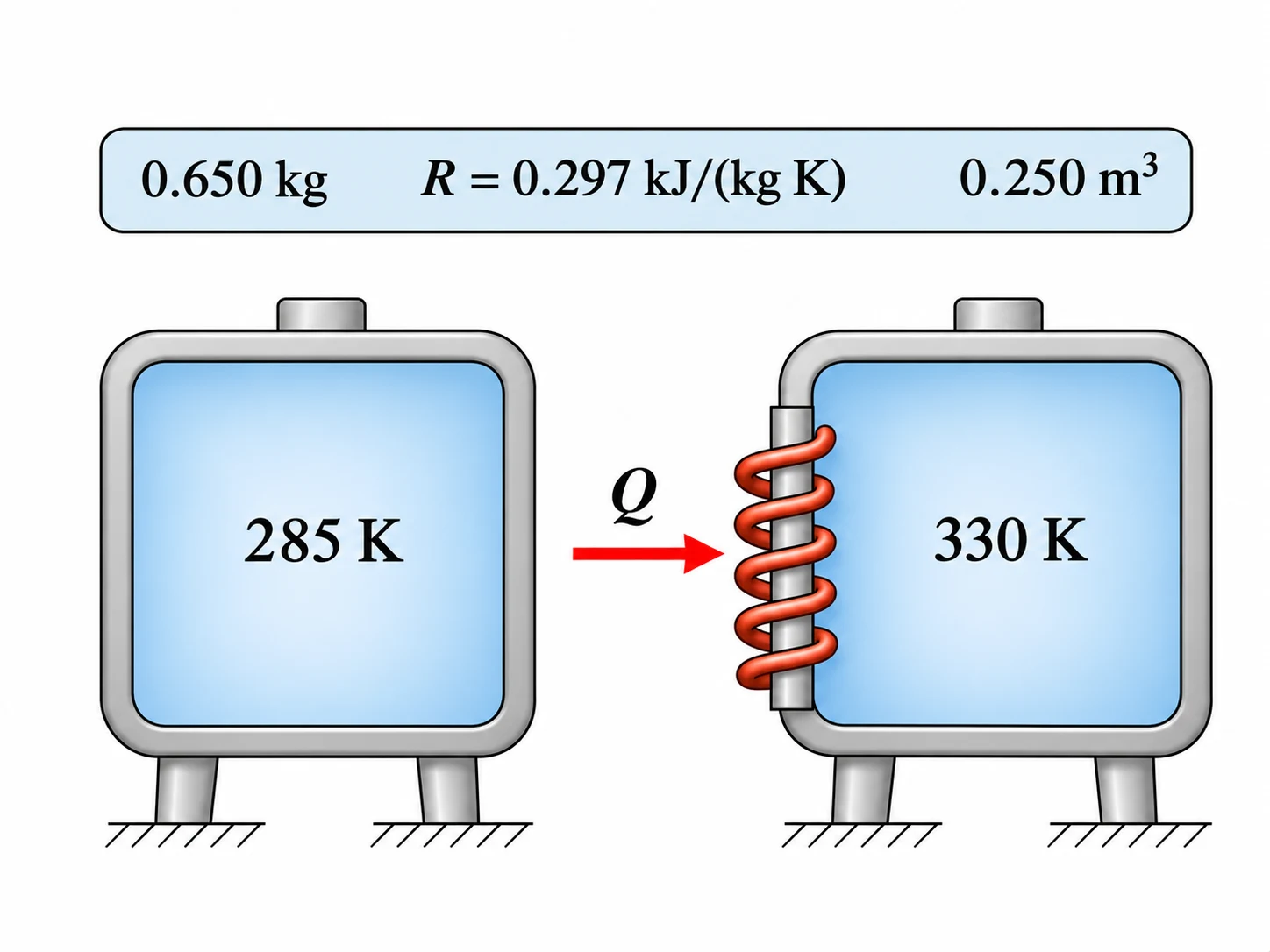
A rigid container holds of an ideal gas with at . Find its absolute pressure and the pressure after heating to .
Common mistakes
Applying constant-mass formulas when gas enters or leaves.
Mixing kilopascals with pascals without converting the gas constant.
Using Celsius in a ratio of temperatures.
Assuming constant pressure automatically means zero work.
Check yourself
Why does a heated sealed rigid tank develop a higher pressure?
Which energy property of an ideal gas depends only on temperature?
What extra information do you need to compute gas mass from pressure and temperature?
Ready to try it yourself?
Related: Pure Substances and Phase Change
Independent Waypoint Mentor learning material. Not affiliated with or endorsed by any university.