Part I: Systems and Gas Processes · Topic 3 of 8 · 19 min read
The First Law in Closed-System Processes
Connect paths on a pressure-volume diagram with work, heat and stored energy.
What you'll learn
Calculate boundary work for common ideal-gas paths.
Distinguish path-dependent transfers from state-dependent properties.
Apply the first law to multistage closed-system processes.
Use physically meaningful sign conventions in compression and expansion.
Understand the concepts
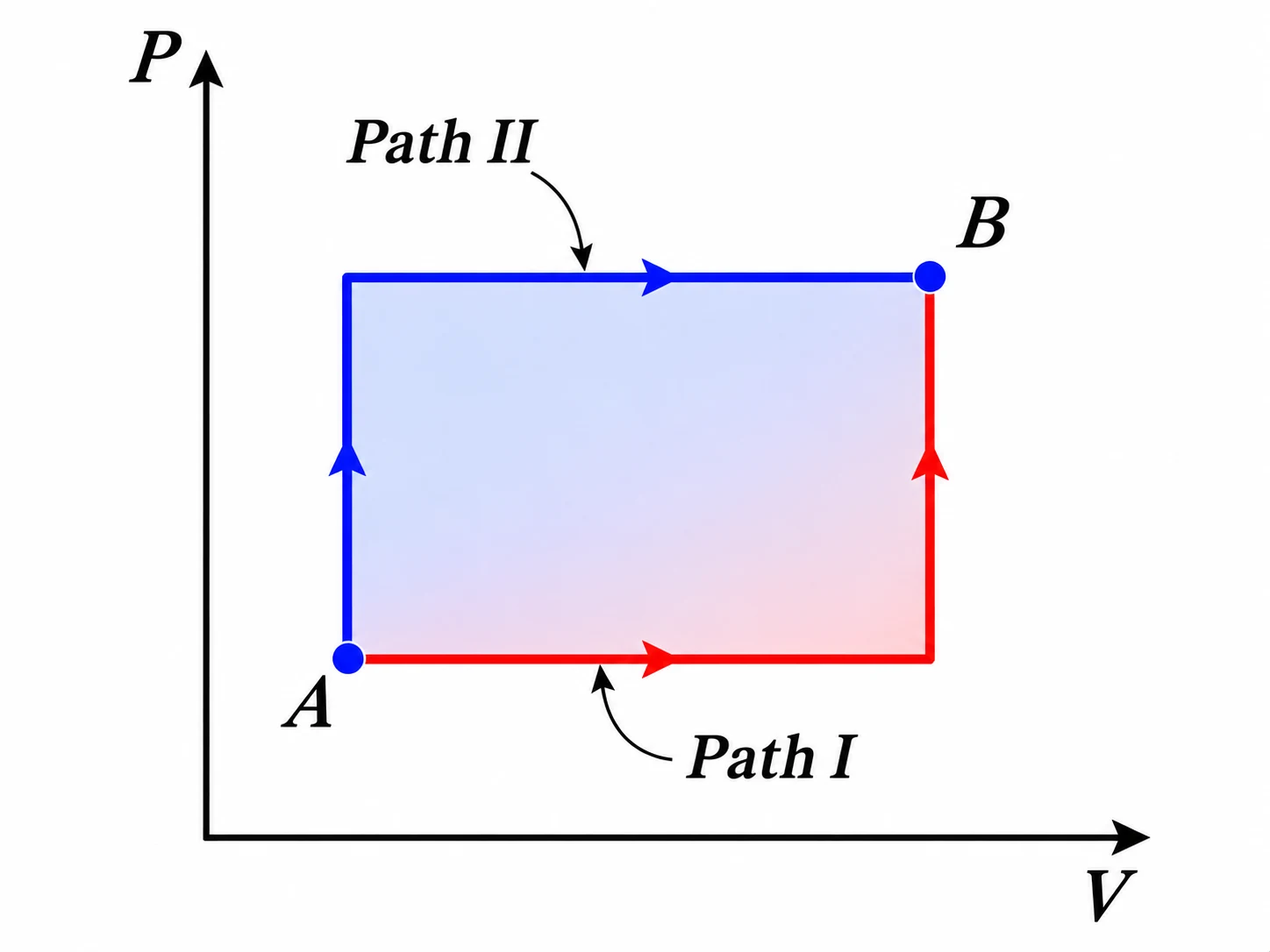
Path versus endpoints
Internal energy is a state property, so its difference depends only on initial and final states. Heat and boundary work depend on the process path. Two paths can share endpoints but exchange different amounts of heat and work.
Moving-boundary work
For a quasistatic piston process, boundary work is the area under the - curve. Expansion has and therefore positive work done by the gas. A rigid vessel has zero boundary work regardless of its pressure rise.
Constant-pressure process
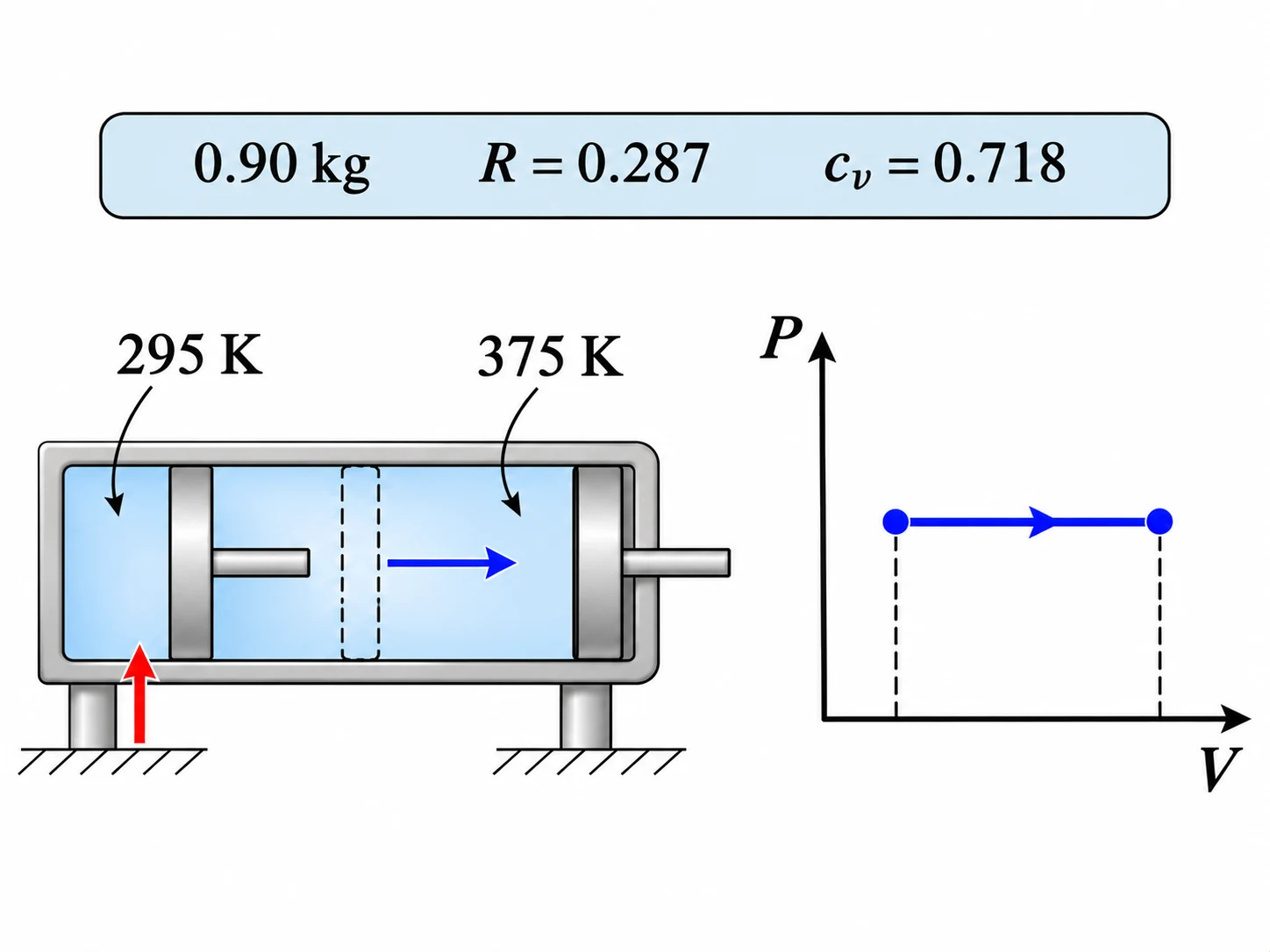
At constant pressure, boundary work is . For a calorically perfect ideal gas with negligible other work, heat transfer equals . Expansion and heating commonly occur together, but state the process constraints explicitly.
Assumptions and sign conventions
Unless stated otherwise, the piston is quasistatic and friction losses are negligible.
Air is modelled as an ideal gas with constant heat capacities when values are supplied.
Heat into the system and work by the system are positive.
Equations that matter
Step-by-step method
Identify the process type for each path segment.
Determine missing endpoint states from and the process constraint.
Evaluate with the correct path law.
Worked example: A controlled constant-pressure heating stroke
An ideal gas with , , is heated quasistatically at constant pressure from to . Determine boundary work and heat added; neglect other work.
Common mistakes
Forgetting that compression work by the gas is negative.
Using directly for heat in a constant-pressure process without accounting for work.
Using a constant-pressure formula along a curved path.
Evaluating an isothermal expression with changing temperature.
Check yourself
Why can identical endpoints have different boundary works?
What is for a rigid tank?
How does a - diagram help determine the sign of work?
Ready to try it yourself?
Related: Steady-Flow Energy and Devices
Independent Waypoint Mentor learning material. Not affiliated with or endorsed by any university.