Part III: Entropy and Engineering Applications · Topic 7 of 8 · 19 min read
Second Law, Entropy and Irreversibility
Evaluate direction, entropy generation and realistic device efficiency.
What you'll learn
Calculate entropy changes for ideal gases and thermal reservoirs.
Identify entropy generation and irreversibility.
Apply Carnot bounds to heat engines and heat pumps.
Relate actual compressor performance to an ideal isentropic benchmark.
Understand the concepts
Why the first law is not enough
Energy conservation says how much energy is transferred, not whether a proposed transfer can occur spontaneously. The second law establishes direction and limits how completely heat can be converted to work. Heat naturally flows from hotter to colder bodies in the absence of external work.
Entropy as a state property
Entropy describes a thermodynamic property that changes with heat transfer and internal irreversibility. Unlike heat, entropy belongs to the state of a system. Its change can be calculated between equilibrium states even if the actual process is irreversible.
Entropy generation
The entropy balance separates entropy entering with heat from entropy created by irreversibilities. For a complete isolated system, entropy cannot decrease. Positive generation accompanies friction, mixing of dissimilar states and heat transfer across finite temperature differences.
Reservoir model
An ideal thermal reservoir remains at nearly uniform constant absolute temperature while exchanging heat. Its entropy change is , taking heat into the reservoir as positive. Summing reservoir changes quantifies entropy produced by direct heat transfer.
Isentropic reference processes
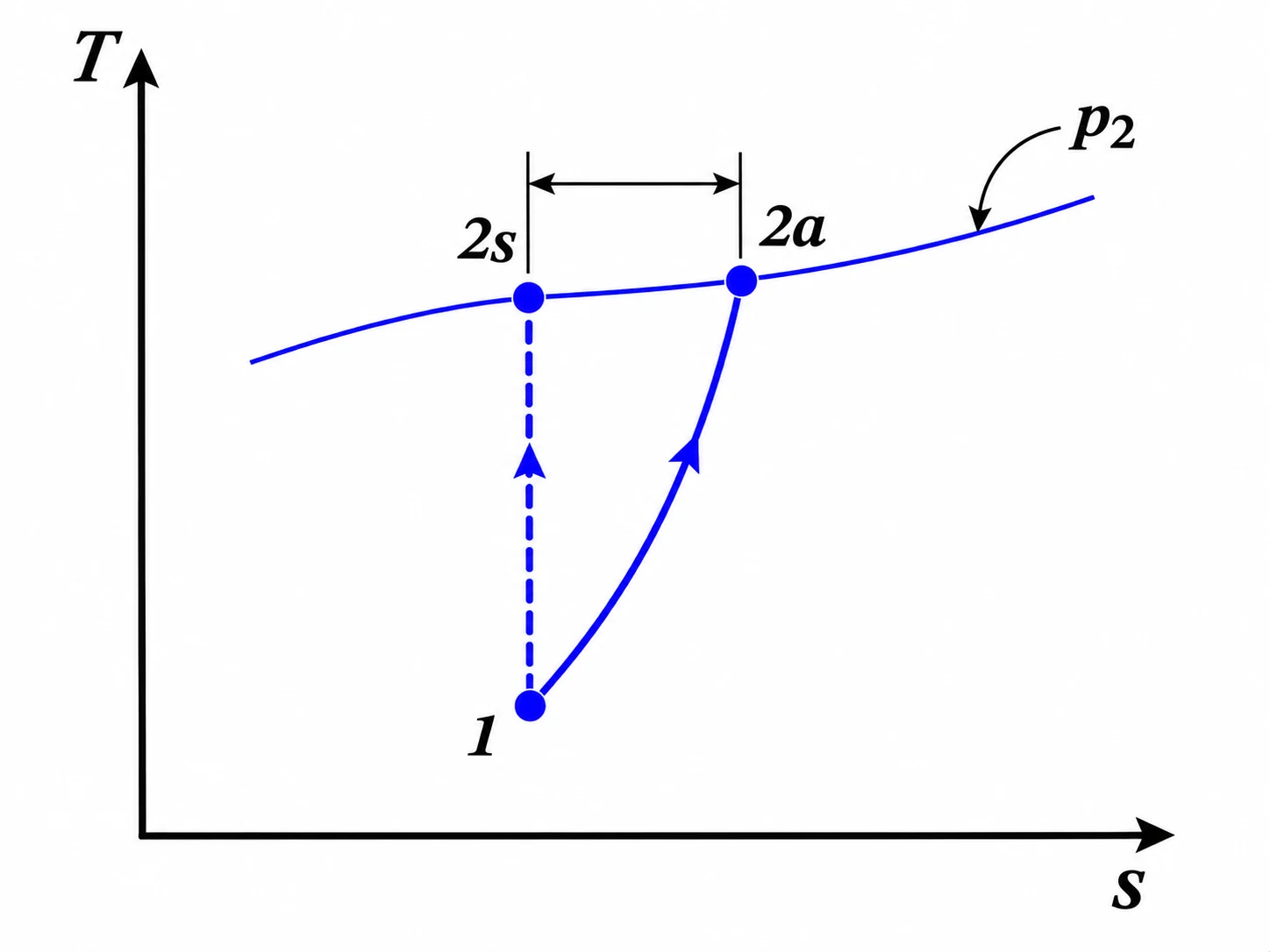
Reversible adiabatic paths have zero entropy change, making them useful benchmarks. Real compressors and turbines generally have irreversibilities and perform less favourably than their corresponding ideal states. Isentropic efficiency compares actual work with the benchmark work for the same inlet and outlet pressure.
Assumptions and sign conventions
Use reservoir temperatures in kelvin.
For ideal-gas entropy relations assume constant specific heats only when specified.
Adiabatic does not automatically mean isentropic; reversibility is also needed.
Equations that matter
Step-by-step method
State the system boundary and reservoirs involved.
Use first-law relations to determine heat or work if needed.
Calculate entropy changes of each subsystem using suitable state relations.
Sum entropy changes and infer whether .
For performance, compare with the relevant reversible temperature or work bound.
Worked example: Entropy change of a warm reservoir
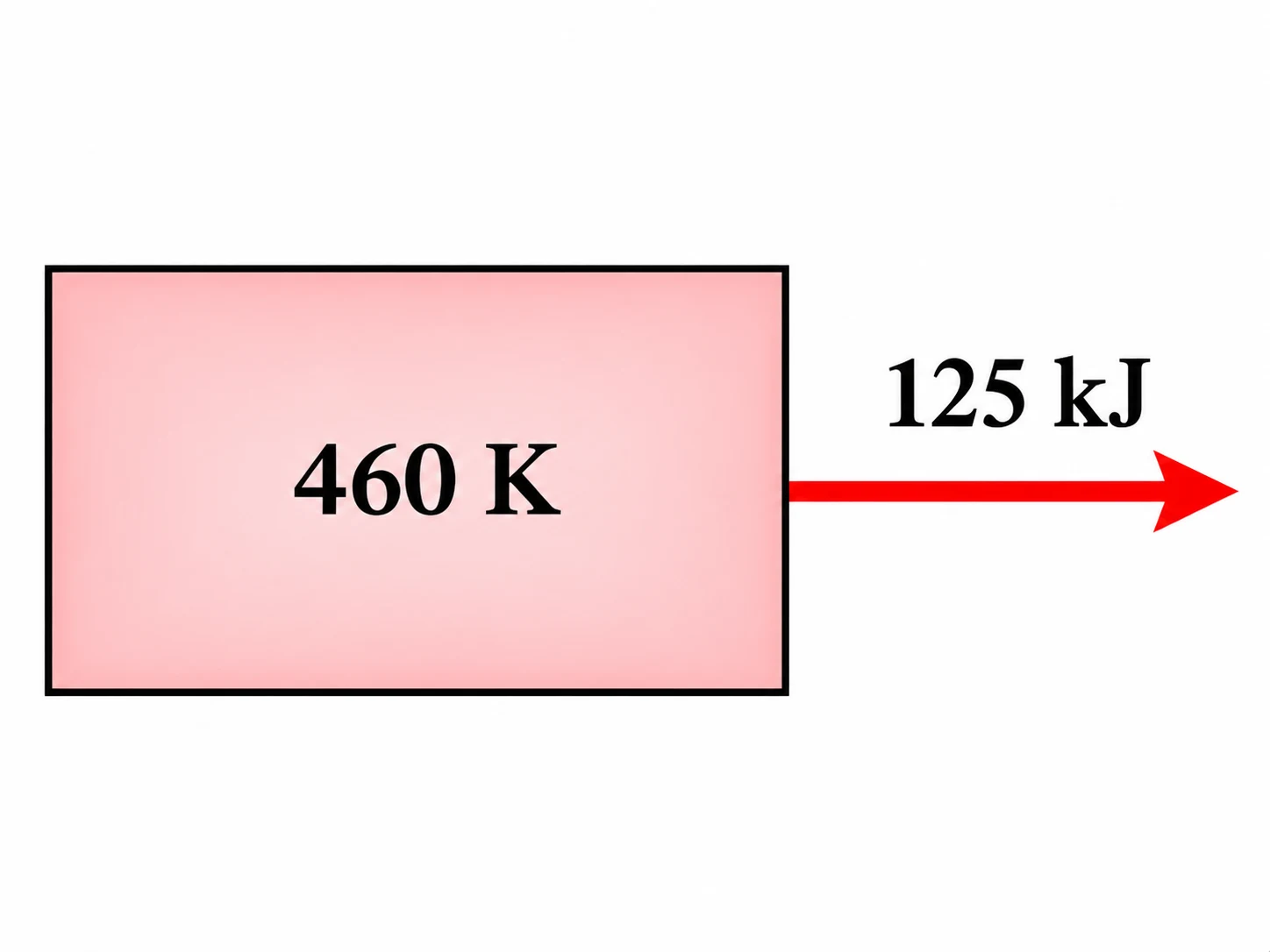
A large reservoir at loses of heat. Find its entropy change.
Step 1: Sign the heat
Heat leaves the reservoir, so its received heat is negative.
Common mistakes
Treating a heat transfer divided by any arbitrary temperature as system entropy change.
Forgetting the receiving reservoir when assessing total entropy generation.
Calling every adiabatic process isentropic.
Using compressor efficiency in the turbine form.
Check yourself
Why is a reversible adiabatic process isentropic?
Can a single hot reservoir convert all its heat into cyclic work?
What does positive entropy generation tell you?
Ready to try it yourself?
Independent Waypoint Mentor learning material. Not affiliated with or endorsed by any university.