Beam deflection
Engineering · First-year engineering · about 10 min
Deflection is the movement of a loaded beam away from its original position. Even when a beam is strong enough not to fail, excessive deflection can prevent it from working properly. The simplest exam cases use standard elastic beam formulas and careful SI unit conversions.
The key idea
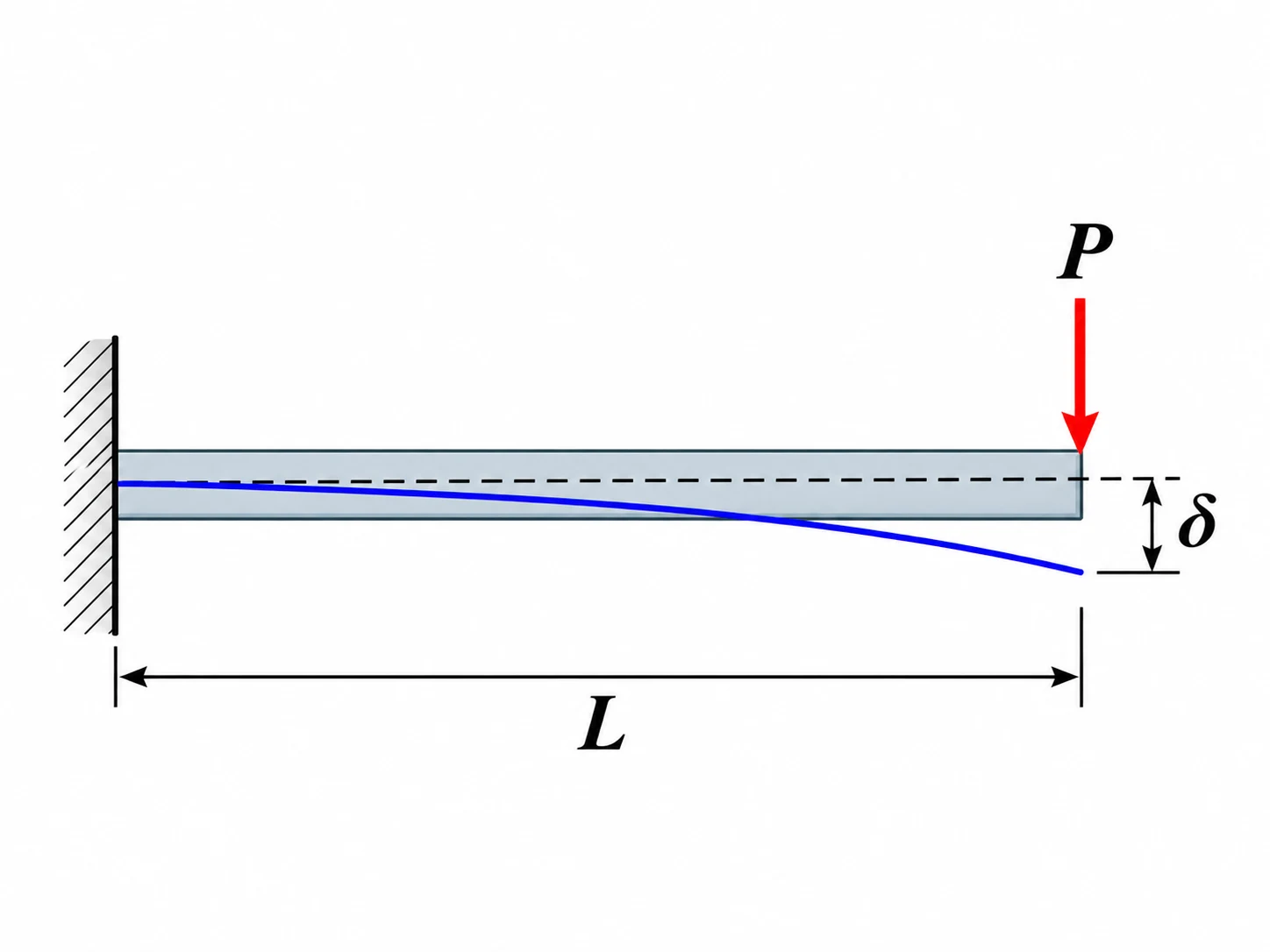
For a constant-section cantilever fixed at one end and carrying a downward point load at its free end, the free-end deflection magnitude is
Here is span, is Young's modulus and is the second moment of area about the bending axis. The tip moves downwards for a downward load.
Try it yourself
Match the support and loading
A cantilever is fixed against translation and rotation at one end, with its other end free. Its maximum deflection under a single downward end force is at the free end. A different support arrangement requires a different formula: for a simply supported beam under a central point load , the midspan deflection magnitude is , not . Distributed loading also changes the expression. Before choosing an equation, sketch the supports and check where and how the load acts.
Understand flexural rigidity
The product is the beam's flexural rigidity. A larger Young's modulus means a less deformable material, while a larger second moment means material is distributed more effectively away from the neutral axis. Both reduce deflection. Length has a particularly strong effect: for an end-loaded cantilever, doubling while keeping , and fixed increases the tip deflection by a factor of . This formula assumes small deflections, linear elasticity and a slender beam with constant and .
Keep units and direction straight
In , use in , in , in and in . The result is in metres. Convert to millimetres only at the end if the answer is small. If upward displacement is defined positive, a downward-load deflection is negative; most standard formula tables instead report its magnitude as a positive number. Deflection and slope are different: deflection has length units, while slope is an angle.
Worked example: Free-end deflection of a steel cantilever
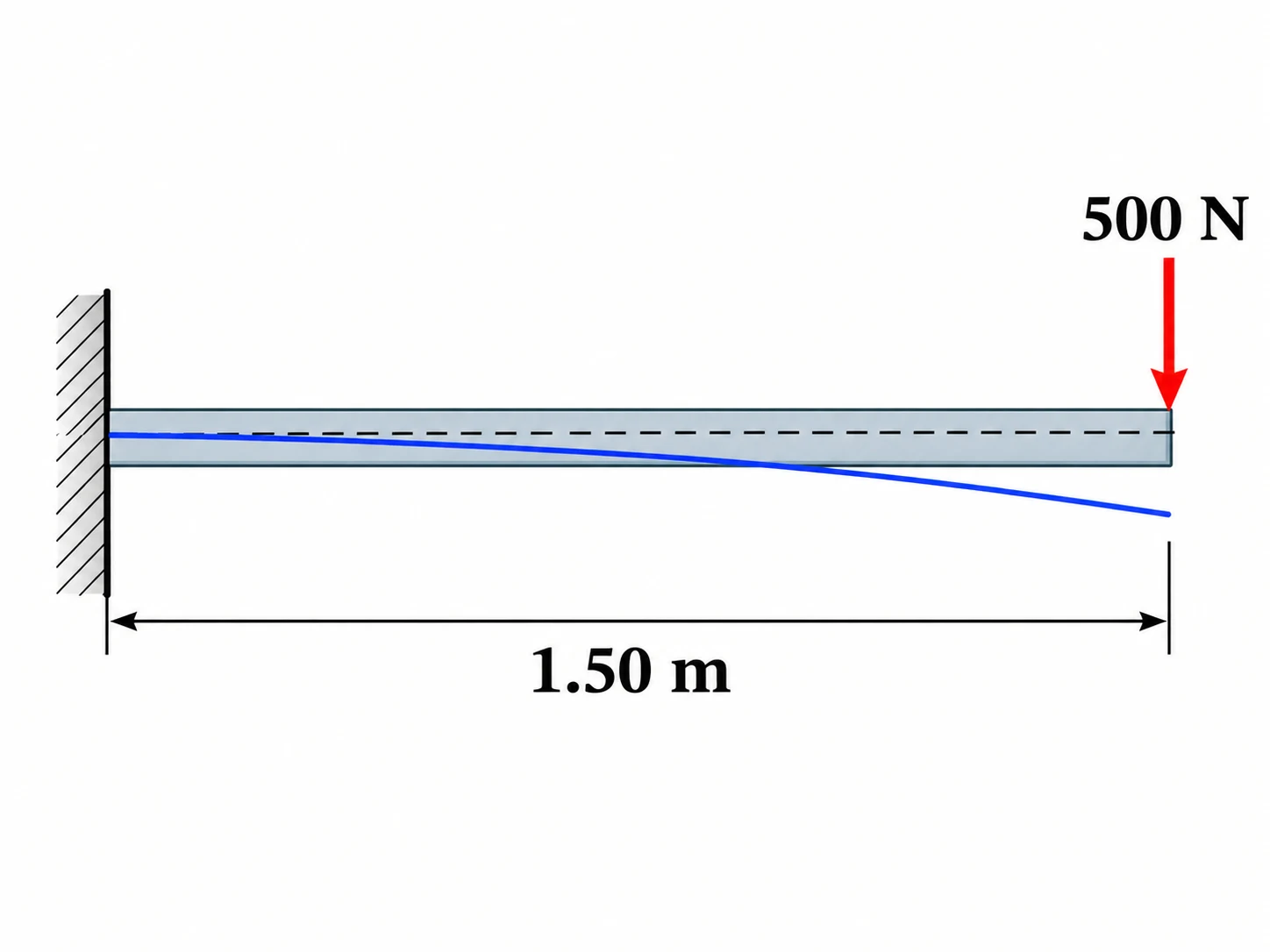
A straight cantilever beam is long and carries a downward force of at its free end. Its Young's modulus is and its constant section has . Assuming small elastic deflections, find the magnitude and direction of the free-end deflection.
Show the solution
This is a fixed-free beam with a point load at the free end, so use the cantilever formula.
- Write the quantities in SI base units:
- Calculate flexural rigidity:
- Substitute without rounding intermediate values:
- Convert metres to millimetres: .
Answer: the tip deflects downwards.
Common mistakes
Using a simply supported formula for a cantilever
Identify the fixed and free ends before selecting the coefficient.
Substituting for
Convert gigapascals into pascals by multiplying by .
Forgetting that length is cubed
Calculate carefully and check that the final units reduce to length.
Confusing deflection with slope
Report displacement in or ; slope is an angle, not a length.
Check your understanding
1. If a cantilever's length doubles with , and unchanged, by what factor does its end-load tip deflection increase?
2. A cantilever has , , and . What is its tip deflection magnitude?
3. Keeping cantilever load, length and material unchanged, what happens to tip deflection when doubles?
Still not sure? Talk it through.
Waypoint Mentor's tutor explains this out loud, works through your own problems on a whiteboard, and checks you've got it. Free to start.