Bending stress in beams
Engineering · First-year engineering · about 10 min
A beam carrying transverse loads bends, so fibres on one side shorten while fibres on the other side lengthen. Bending stress quantifies the normal stress caused by that deformation. Exam questions typically ask for the largest stress and whether it is tensile or compressive.
The key idea
For a straight, homogeneous, linearly elastic beam in small-deflection bending,
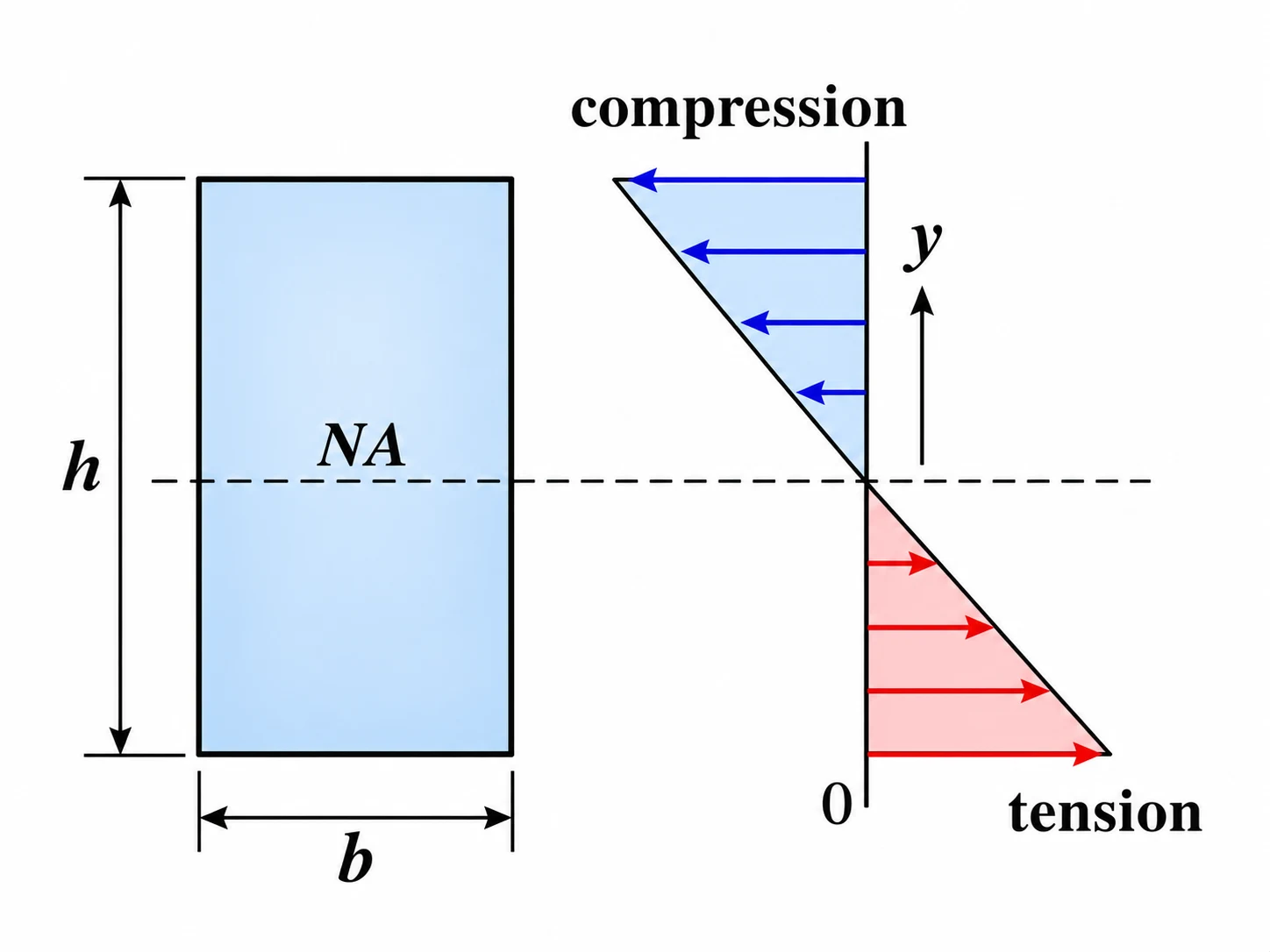
Here is the signed bending moment at the section, is the second moment of area about its centroidal neutral axis, and is measured upwards from that axis. Positive sagging gives compression above the axis and tension below it.
Read the stress distribution
Bending normal stress varies linearly with distance from the neutral axis. At , bending stress is zero; at the extreme fibres, its magnitude is largest. For a symmetric rectangular section of height , the extreme-fibre distance is , so . Under a positive sagging moment, the top fibres are in compression and the bottom fibres are in tension. A negative hogging moment reverses those signs. Keep this bending normal stress separate from transverse shear stress, which has a different distribution.
Use the correct section geometry
For a rectangle of width and vertical depth , the centroidal second moment is . Substituting gives . The cubed depth in makes increasing beam depth an effective way to reduce bending stress. For a built-up or asymmetric section, calculate the centroid and about the relevant neutral axis. The distances to its top and bottom extreme fibres may differ, so evaluate both stresses before deciding which is largest.
Find the critical section
First obtain support reactions from equilibrium, then find the bending moment along the beam using cuts or a bending-moment diagram. The location of greatest normally controls the largest bending normal stress when the cross-section is constant. Use consistent units: in , in and in produce stress in . Alternatively, with and produces , numerically equal to .
Worked example: Maximum stress in a simply supported beam
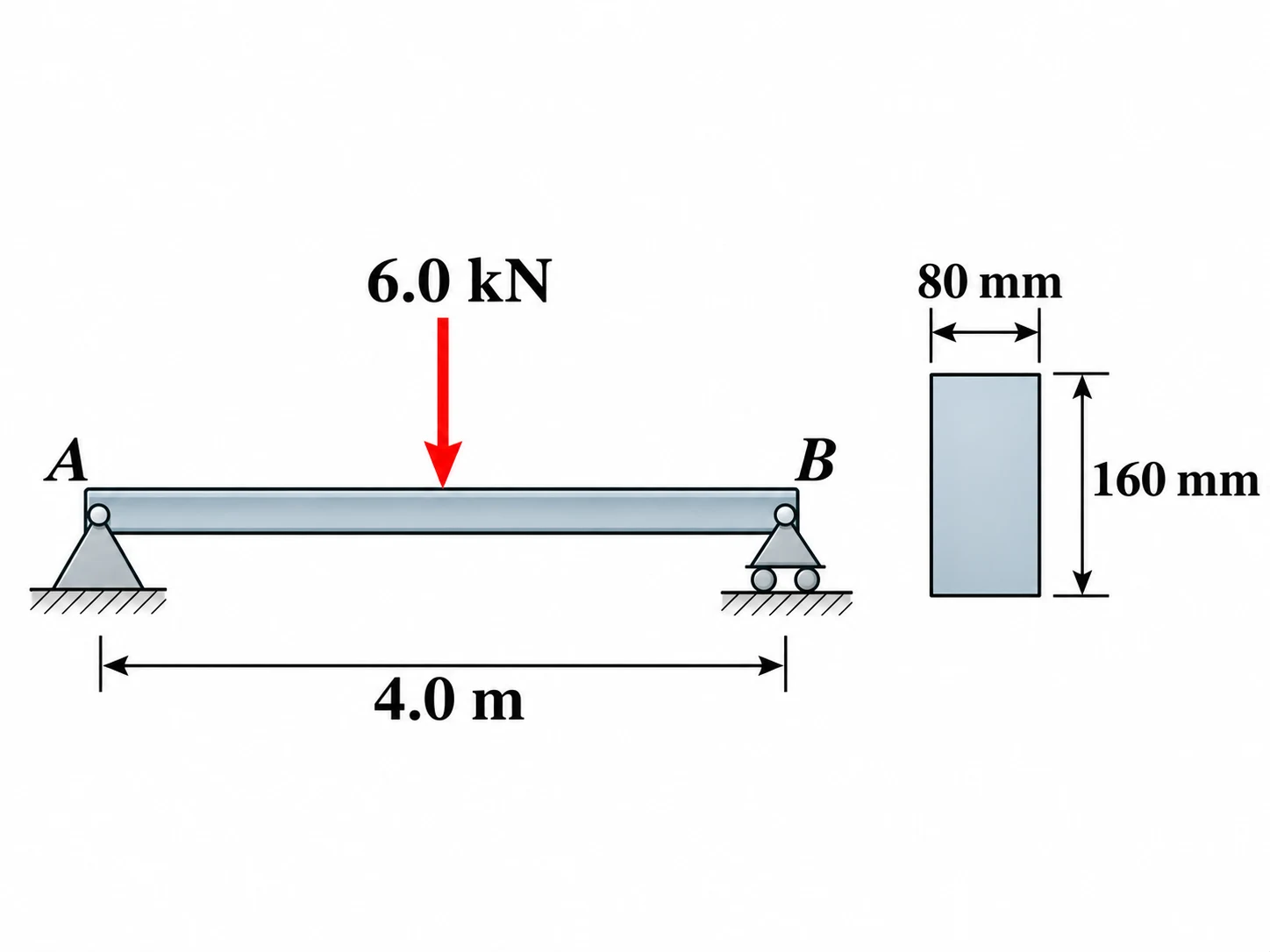
A simply supported beam has a span of and a downward point load of at midspan. Its rectangular section is wide and deep. Assume elastic bending of a prismatic beam. Determine the maximum bending normal stress and identify which face is in tension.
Show the solution
By symmetry, each vertical support reaction is .
- The largest positive bending moment occurs at midspan:
- Convert the cross-section dimensions to metres and calculate its second moment:
- The extreme-fibre distance is . Use the unrounded value:
- The moment is sagging, so the top face is compressed and the bottom face is stretched.
Answer: maximum bending stress magnitude , with tension at the bottom and compression at the top.
Common mistakes
Putting the applied force into instead of moment
Find the internal bending moment at the critical section first.
Using the full beam depth as for a symmetric rectangle
Measure from the neutral axis: the extreme distance is .
Mixing with without conversion
Choose a consistent length and force system before substituting.
Calling both faces tensile
For positive sagging bending, the top is compressive and the bottom tensile.
Check your understanding
1. A rectangular beam is wide and deep. Under , what is the extreme-fibre bending stress magnitude?
2. For a homogeneous beam under positive sagging bending, which statement is correct?
3. At the same , what happens to the maximum bending stress of a rectangular beam if its depth doubles but its width stays fixed?
Still not sure? Talk it through.
Waypoint Mentor's tutor explains this out loud, works through your own problems on a whiteboard, and checks you've got it. Free to start.