Centroids and second moment of area
Engineering · First-year engineering · about 10 min
The centroid locates the geometric centre of an area. The second moment of area measures how that area is spread about an axis. Both are essential when analysing beam bending and deflection, especially for L-shaped, T-shaped and other built-up sections.
The key idea
Split a section into simple, non-overlapping areas. Find its centroid, then shift each part's second moment to the required centroidal axis:
Here and are each part's area and centroid height, and is its second moment about its own horizontal centroidal axis.
Try it yourself
Locate the centroid
Place an origin and divide the shape into rectangles, triangles or other areas with known centroids. For a composite area, use and . Distances and must be measured from the same origin. The centroid of a rectangle lies halfway across its width and height. Symmetry can save work: a section symmetric about a vertical centreline has its centroid on that line. Report centroid coordinates in a length unit, such as .
Measure the area spread
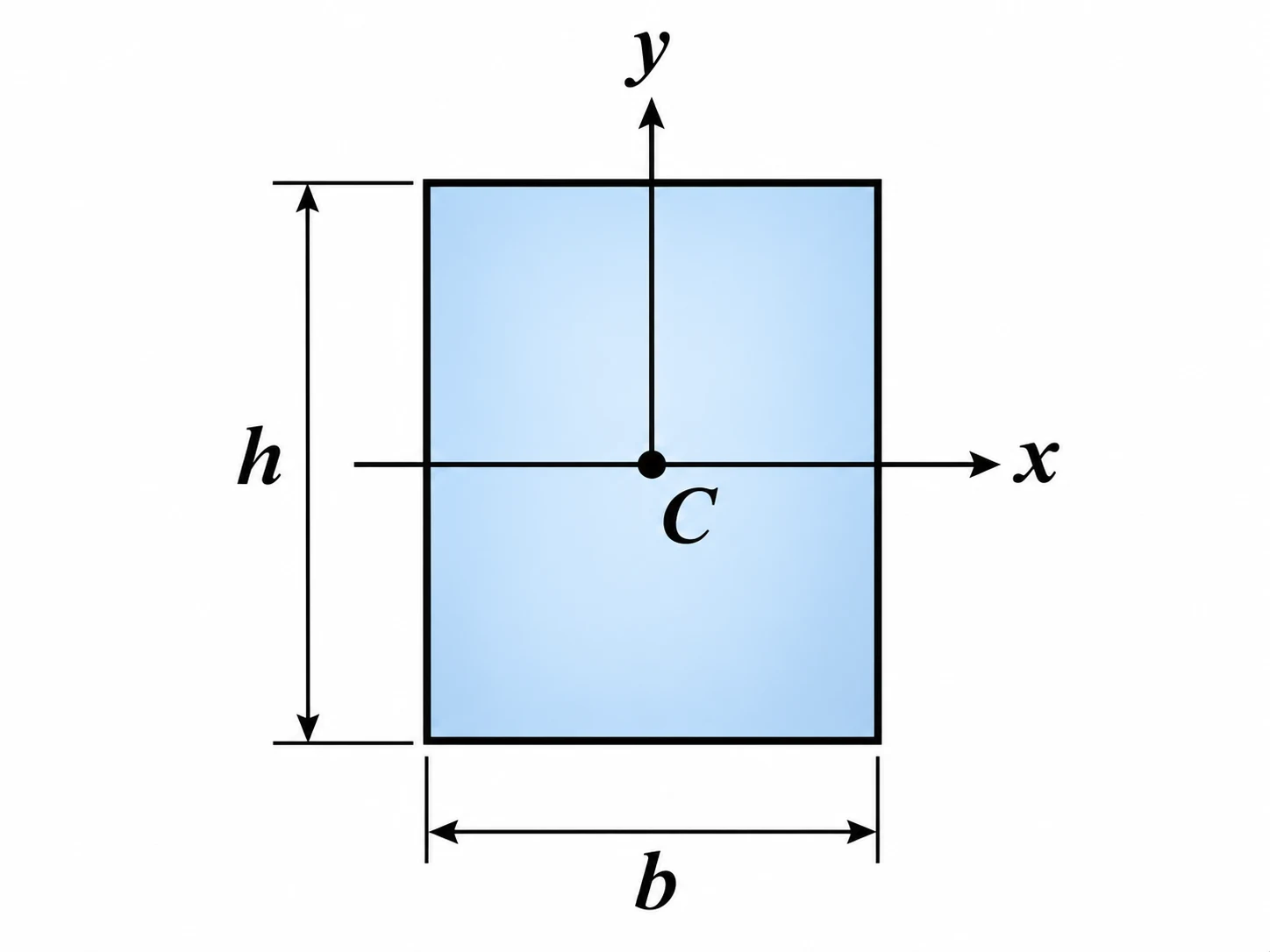
The second moment of area about a horizontal axis is . For a rectangle of width and vertical height , about its horizontal centroidal axis. The cube makes depth particularly influential: doubling at fixed multiplies this value by . Units are length to the fourth power, commonly . Do not confuse this geometric quantity with the mass moment of inertia, which measures resistance to angular acceleration.
Shift axes and handle openings
For an axis parallel to a component's centroidal axis, use , where is the perpendicular distance between the axes. Calculate the whole-section centroid first and use the distance from each component to that axis. A circular or rectangular opening can be represented with negative area, provided its centroid and second moment are also subtracted consistently. The term is always non-negative for a solid component. As a reasonableness check, the composite centroid should lie within the range of the component centroid coordinates for an all-solid section.
Worked example: Centroid and horizontal second moment of an L-section
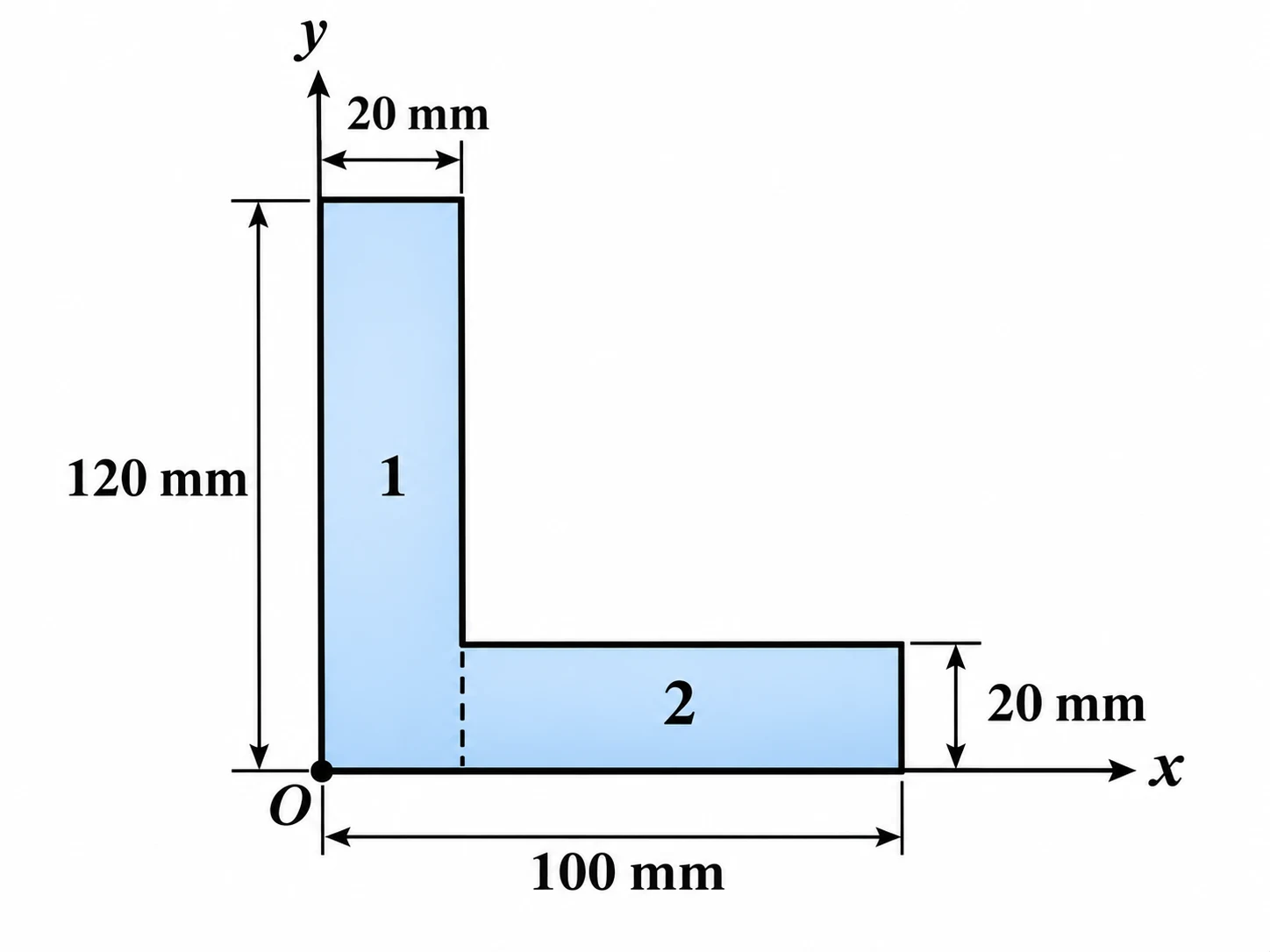
An L-shaped area consists of a vertical rectangle wide and tall, plus a bottom rectangle extending a further to the right and measuring tall. The two rectangles do not overlap. The origin is at the outside lower-left corner. Find , , and the second moment about the horizontal axis through the composite centroid.
Show the solution
Call the vertical rectangle part 1 and the extra bottom rectangle part 2. All coordinates are measured from the lower-left origin.
- Areas and part centroids are
- Total area and centroid coordinates are
- Find each rectangle's own horizontal centroidal second moment:
- Shift both to :
Answer: , and .
Common mistakes
Counting an overlapping corner twice
Use disjoint rectangles, or subtract the overlap once from area and moments.
Using a different origin for each centroid
Measure every component coordinate from the same reference axes.
Forgetting the parallel-axis term
Add to each part when its centroidal axis differs from the target axis.
Using with the wrong height
The cubed dimension is perpendicular to the axis about which you calculate .
Check your understanding
1. What is for a rectangle wide and tall, about its horizontal centroidal axis?
2. Two non-overlapping areas of each have centroid heights and . What is their combined centroid height?
3. A solid part has area . Its centroidal axis is from a parallel target axis. What term must be added to its centroidal second moment?
Still not sure? Talk it through.
Waypoint Mentor's tutor explains this out loud, works through your own problems on a whiteboard, and checks you've got it. Free to start.