The binomial distribution
Statistics · Senior school statistics · about 10 min
A binomial model counts how many successes occur in a fixed number of repeated trials. It is useful for questions involving correct answers, passed inspections or successful attempts, provided each attempt has the same success probability and trials are independent.
The key idea
If , then
Here is the number of independent trials, the probability of success per trial, and the number of successes.
Check the model first
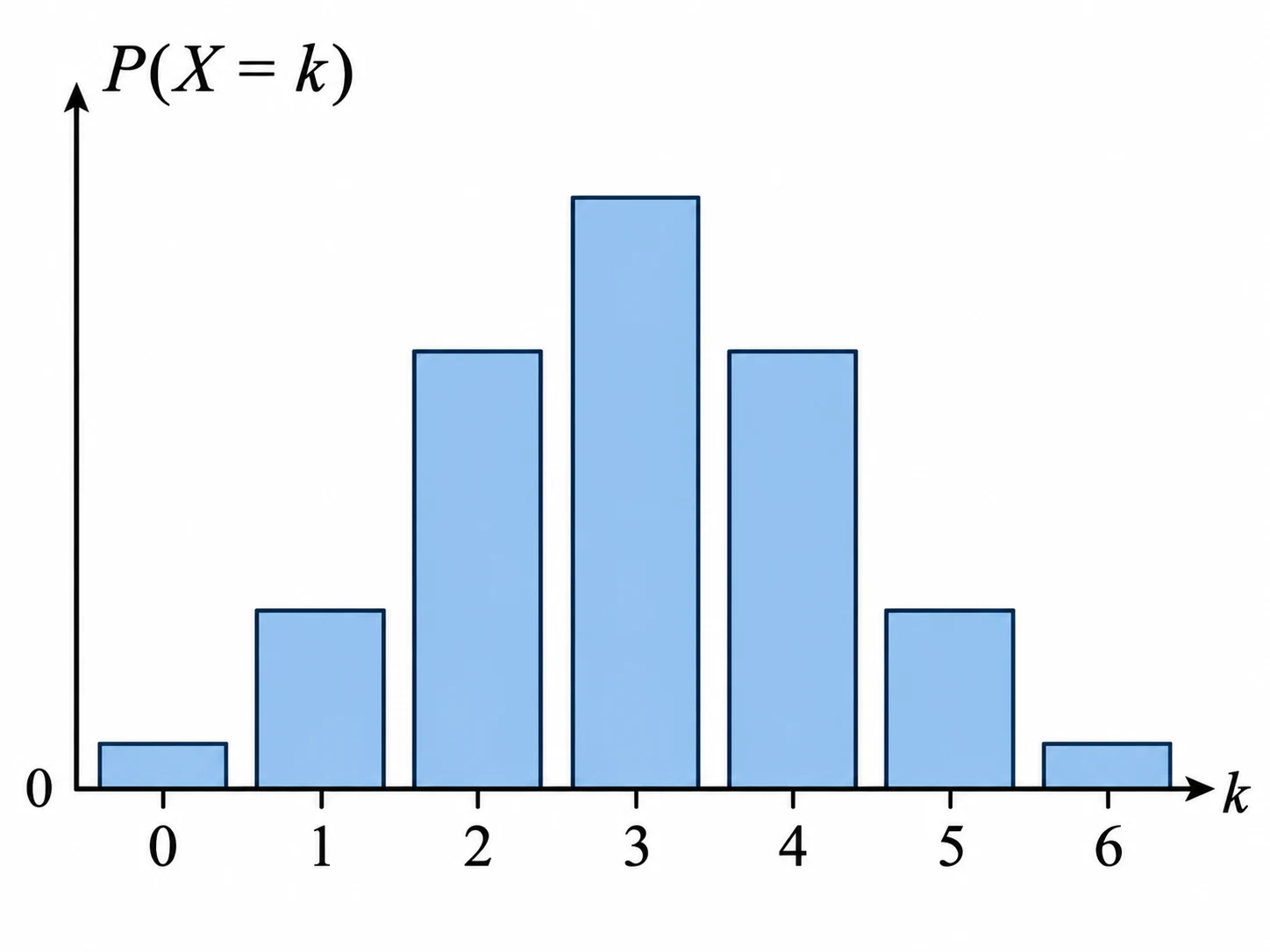
Use a binomial model when there is a fixed number of trials, exactly two outcomes per trial, independent trials and a constant success probability . The variable counts successes, so it can take the values . When sampling without replacement from a small population, independence and constant probability may fail, so a binomial model is not exact. The combinations term counts the different arrangements of successes among trials.
Exact and cumulative probabilities
The formula returns the probability of exactly successes. For a range, add the relevant exact probabilities, for example . For at least one, the complement is shorter: . Watch inclusive wording: at most includes , whereas fewer than does not. A probability is a number between zero and one; convert to a percentage only when requested.
Mean and spread
The expected number of successes is and the variance is . Standard deviation is . The mean need not be an integer because it is a long-run average rather than a required outcome. An increasing generally increases the expected number of successes at fixed . A probability histogram has a bar at every integer from zero to , and all bar heights sum to one. This makes a useful check when calculations seem unreasonable.
Worked example: Successful inspections
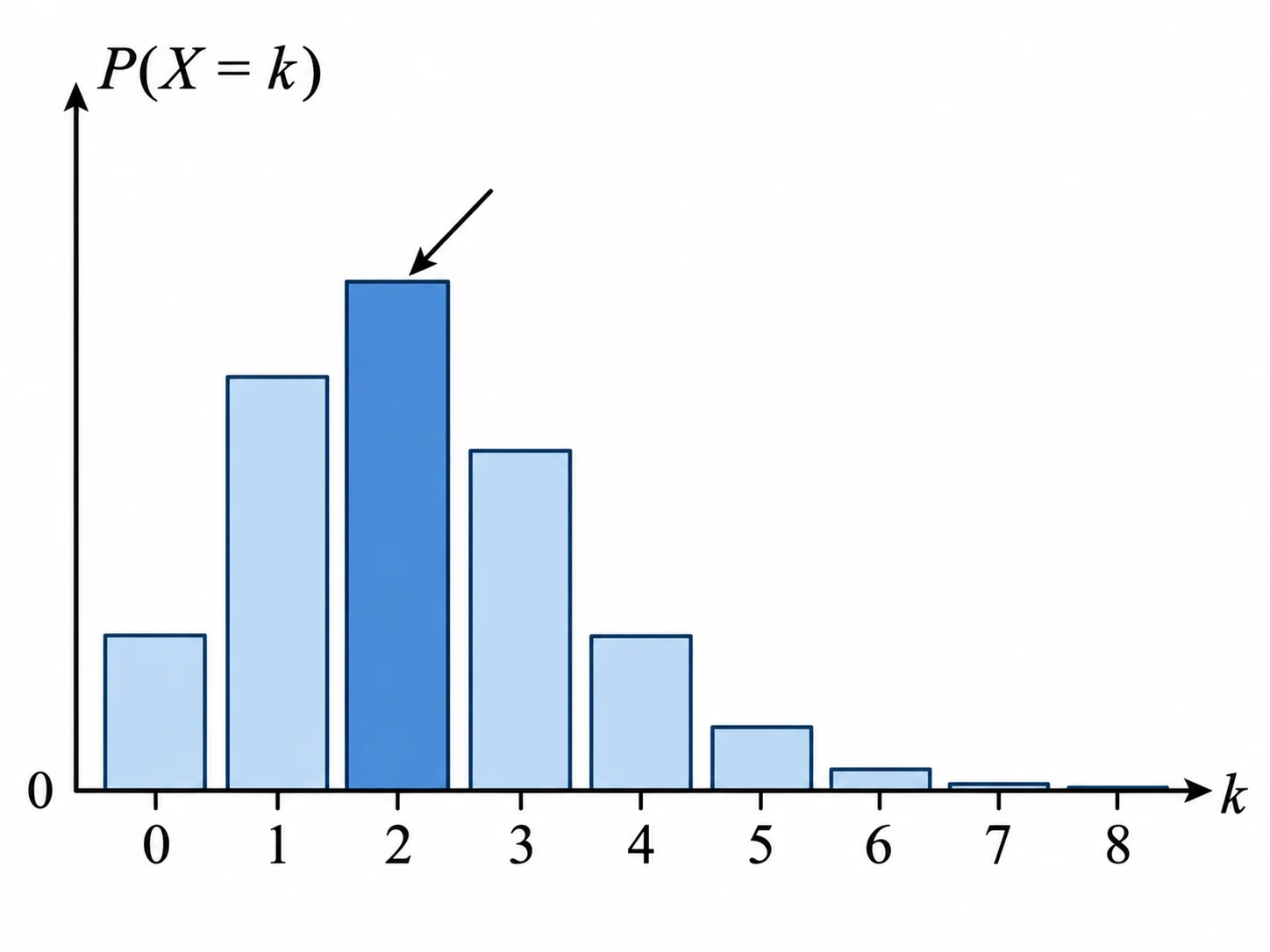
Each of independently inspected components has a probability of passing a demanding test. Find the probability that exactly components pass. Also determine the expected number of passes.
Show the solution
Let be the number passing. Independence and constant success probability justify .
-
Select , , and .
-
Calculate the number of possible success arrangements:
- Substitute into the probability formula:
- Compute the expected count:
Answer: and the expected number of passes is .
Common mistakes
Treating unequal trials as binomial
Check both independence and a constant success probability before using the formula.
Omitting the combinations term
Include when computing the probability of exactly successes.
Confusing at least with exactly
For , use rather than .
Using variance as standard deviation
Take the square root of to obtain standard deviation.
Check your understanding
1. If , what is ?
2. For , find .
3. Five independent trials each have success probability . What is the probability of at least one success?
Still not sure? Talk it through.
Waypoint Mentor's tutor explains this out loud, works through your own problems on a whiteboard, and checks you've got it. Free to start.