Probability rules and Bayes' theorem
Statistics · Senior school statistics · about 10 min
Probability lets us measure uncertainty and reason from incomplete information. The same event can have a different likelihood once new evidence is known. In exam questions, the main challenge is choosing the correct denominator and distinguishing an event from evidence about that event.
The key idea
Bayes' theorem reverses a conditional probability:
Here is the event of interest, is observed evidence, and . The numerator is the joint probability of and .
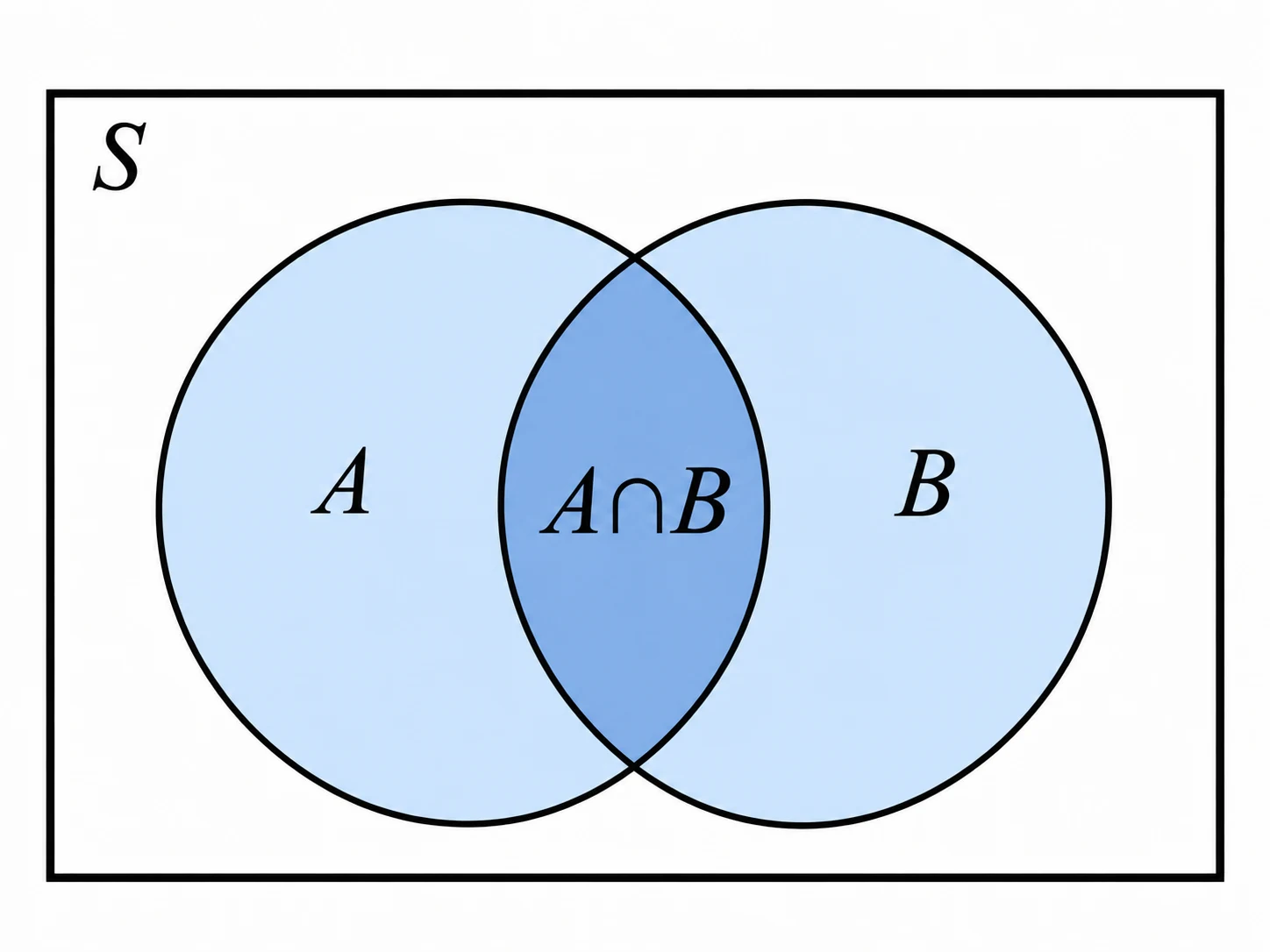
Addition and multiplication rules
For any events and , the addition rule is . Subtract the overlap so it is not counted twice. The multiplication rule is , provided . If events are independent, this becomes ; independence is an assumption to justify, not a default. Complements are often quicker: . When a question says at least one, calculate the probability of none and subtract it from one whenever that is simpler.
Conditional probability
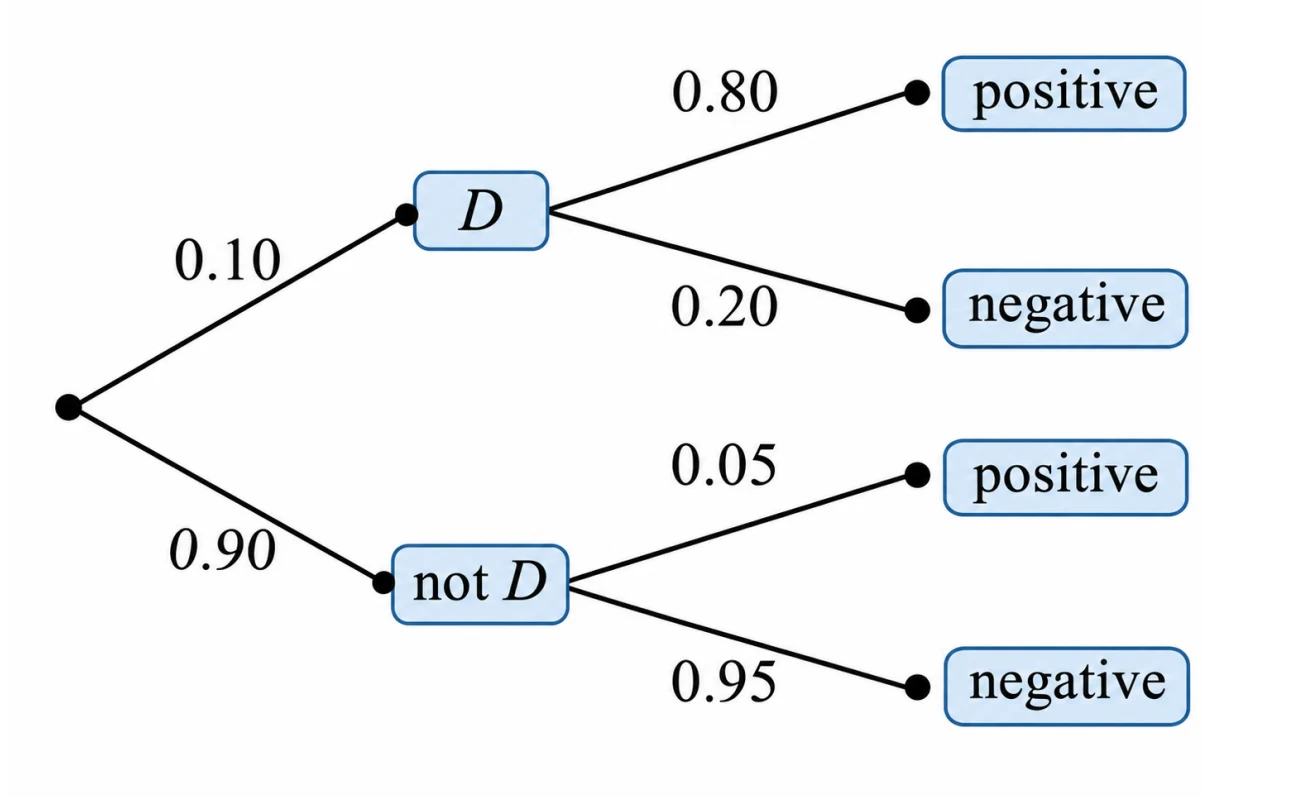
A conditional probability restricts the sample space to cases where the condition occurred. Formally, . Therefore need not equal . On a tree diagram, multiply probabilities along each path to obtain its joint probability, then add paths that lead to the same observed result. When a test returns a positive result, include both true positives and false positives in the denominator. The initial prevalence, sometimes called the prior probability, can make a large difference to the answer.
Using Bayes in an exam
Label the hypothesis and evidence before inserting numbers. First obtain the total probability of the evidence using for a two-case partition. Next divide the probability of the path containing both and by that total. A frequency table with a convenient total such as is an alternative to algebra and provides a useful check. Finally, interpret the posterior as a probability after observing the evidence, not the accuracy of the test in isolation.
Worked example: A positive screening result
In a large group, of items have a particular defect. A screening test is positive for of defective items and for of non-defective items. If a randomly selected item tests positive, find the probability that it is defective.
Show the solution
Let mean defective and mean a positive result. The data give , , and .
- Find the two positive-result paths:
- Add these paths to obtain the probability of a positive result:
- Apply Bayes' theorem:
Answer: of positive items are defective. As a check, among items there would be true positives and false positives, giving .
Common mistakes
Reversing the condition
Do not replace with . Write the desired probability first.
Ignoring false positives
Calculate the probability of every route to a positive result before forming the denominator.
Assuming independence
Only use the product of unconditional probabilities when independence is stated or justified.
Adding overlapping events without subtracting overlap
Use .
Check your understanding
1. Suppose , and . What is ?
2. Independent events satisfy and . Find .
3. If , what is ?
Still not sure? Talk it through.
Waypoint Mentor's tutor explains this out loud, works through your own problems on a whiteboard, and checks you've got it. Free to start.