Circular motion and centripetal force
Physics · Senior school physics · about 10 min
An object moving at constant speed around a bend is still accelerating because its velocity continually changes direction. The necessary acceleration points towards the centre of the circular path. Finding the force that produces this inward acceleration is the main skill in circular motion questions.
The key idea
For motion on a circle of radius , the net inward force is
Here is mass, is tangential speed and is radius. The corresponding inward acceleration is .
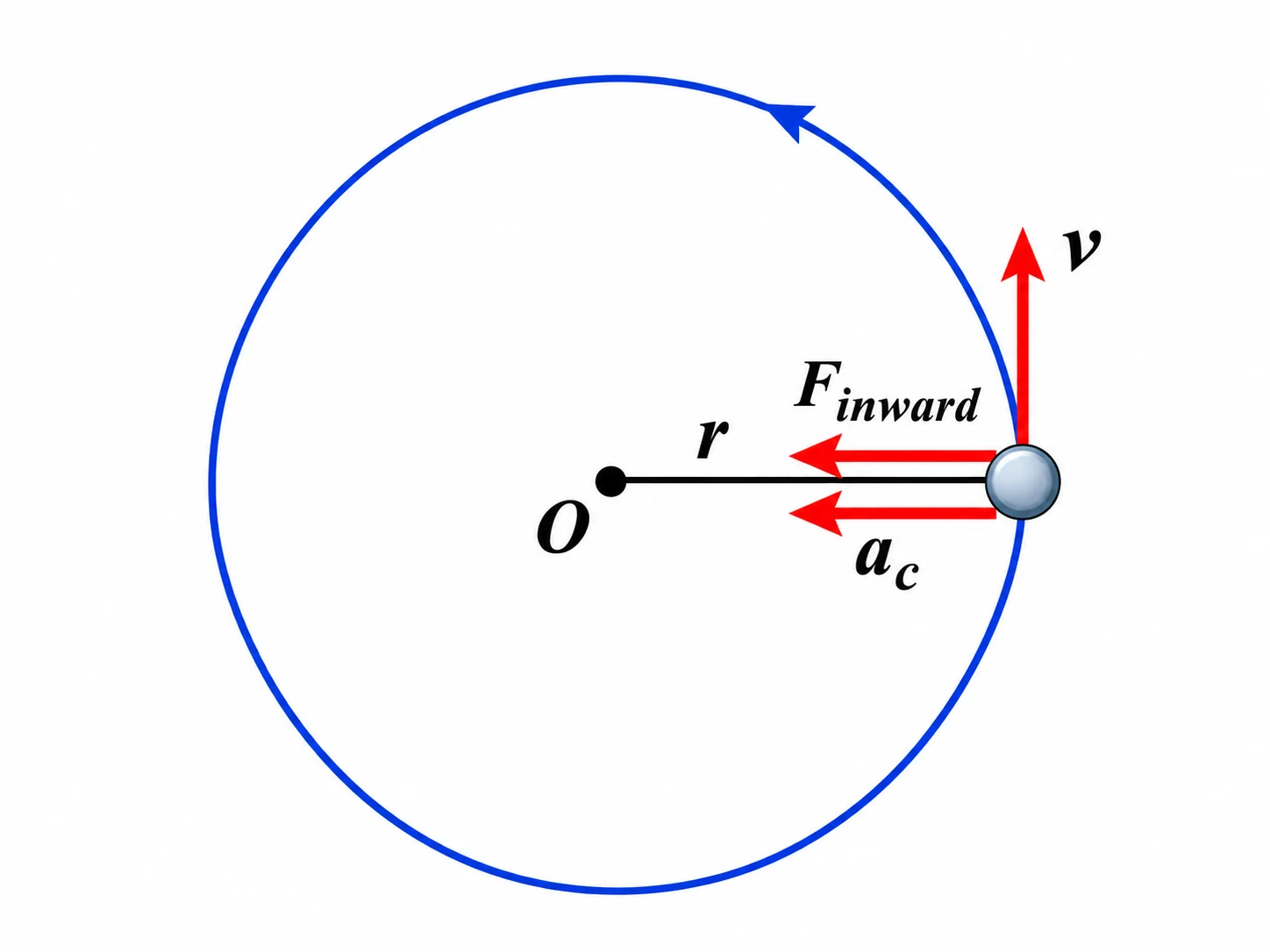
Velocity and acceleration directions
Instantaneous velocity is tangent to the circle, whereas centripetal acceleration points towards its centre. The directions are perpendicular in uniform circular motion. The speed may stay fixed even though the velocity vector changes. An inward acceleration of magnitude follows from the changing direction of velocity. On a force diagram, draw the actual forces first and resolve them towards the centre. A so-called outward centrifugal force is not an additional real force in an inertial frame. If the inward net force disappears, an object moves along its instantaneous tangent rather than continuing around the circle.
What supplies the inward force?
Centripetal force is the name for the resultant inward force, not a separate force to add to the diagram. Tyre-road friction can turn a car on a level road, tension can turn a ball attached to a string, and gravity can keep a satellite in orbit. For a level turn with negligible other horizontal forces, static friction must supply . If its available magnitude is smaller than this requirement, the assumed circular path cannot be maintained without slipping. Include forces in the radial equation according to their directions, and use a separate equation for vertical equilibrium if needed.
Speed, radius and period
One complete revolution covers a distance . If the period is , the speed is . Substitution gives . Be clear about which quantities stay constant in a comparison: at fixed radius, doubling speed requires four times the inward force; at fixed speed, doubling radius halves that force. If a question gives a diameter, halve it before using the radius in a formula. Keep speed in , radius in and force in .
Worked example: Car rounding a level bend
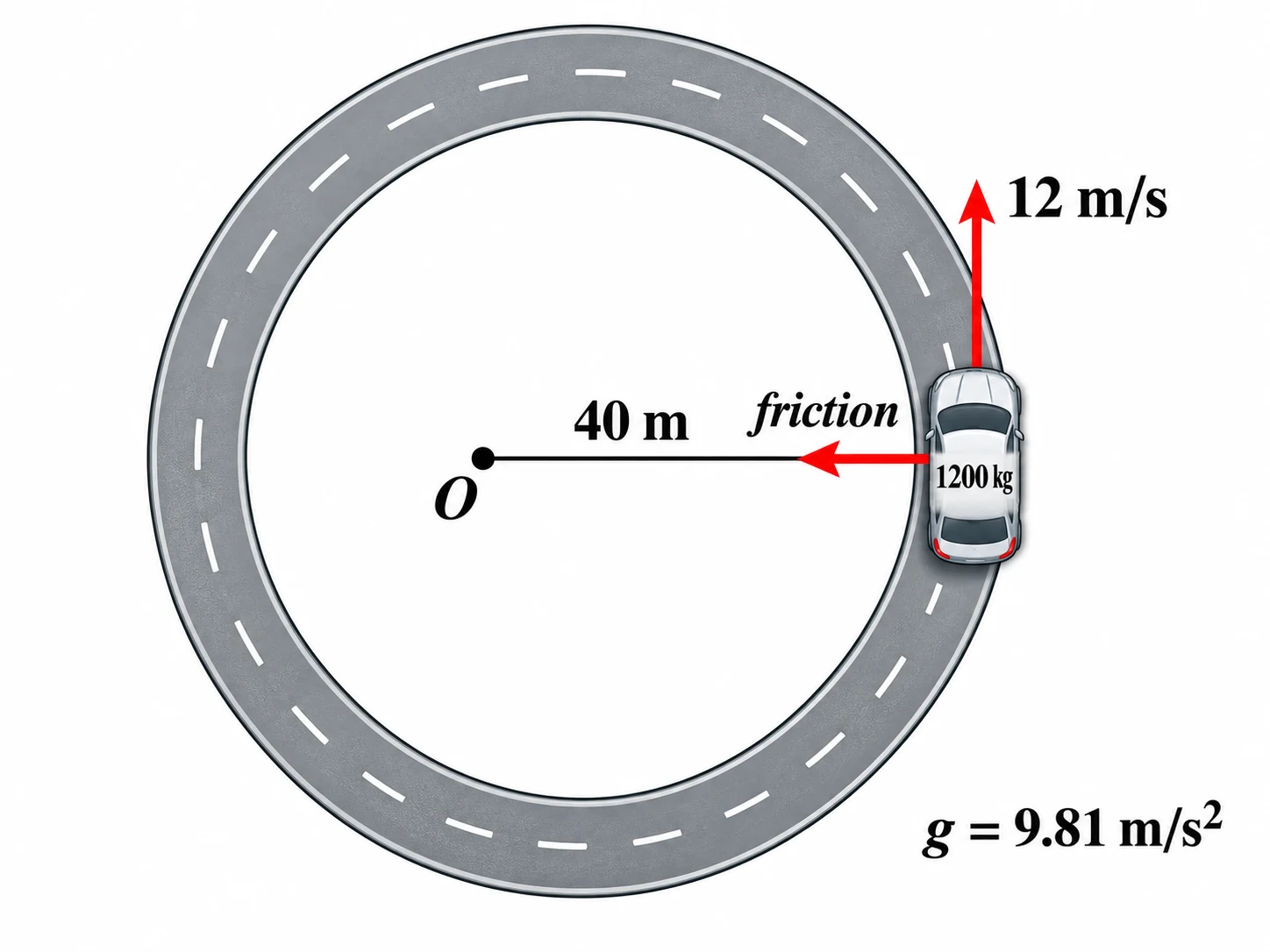
A car travels at a steady around a level circular bend of radius . Assume tyre-road static friction is the only horizontal force and take . Find the centripetal acceleration, the required friction force and the minimum coefficient of static friction for no slipping.
Show the solution
Step 1: Calculate the inward acceleration.
Step 2: Find the required horizontal force. Friction supplies the net inward force:
Step 3: Apply the maximum static friction condition. On the level road, and . At the threshold of slipping:
\mu_{s,\min}&=\frac{F_f}{mg}\\ &=\frac{4320}{(1200)(9.81)}\\ &=0.36697\ldots\approx0.367. \end{aligned}$$ **Answer: $a_c=3.6\,\mathrm{m/s^2}$ inward, $F_f=4320\,\mathrm{N}$ inward and $\mu_{s,\min}=0.367$.**Common mistakes
Drawing velocity towards the centre
Velocity is tangent to the circle; net radial force and centripetal acceleration point inward.
Adding centripetal force on top of friction or tension
Identify the real forces and set their net inward component equal to .
Using diameter where the equation requires radius
Convert diameter to radius first, then check the unit.
Assuming constant speed means zero acceleration
Remember that changing direction changes velocity, even at a constant speed.
Check your understanding
1. An cyclist turns at along a circle of radius . What is the required net inward force?
2. For the same mass and circular radius, how does the inward force change if speed doubles?
3. A object moves at on a circle of radius . What is its inward force?
Still not sure? Talk it through.
Waypoint Mentor's tutor explains this out loud, works through your own problems on a whiteboard, and checks you've got it. Free to start.