Simple harmonic motion and the pendulum
Physics · Senior school physics · about 10 min
A swinging pendulum provides a familiar model of oscillation. Near its equilibrium position, a small displacement produces a restoring acceleration directed back towards equilibrium. This leads to simple harmonic motion, a model that connects force, frequency, period and energy.
The key idea
For an ideal simple pendulum swinging through small angles,
Here is period, is the distance from the pivot to the bob's centre of mass and is gravitational acceleration. The angle must be small enough for the approximation to apply.
Try it yourself
Recognising simple harmonic motion
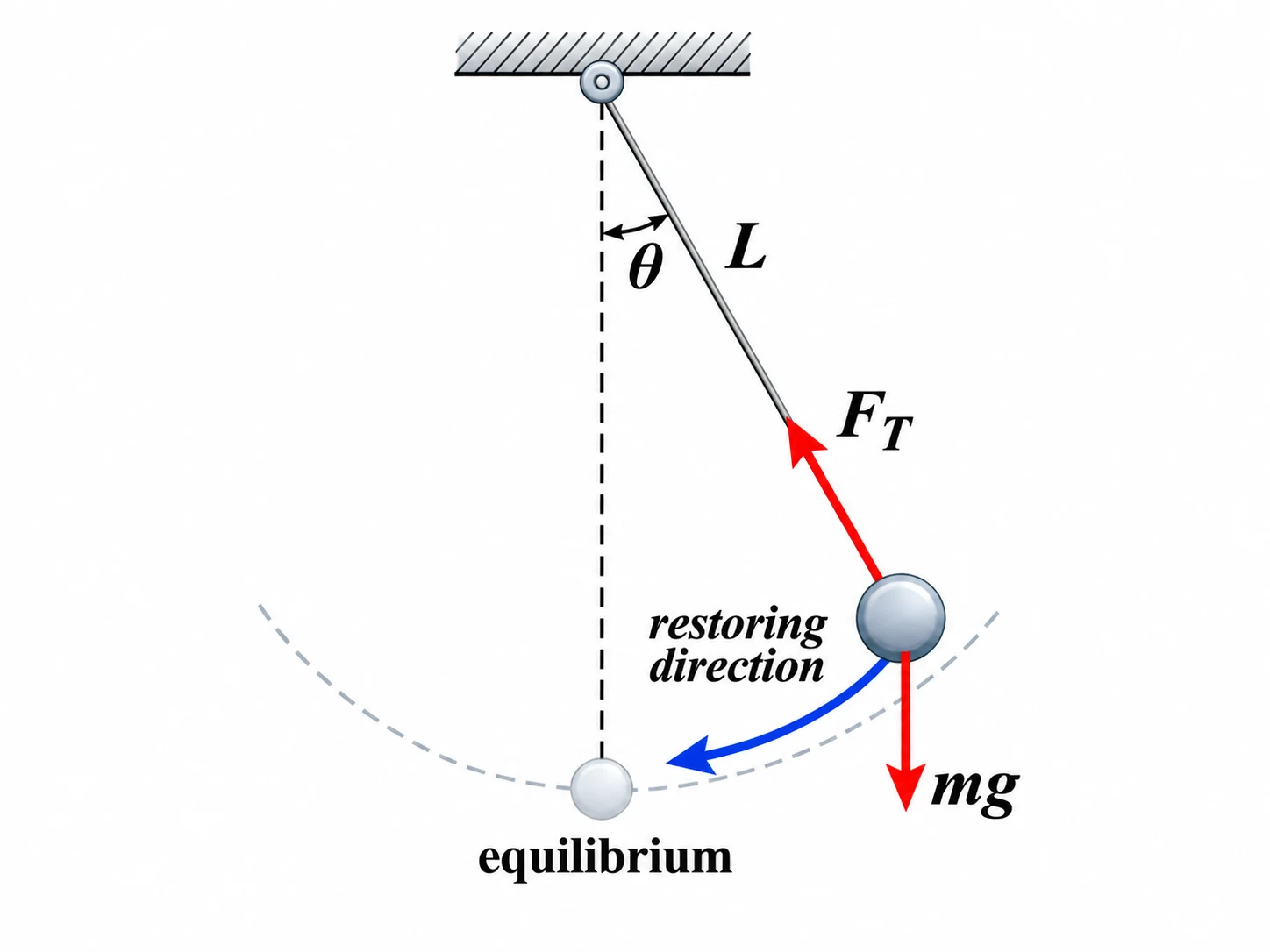
Simple harmonic motion occurs when the acceleration is proportional to displacement from equilibrium and directed towards it:
The negative sign represents the restoring direction. A sinusoidal displacement model is , where is amplitude, is angular frequency and is phase. The period and frequency satisfy and . At the turning points the speed is zero and the restoring acceleration has its greatest magnitude. At equilibrium the speed is greatest and the restoring acceleration is zero.
The small-angle pendulum
For a bob on a light string of length , gravity has a tangential component . For a small angular displacement measured in radians, . The rotational equation then becomes , which has the form of simple harmonic motion with . That is why the period depends on length and gravity, but not on the bob's mass. For large swings, the small-angle formula underestimates the true period. Air resistance and pivot friction gradually reduce the amplitude of a real pendulum.
Period, frequency and predictions
The period is the time for one complete back-and-forth cycle, not the time to travel from one extreme to the other. Frequency counts cycles per second and has units . To find the approximate number of cycles in a duration , use . Because at fixed gravity, making a pendulum four times longer doubles its period. A heavier bob does not change the ideal small-angle period. Always convert length to metres and use consistent SI units before evaluating the square root.
Worked example: Timing a small-angle pendulum
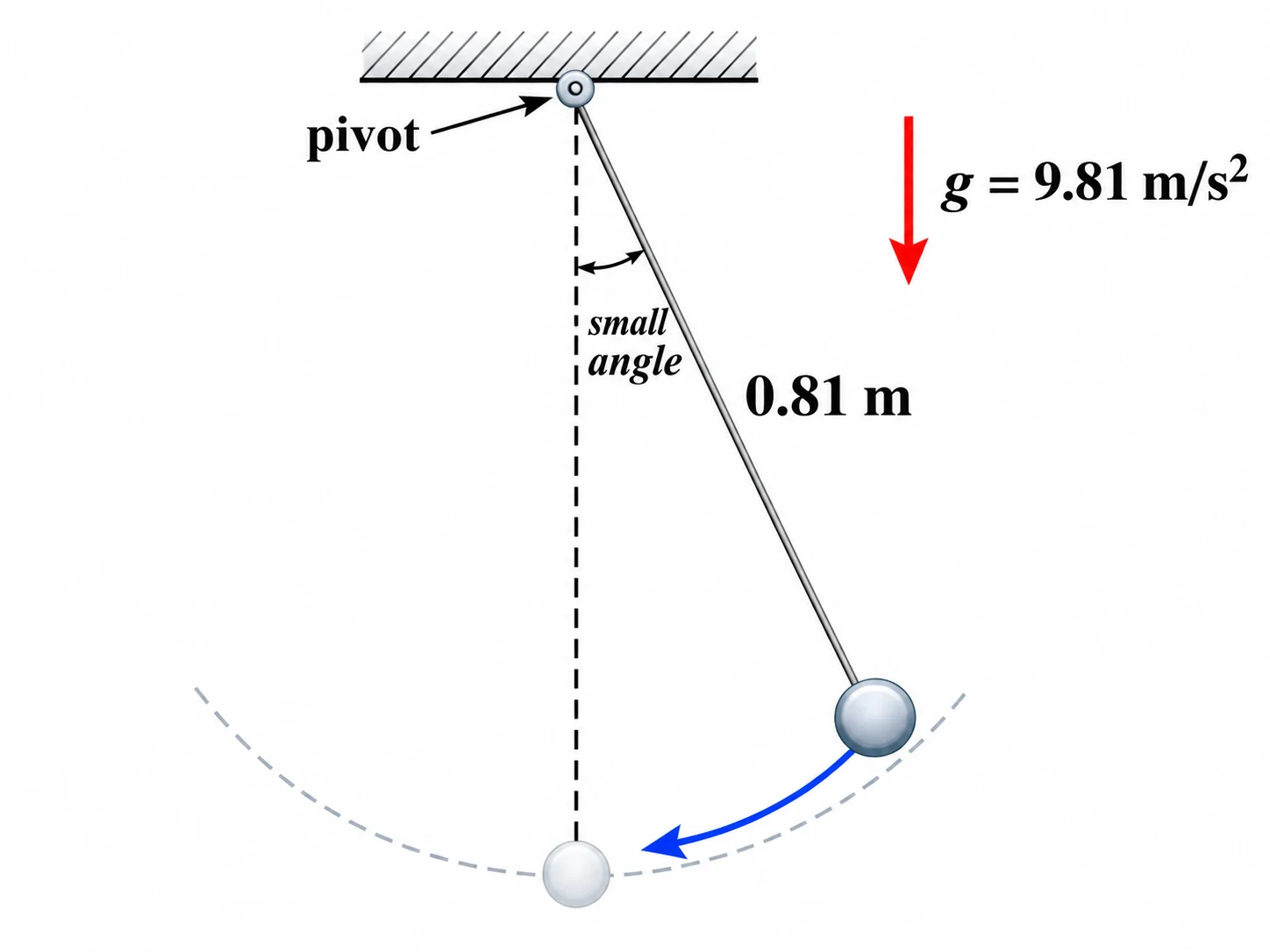
A simple pendulum has length and swings through a small angle. Take . Calculate its period, its frequency and approximately how many complete oscillations it performs in . Neglect damping.
Show the solution
Step 1: Calculate the period.
Step 2: Convert period to frequency. Use the unrounded period:
Step 3: Estimate the number of cycles.
Because only complete oscillations count, are completed within the stated time.
Answer: period , frequency and complete oscillations in .
Common mistakes
Treating a half-swing as a complete period
Measure the time to return to the same position while moving in the same direction.
Using pendulum mass in the ideal period equation
For small-angle motion, period depends on and , not on bob mass.
Using the approximation for very large swings
Use the small-angle formula only when in radians is justified.
Confusing angular frequency and ordinary frequency
Remember ; their units are and .
Check your understanding
1. At the same gravitational acceleration, what happens to the small-angle pendulum period when its length doubles?
2. An oscillator has a frequency of . What is its period?
3. A pendulum bob of mass is replaced by one of mass . Length and small amplitude stay the same. What happens to the period?
Still not sure? Talk it through.
Waypoint Mentor's tutor explains this out loud, works through your own problems on a whiteboard, and checks you've got it. Free to start.