Complex numbers
Mathematics · Senior school maths · about 10 min
Complex numbers extend ordinary real numbers by including a unit whose square is negative one. They allow equations without real solutions to be solved and make it easier to describe rotations, oscillations and electrical quantities. The two most useful views are algebraic form, which makes arithmetic straightforward, and the complex plane, which makes size and angle visible.
The key idea
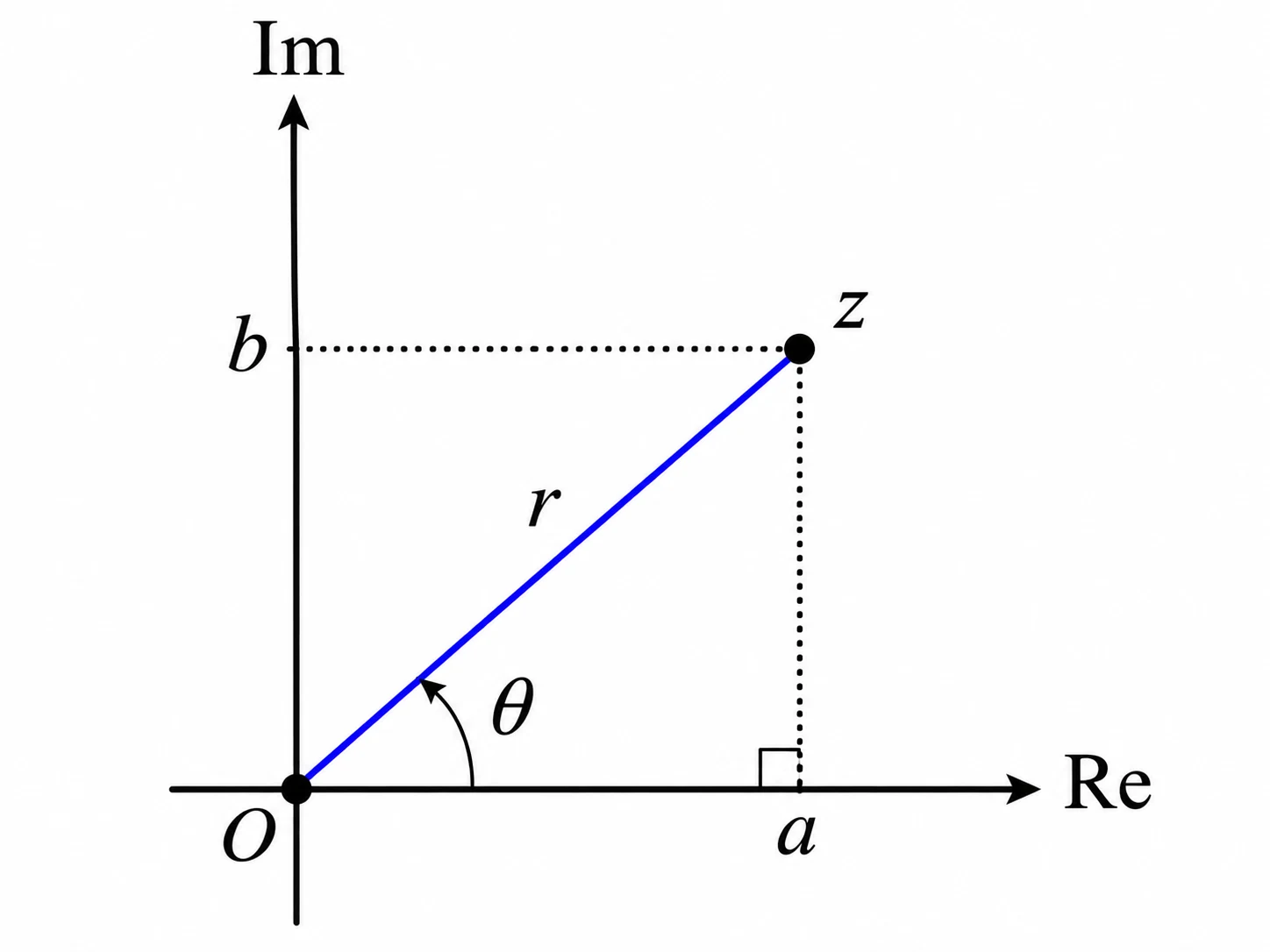
Write a complex number in Cartesian form as
Here is the real part, is the imaginary part, is the imaginary unit, and is the modulus.
Try it yourself
Calculate using algebra
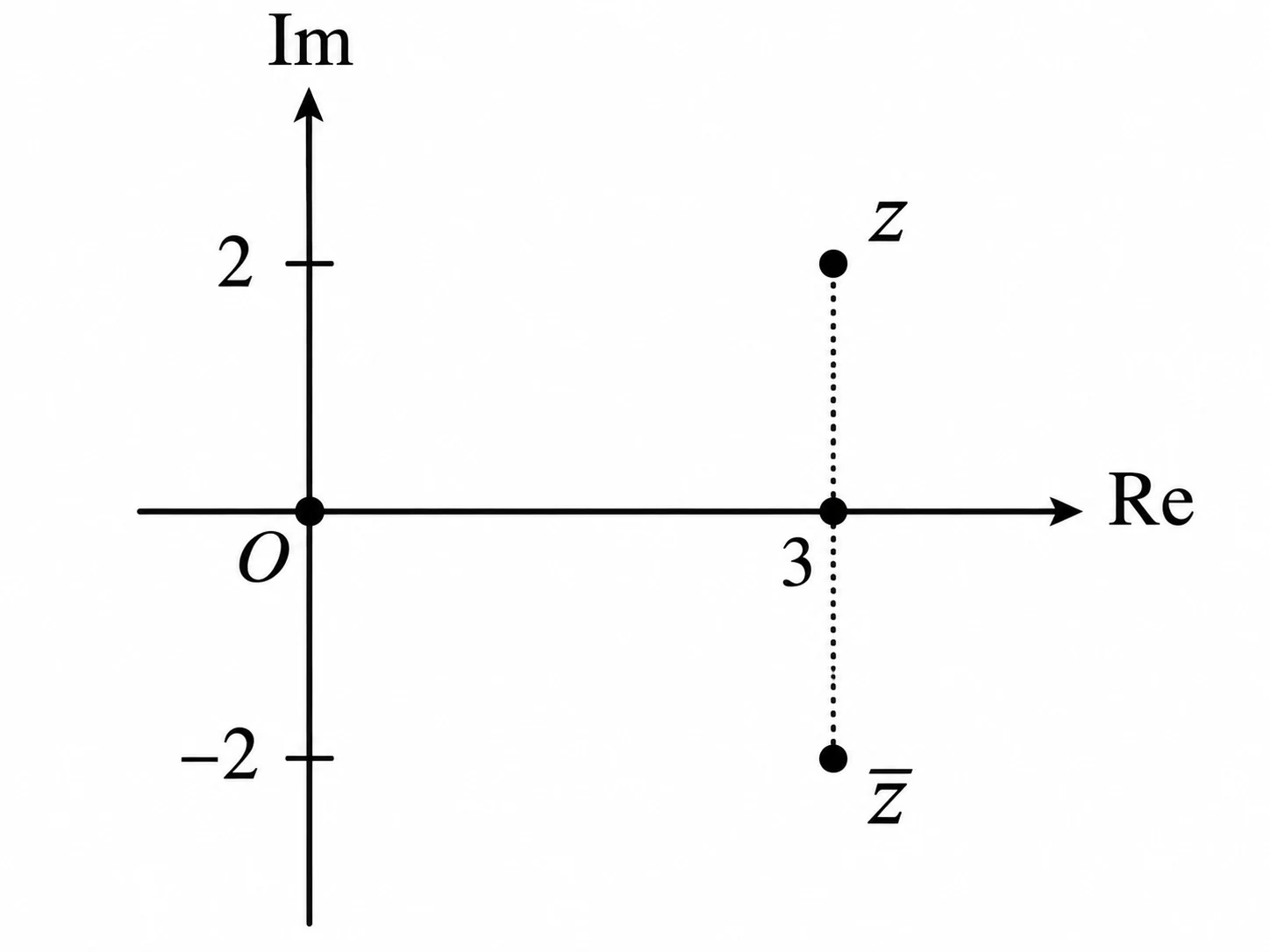
Add or subtract complex numbers by combining real parts and imaginary parts separately. Multiply by expanding brackets and replacing every with . The conjugate of is , which reflects the point across the real axis. Multiplying a number by its conjugate gives , a real value. To divide by , multiply the numerator and denominator by . The denominator becomes , so the result can be separated into its real and imaginary parts, provided the denominator is not zero.
Read the complex plane
Plot at coordinates , with the real axis horizontal and the imaginary axis vertical. The modulus is its distance from the origin. Its argument is the angle measured anticlockwise from the positive real axis. Determine the quadrant before using an inverse tangent: is a reliable calculator expression. A principal argument is commonly chosen in . Numbers in different quadrants can have the same ordinary tangent value but different arguments, so simply entering can produce a wrong angle.
Use polar form
For , write , where and . Polar form makes products easier: multiply moduli and add arguments. For quotients, divide moduli and subtract arguments. For integer powers, de Moivre's result gives . Angles that differ by an integer multiple of describe the same complex number. When a question requests the principal argument, convert the angle into the specified principal range. The number zero has modulus zero but no defined argument.
Worked example: Divide two complex numbers
Calculate in the form . Then find its modulus and its principal argument in radians.
Show the solution
- Use the conjugate of the denominator:
- Expand and simplify using :
- Modulus:
- Principal argument: The point is in quadrant II, so
Answer: , , and .
Common mistakes
Using when expanding brackets.
Replace every with before collecting terms.
Conjugating the numerator rather than the denominator during division.
Multiply both numerator and denominator by the conjugate of the denominator.
Using inverse tangent without checking the quadrant.
Plot the signs of the real and imaginary parts, or use .
Assigning an argument to the number zero.
Remember that the zero vector has no direction and therefore no defined argument.
Check your understanding
1. Calculate .
2. What is the modulus of ?
3. What is the principal argument of ?
Still not sure? Talk it through.
Waypoint Mentor's tutor explains this out loud, works through your own problems on a whiteboard, and checks you've got it. Free to start.