Vectors: dot and cross product
Mathematics · First-year university mathematics · about 10 min
A vector has magnitude and direction. The dot product combines two vectors into a scalar that tells you about their alignment. The cross product combines two vectors in three dimensions into a perpendicular vector. These operations appear in geometry, work, torque and many engineering calculations.
The key idea
For vectors and with angle between them,
The dot product is a scalar. The cross product is a vector perpendicular to both inputs.
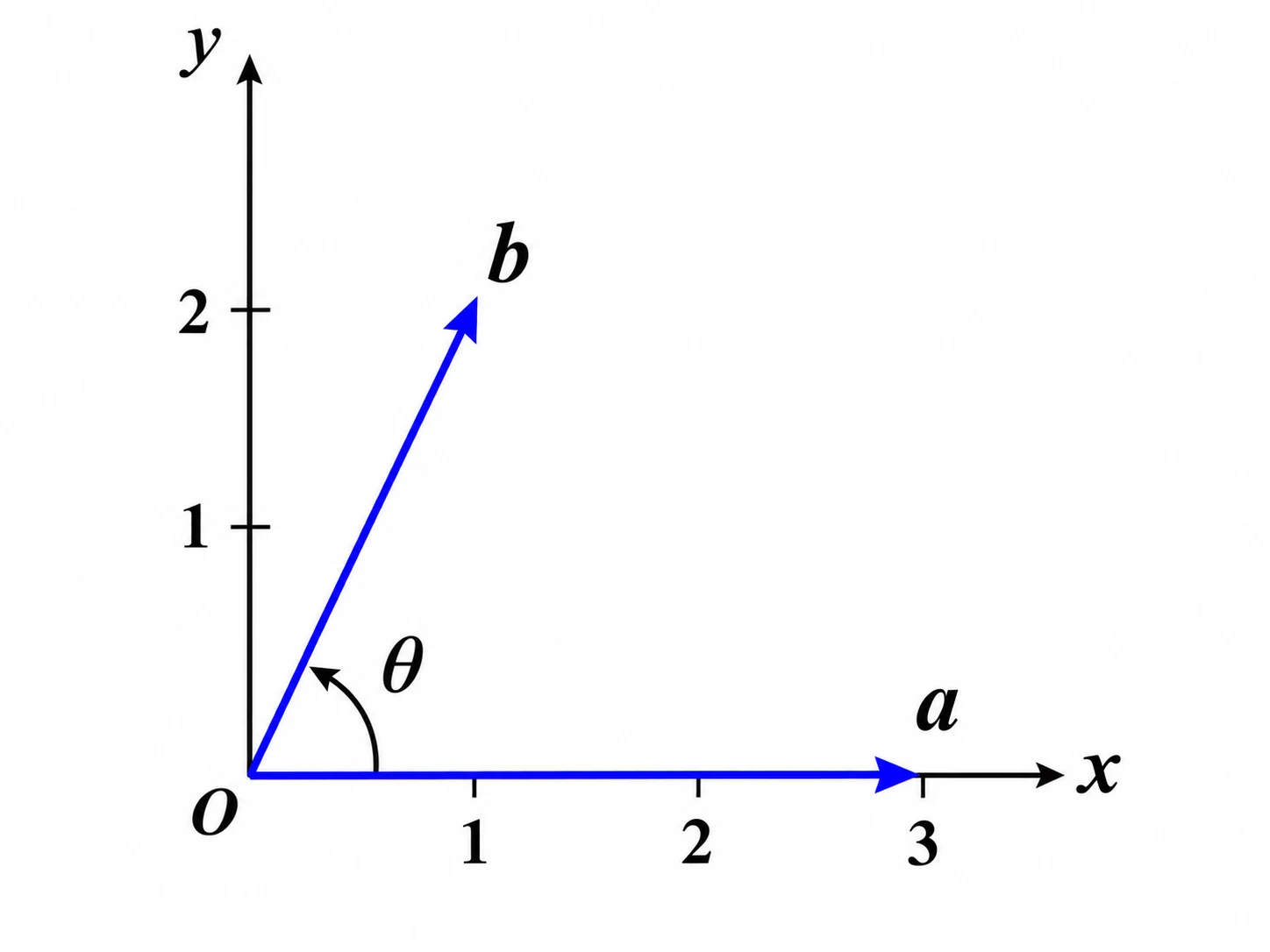
Try it yourself
Dot product and angles
For three-dimensional vectors and , calculate . To find the angle, rearrange to , provided neither vector is zero. A positive dot product means an acute angle, a negative result means an obtuse angle, and zero means perpendicular nonzero vectors. Magnitudes come from . The dot product also measures how strongly one vector points in the direction of another.
Cross product and direction
In three dimensions, . The resulting vector is perpendicular to both original vectors. Use the right-hand rule to determine its direction; reversing the order reverses the sign, so . Its magnitude is the area of the parallelogram formed by the two vectors. For parallel vectors this area is zero, so their cross product is the zero vector. Do not confuse the vector result with its magnitude.
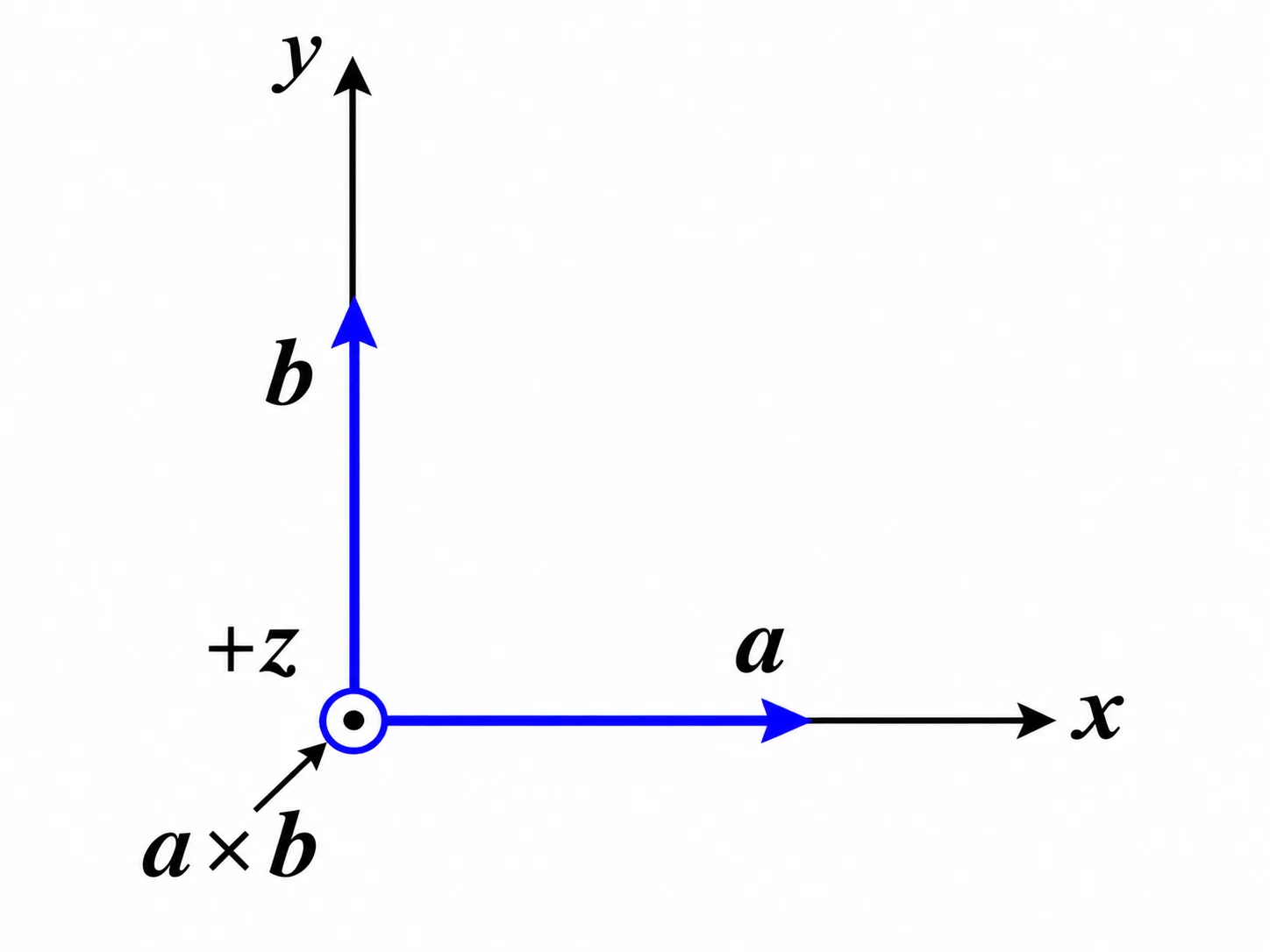
Choosing the right product
Use the dot product for an angle, a projection or a component of force along a displacement. For constant force, work is , a scalar. Use the cross product for a perpendicular direction, an oriented area or a moment such as . Check units as well as direction: if both vectors have length units, the dot product has units of area, and the cross-product magnitude also has units of area. The choice depends on what quantity the question asks for.
Worked example: Angle and perpendicular vector
Two vectors are and . Calculate their dot product, the angle between them to two decimal places, their cross product , and the magnitude of that cross product.
Show the solution
Step 1: Calculate the dot product.
Step 2: Calculate the angle. The magnitudes are
Therefore
Step 3: Form the cross product in component order.
Step 4: Find its magnitude and check.
As a check, .
Answers: dot product , angle , cross product , and magnitude .
Common mistakes
Treating the dot product as a vector.
Remember that adding pairwise component products produces one scalar.
Reversing the cross product without changing its sign.
Write the vector order explicitly and use the right-hand rule.
Forgetting to divide by both magnitudes when finding an angle.
Use .
Confusing a cross product with its magnitude.
Report three components for the vector, or a nonnegative number for its magnitude.
Check your understanding
1. Find .
2. Using right-handed unit vectors, what is ?
3. What is ?
Still not sure? Talk it through.
Waypoint Mentor's tutor explains this out loud, works through your own problems on a whiteboard, and checks you've got it. Free to start.