Matrices and determinants
Mathematics · First-year university mathematics · about 10 min
Matrices organise numbers so that several linear relationships can be handled together. They describe systems of equations and transformations of vectors. The determinant helps you tell whether a square matrix has an inverse and how a transformation changes area.
The key idea
For a matrix,
If , then is invertible and .
Try it yourself
Matrix multiplication
A matrix times a vector combines each row of the matrix with the vector's entries. For example, . For two matrices, each entry in the product is a row-by-column dot product. The inner dimensions must agree: an matrix can multiply an matrix, producing an matrix. In general, reversing the order changes the result, so need not equal . Check dimensions before doing any arithmetic.
Determinants and invertibility
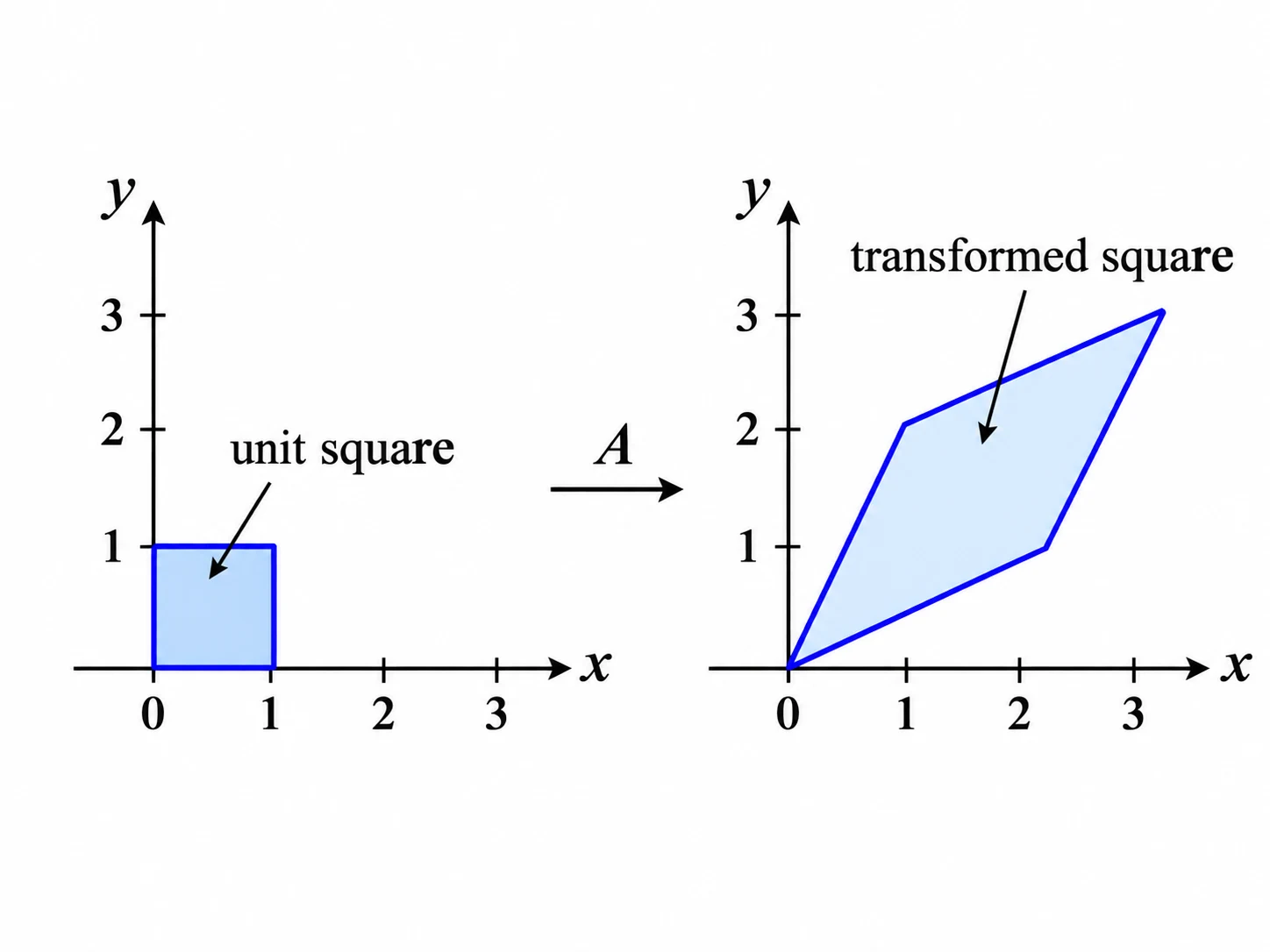
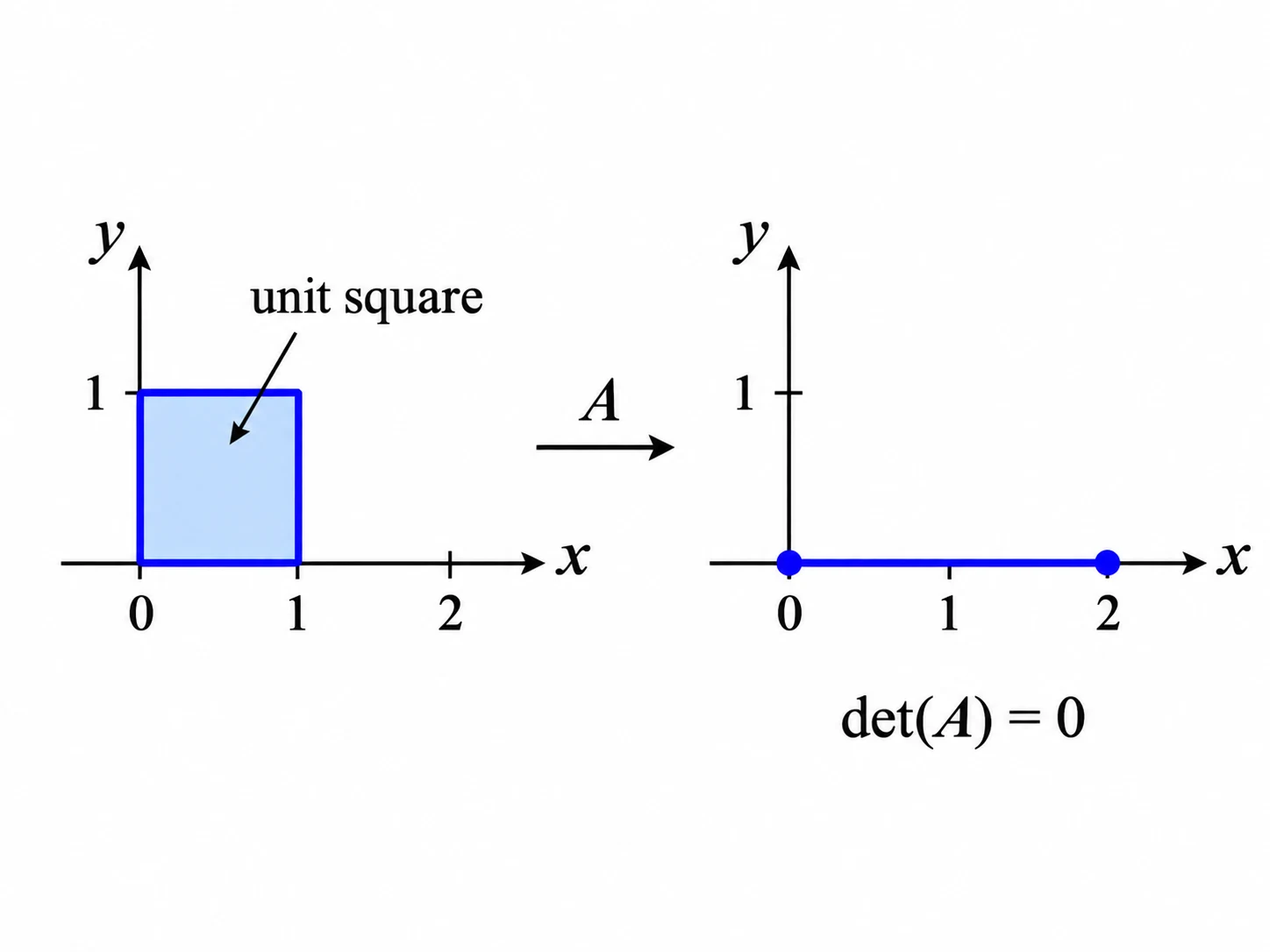
For , the determinant is , not . The absolute determinant is the factor by which the associated two-dimensional transformation changes area. If the determinant is negative, orientation reverses. If it is zero, a square or parallelogram can collapse onto a line or point. The transformation then loses information and the matrix has no inverse. For a nonzero determinant, the standard inverse swaps the diagonal entries, negates the off-diagonal entries and divides by the determinant.
Solving simultaneous equations
Write two linear equations in the form , with the unknowns in a column vector. If is invertible, multiply on the left by to obtain . For larger problems, row reduction is often more efficient than finding an inverse, but the underlying idea is the same. Always check a solution by substituting it back into the original equations. When , the inverse method does not apply; the system may have no solution or infinitely many solutions.
Worked example: Two unknown flow rates
Two unknown flow rates and , each measured in , satisfy
Write the system in matrix form, use the inverse of the coefficient matrix to solve it, and verify both equations.
Show the solution
Step 1: Write the matrix equation.
Step 2: Check invertibility.
Thus an inverse exists:
Step 3: Multiply by the right-hand side.
Step 4: Verify. and , so both original equations hold.
Answers: and .
Common mistakes
Multiplying matrices entry by entry.
Use a row-by-column dot product and check dimensions first.
Calculating the determinant as .
For a matrix, multiply the main diagonal and subtract the other diagonal: .
Using the inverse formula when the determinant is zero.
Check before dividing by it.
Forgetting the order when multiplying by an inverse.
Solve with on the left, then verify the equations.
Check your understanding
1. Find .
2. Find .
3. What does a zero determinant tell you about a square matrix?
Still not sure? Talk it through.
Waypoint Mentor's tutor explains this out loud, works through your own problems on a whiteboard, and checks you've got it. Free to start.