Derivatives and the chain rule
Mathematics · Senior school calculus and first-year maths · about 12 min
A derivative measures how fast something changes: the gradient of a curve at a point, the speed of a moving object, the rate a tank fills. The chain rule is what lets you differentiate functions built from other functions, which is most of them.
The key idea
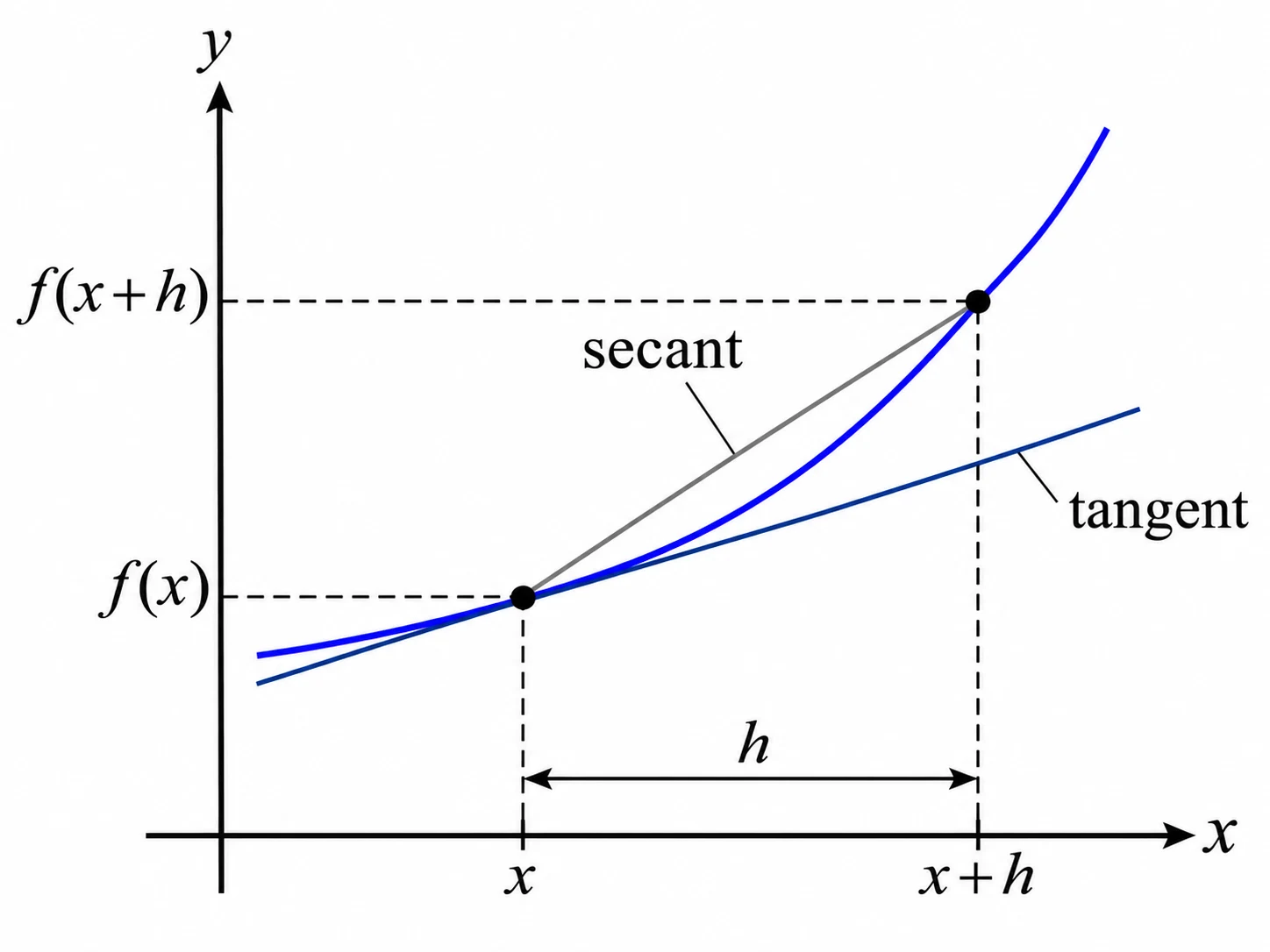
The derivative is the limit of the gradient over a shrinking interval:
and the chain rule for a function of a function is
Try it yourself
The rules you'll use most
| Function | Derivative |
|---|---|
Plus: constants multiply through, and the derivative of a sum is the sum of the derivatives.
Using the chain rule
Spot the inside function and the outside function . Differentiate the outside, leaving the inside alone, then multiply by the derivative of the inside.
For : outside , inside , so
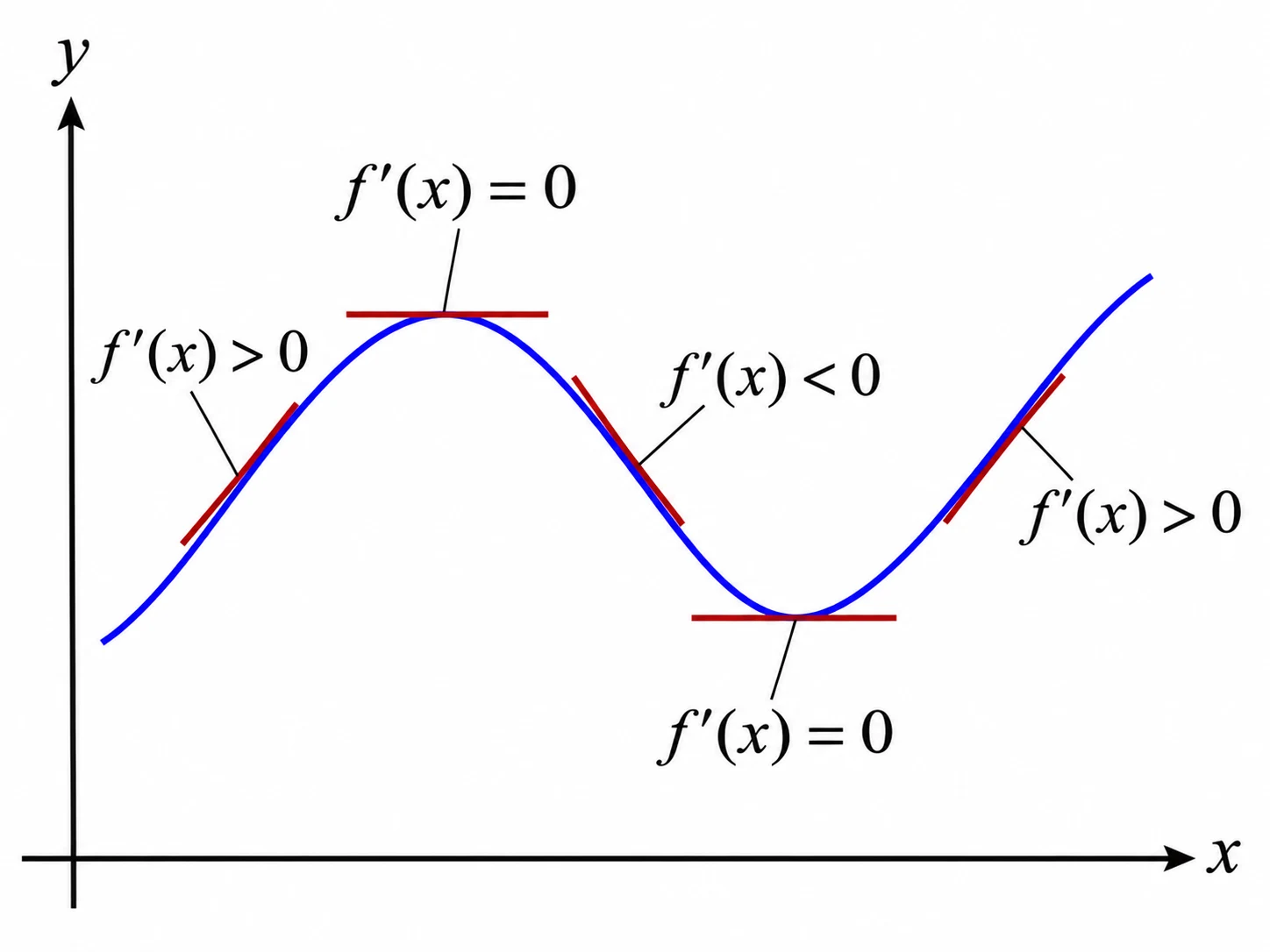
What the answer means
- : the function is increasing there.
- : it's decreasing.
- : a stationary point, possibly a maximum or minimum.
In physics, the derivative of position is velocity, and the derivative of velocity is acceleration.
Worked example: a power of a bracket
Differentiate , and find the gradient at .
Show the solution
Outside: , with derivative . Inside: , with derivative .
At :
Common mistakes
Forgetting to multiply by the inside's derivative
is not ; you still need the .
Differentiating the inside before the outside
Differentiate the outer function first with the inside left untouched, then multiply by the inside's derivative.
Treating like
, whose derivative is . That's a different function from .
Check your understanding
1. What is ?
2. What is ?
3. At a point where , the graph of is...
Still not sure? Talk it through.
Waypoint Mentor's tutor explains this out loud, works through your own problems on a whiteboard, and checks you've got it. Free to start.