Free body diagrams
Engineering · First-year engineering · about 10 min
A free body diagram (FBD) is a sketch of one object with every external force acting on it. It turns a complicated scene into a small set of force equations. A reliable FBD is the first step in questions about supports, ropes, friction and acceleration.
The key idea
For one isolated body, the vector sum of the external forces is
Here denotes force, is mass and is acceleration. Resolve the equation along independent axes, usually and .
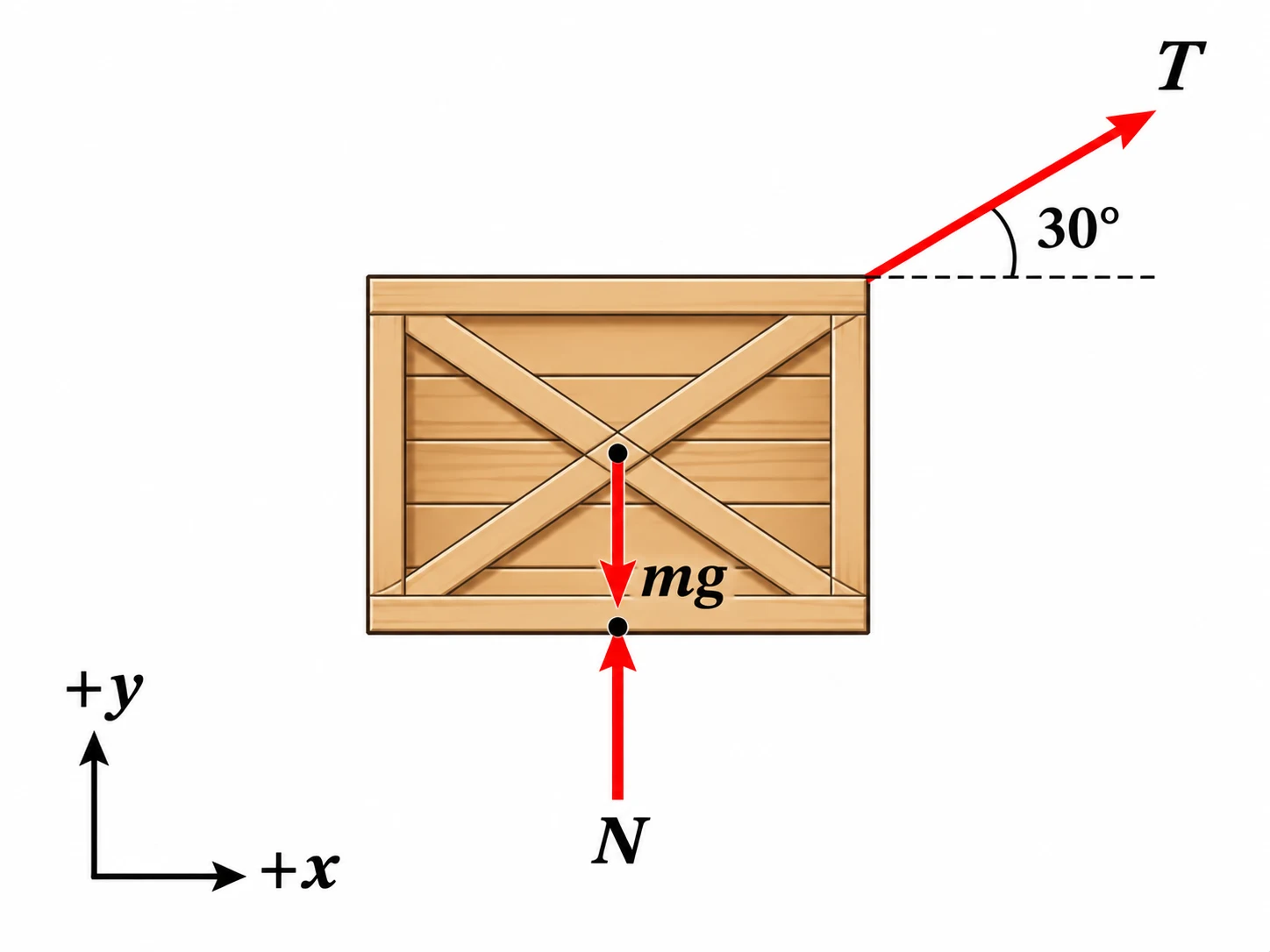
Try it yourself
Isolate the object
Sketch the object alone, replacing each contact with the force that contact exerts on the object. Gravity acts vertically down with magnitude . A rope pulls along its length, away from the object. A smooth surface exerts a normal force perpendicular to the surface. Friction, when present, lies along the contact and opposes relative motion or the tendency to slip. Put forces at their relevant contact points if rotation matters; for particle-like translation problems, their directions and magnitudes are the priority. Do not add a force that the object exerts on something else.
Resolve forces into components
Choose axes and mark their positive directions before writing equations. If a pull makes an angle above the positive horizontal, its components are and . Components pointing against a chosen axis are negative. Add all components algebraically, rather than adding the magnitudes of slanted forces. For instance, a vertical force cannot directly change horizontal acceleration, although it can change the normal force and therefore the available friction. An FBD should contain the original forces; component arrows can be shown separately if they improve clarity.
Apply the motion condition
For a body at rest or moving with constant velocity, , so and . For an accelerating body, use the measured or unknown acceleration in along each axis. If a crate stays in contact with a horizontal floor, its vertical acceleration is zero even when it accelerates horizontally. The normal reaction is whatever the vertical balance requires, provided it stays non-negative. It is not automatically equal to , particularly when another force has a vertical component.
Worked example: A crate pulled by an angled rope
A crate is pulled across a smooth horizontal floor by a rope at above the horizontal. The crate remains on the floor. Take . Find its horizontal acceleration and the floor's normal reaction.
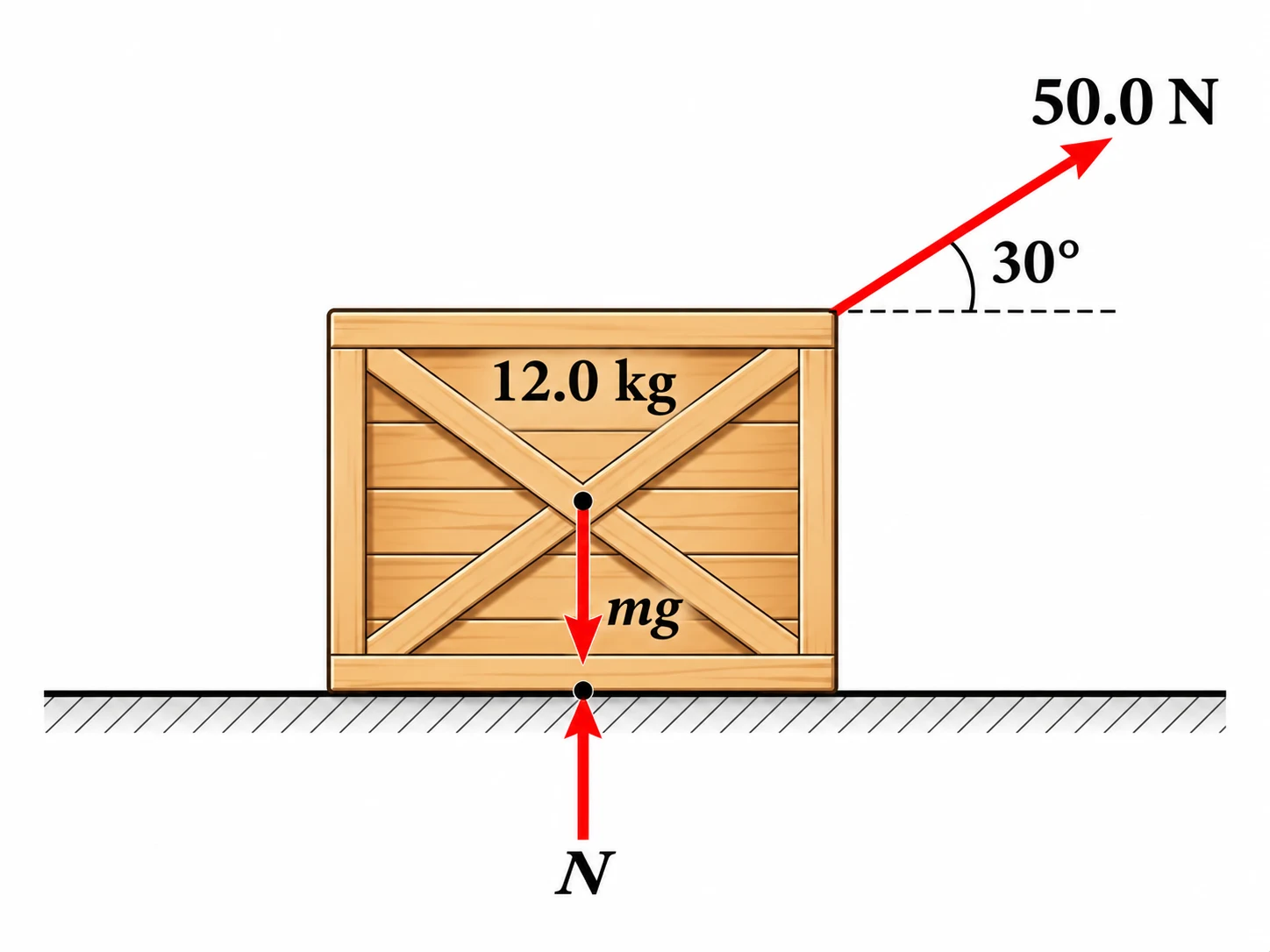
Show the solution
Choose right and up. The floor is smooth, so friction is zero.
- The downward weight is
- Resolve the rope force:
- Use horizontal Newton's second law:
- As the crate has no vertical acceleration,
Answer: to the right and upward.
Common mistakes
Drawing forces exerted by the object on other objects
Keep only forces acting on the isolated object. Reaction partners belong on another FBD.
Treating a slanted rope force as entirely horizontal
Resolve it into horizontal and vertical components using the stated angle.
Setting the normal reaction equal to weight without checking
Write the vertical force equation first. Vertical pulls can reduce the normal force.
Using equilibrium equations for an accelerating object
Use and set a component to zero only when acceleration in that direction is zero.
Check your understanding
1. What is the weight of a object when ?
2. A crate remains stationary while a horizontal push acts to the right. What horizontal static-friction force acts on it?
3. Two forces of right and up act on a particle. What is the resultant magnitude?
Still not sure? Talk it through.
Waypoint Mentor's tutor explains this out loud, works through your own problems on a whiteboard, and checks you've got it. Free to start.