Hydrostatic pressure and buoyancy
Engineering · Second-year university engineering · about 10 min
A liquid at rest pushes on surfaces because of its pressure, and that pressure increases with depth. The same pressure variation produces an upward force on submerged objects. Understanding both effects helps you analyse tanks, gates, floats and equipment placed in water.
The key idea
For a stationary liquid of uniform density, the gauge pressure at vertical depth below a free surface is
Here is pressure above surface pressure, is fluid density, is gravitational acceleration and is measured vertically downwards.
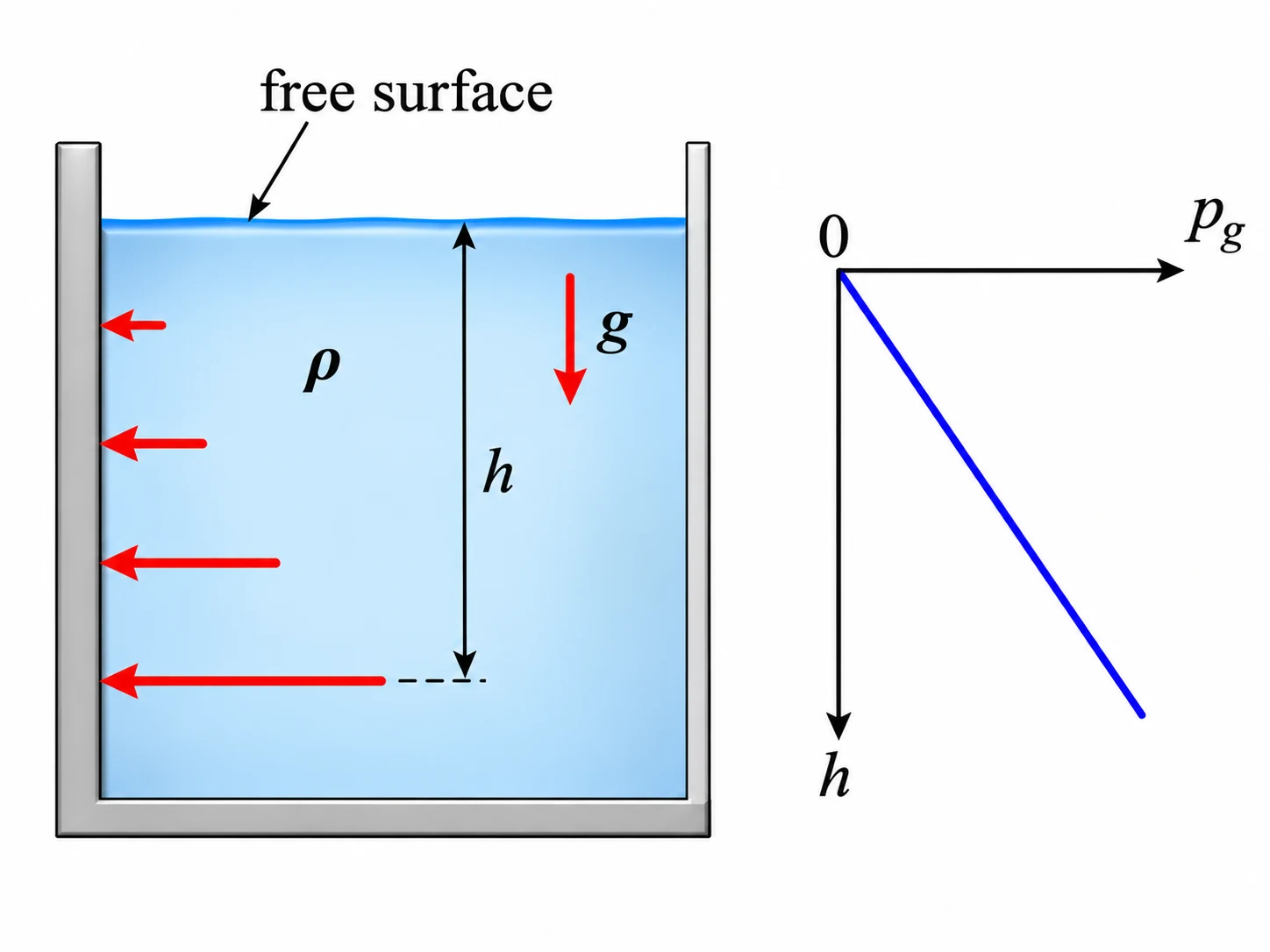
Pressure at a specified depth
A static fluid applies pressure perpendicular to any small surface element. In a liquid of constant density, pressure increases linearly with vertical depth: , where is the pressure at the free surface. If the surface is open to the atmosphere, measures gauge pressure and gives absolute pressure. At the same horizontal level within one connected stationary liquid, pressures are equal. Do not use the sloping distance along an inclined wall in place of vertical depth.
Why a body experiences buoyancy
Pressure on a submerged object's lower surface is generally greater than on its upper surface, producing a net upward pressure force. Archimedes' principle gives , where is the volume of fluid displaced and is the fluid density. For a fully submerged solid, displaced volume equals its outside volume. For a floating body, only the submerged portion displaces liquid. Buoyancy depends on displaced fluid weight rather than directly on the object's own weight.
Floating, sinking and force balance
Take upwards as positive for a vertical force balance: if no other vertical forces act. An unrestrained object in equilibrium floats when buoyancy equals its weight; a denser-than-water object may sink if its weight exceeds the maximum buoyancy available from its full volume. For a flat vertical gate, remember that fluid pressure changes across its height, so the pressure force must be integrated or found using the appropriate area and centroid depth. A single pressure value at a point is not automatically the total pressure force on a large surface.
Worked example: A fully submerged rectangular block
A solid rectangular block measuring is fully submerged in fresh water. Its centre is vertically below the open free surface. The block weighs . Take water density as and . Find the gauge pressure at its centre, the buoyancy force, and the net vertical force if no other forces act.
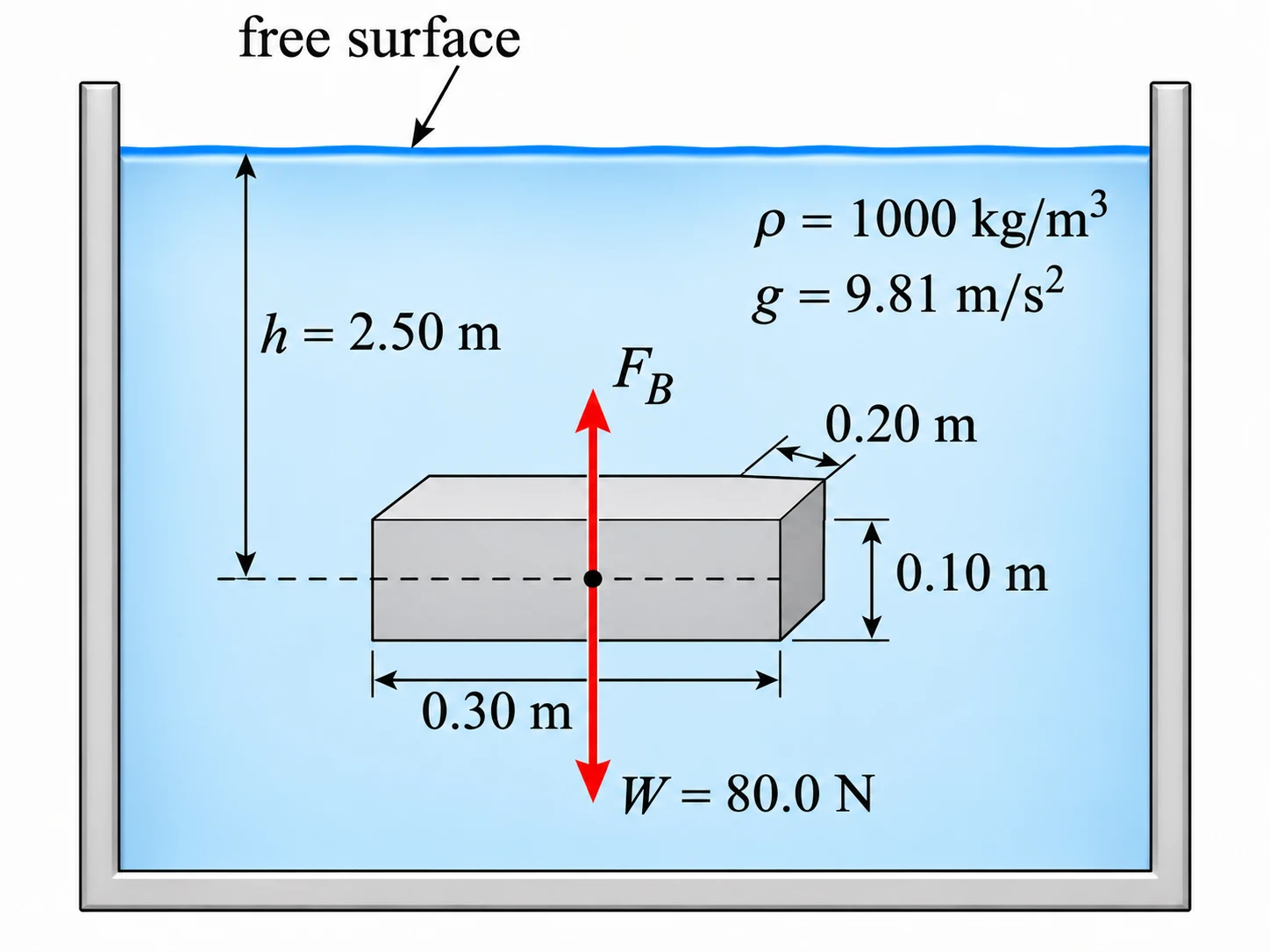
Show the solution
1. Calculate gauge pressure at the centre.
2. Find the displaced water volume. The block is fully submerged.
3. Calculate the buoyancy force.
4. Apply a vertical force balance, taking upwards as positive.
Answer: at the centre, upwards and downwards.
Common mistakes
Measuring depth along a sloping surface.
Use vertical distance below the reference free surface.
Adding atmospheric pressure when a gauge pressure is requested.
Use for gauge pressure and add surface pressure only for absolute pressure.
Using the solid density in the buoyancy equation.
Buoyancy uses displaced fluid density , not object density.
Using the whole object volume when it is only partially submerged.
Use the immersed volume to determine displaced fluid weight.
Check your understanding
1. What is the gauge pressure at depth in water with and ?
2. A submerged object displaces of fresh water. What buoyancy force acts if and ?
3. An object floats freely in equilibrium and weighs . What is the buoyancy force?
Still not sure? Talk it through.
Waypoint Mentor's tutor explains this out loud, works through your own problems on a whiteboard, and checks you've got it. Free to start.