Integration by substitution and by parts
Mathematics · First-year university mathematics · about 11 min
Many integrals cannot be evaluated by applying a basic antiderivative rule straight away. Substitution handles a function nested inside another function, while integration by parts handles certain products. Learning to recognise the structure is usually more important than memorising extra formulas.
The key idea
These two methods reverse familiar differentiation rules:
Substitution reverses the chain rule. Integration by parts reverses the product rule.
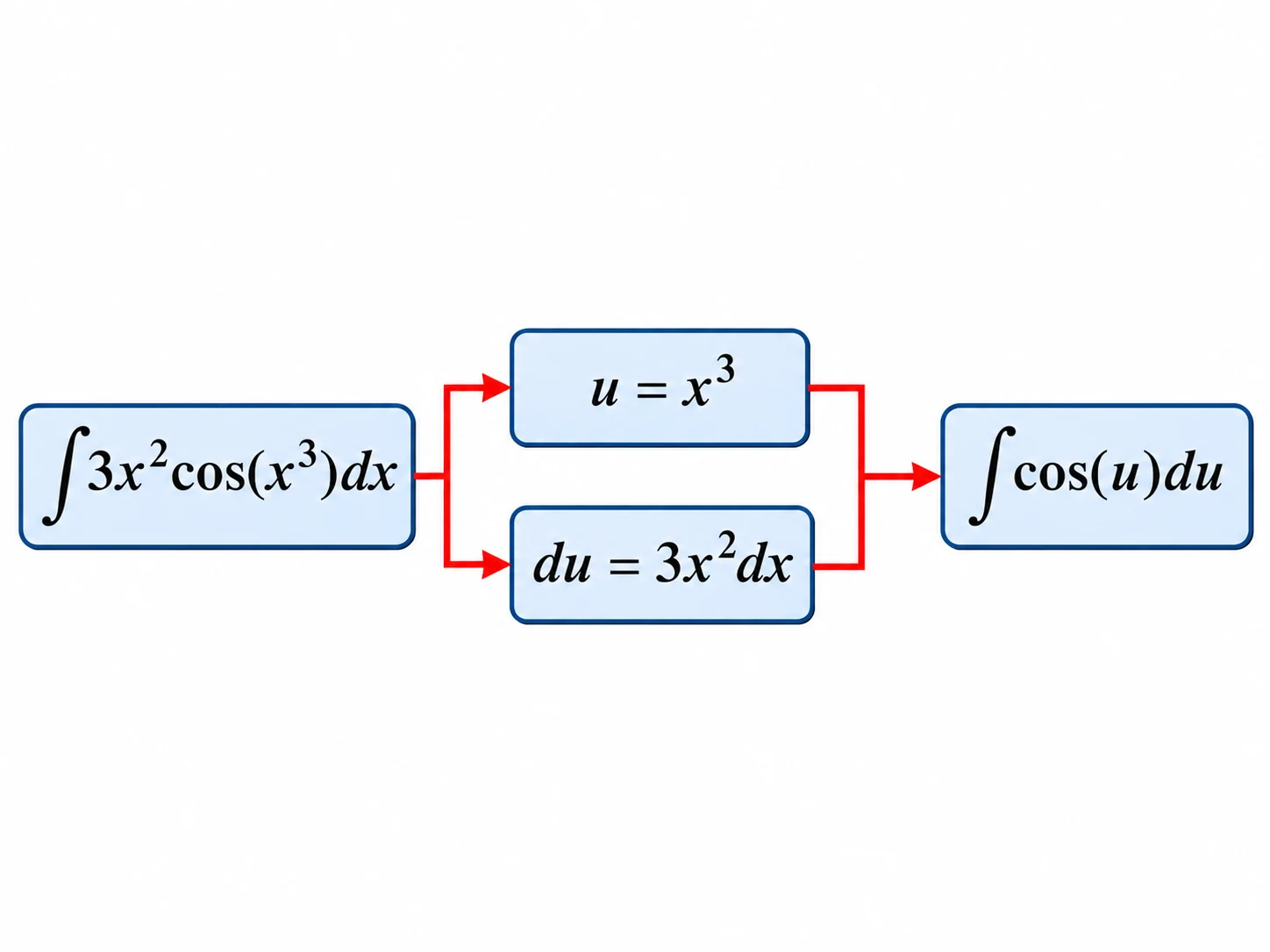
Substitution
Look for an inner expression whose derivative also appears as a factor. Set and replace all parts of the integral, including , using . For example, in , choose to obtain . Then substitute back. For definite integrals, either change the bounds to values immediately or return to before inserting the original bounds. Never mix bounds with a antiderivative.
Integration by parts
Use integration by parts when multiplying two functions makes direct integration difficult. Choose as the factor that becomes simpler when differentiated, and as the part you can integrate. Compute and , then apply . A common choice in is and , giving . The result is . With definite integrals, evaluate the boundary term and the remaining definite integral.
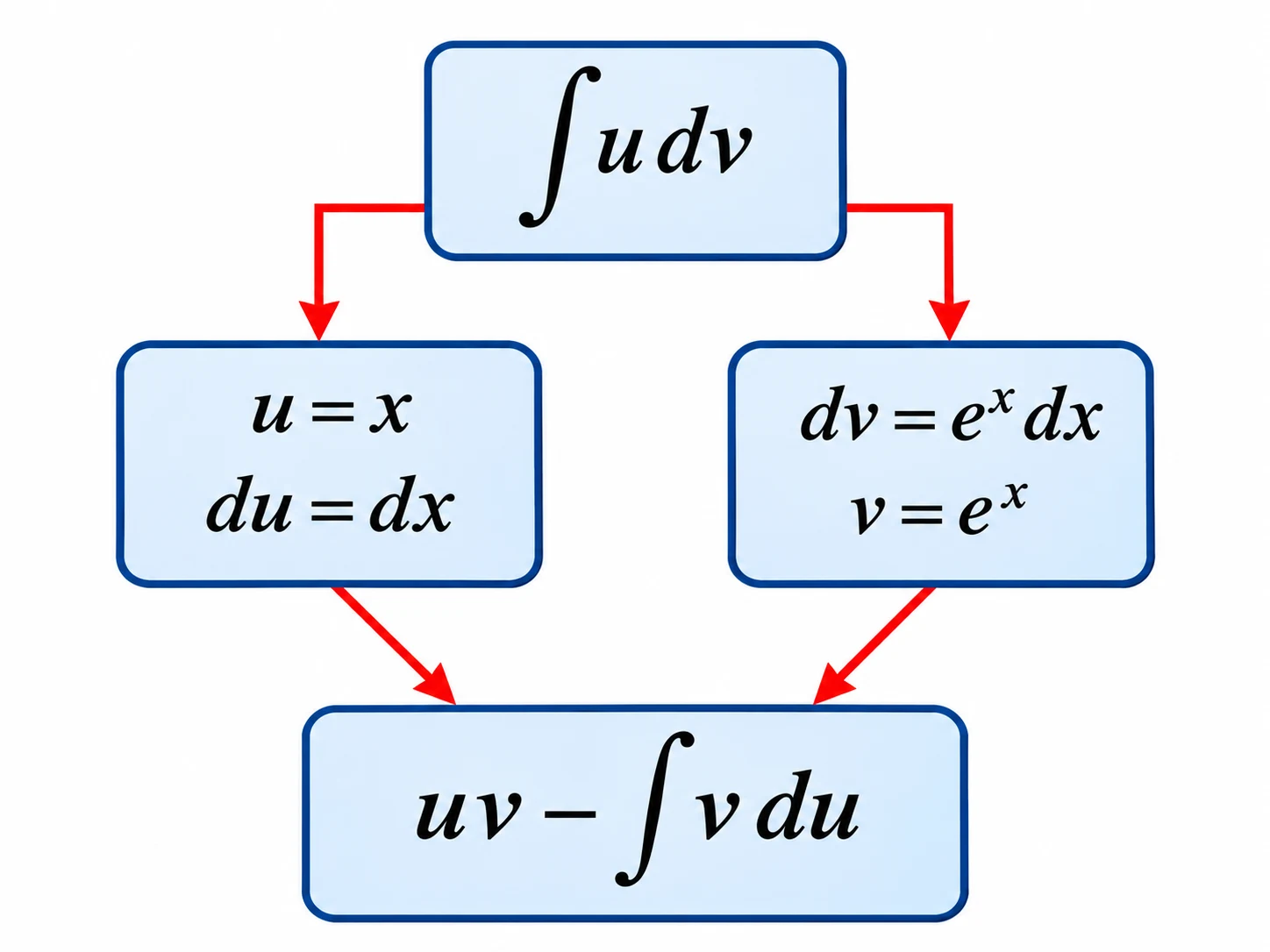
Choosing and checking
First look for a derivative of an inner expression: that suggests substitution. If you see a product such as a polynomial times an exponential or trigonometric function, try parts. Neither technique replaces basic rules, and some integrals require repeating or combining methods. Check an indefinite result by differentiating it to recover the original integrand. Check a definite result by differentiating the antiderivative and evaluating both bounds. Always add to an indefinite integral, but not to a definite integral, which gives a number.
Worked example: Two similar integrals, two different methods
Evaluate both definite integrals exactly:
Explain why a different technique is natural for each.
Show the solution
Step 1: Use substitution for . The derivative of is , already present. Set , so . The new bounds are and .
Step 2: Use integration by parts for . Choose and , giving and .
Step 3: Check the structure. In , the inner and its derivative form a chain-rule pattern. In , differentiating the factor simplifies the product.
Answers: and .
Common mistakes
Changing the integrand but not the differential.
After choosing , substitute and eliminate all remaining terms.
Keeping old bounds after a substitution.
Convert both bounds to values, or substitute back before evaluating.
Dropping the minus sign in integration by parts.
Write before substituting the chosen functions.
Including in the result of a definite integral.
Use only for indefinite integrals.
Check your understanding
1. Which is an antiderivative of ?
2. Evaluate .
3. Evaluate .
Still not sure? Talk it through.
Waypoint Mentor's tutor explains this out loud, works through your own problems on a whiteboard, and checks you've got it. Free to start.