Limits and continuity
Mathematics · First-year university mathematics · about 10 min
A limit describes the value a function approaches near a point, even if the function is not defined there. Continuity asks a further question: does the function actually take that limiting value? These ideas help you recognise breaks in graphs and give a precise foundation for calculus.
The key idea
A function is continuous at precisely when its limit exists and equals its value there:
Here is the input being approached, is the actual function value, and the limit describes nearby behaviour.
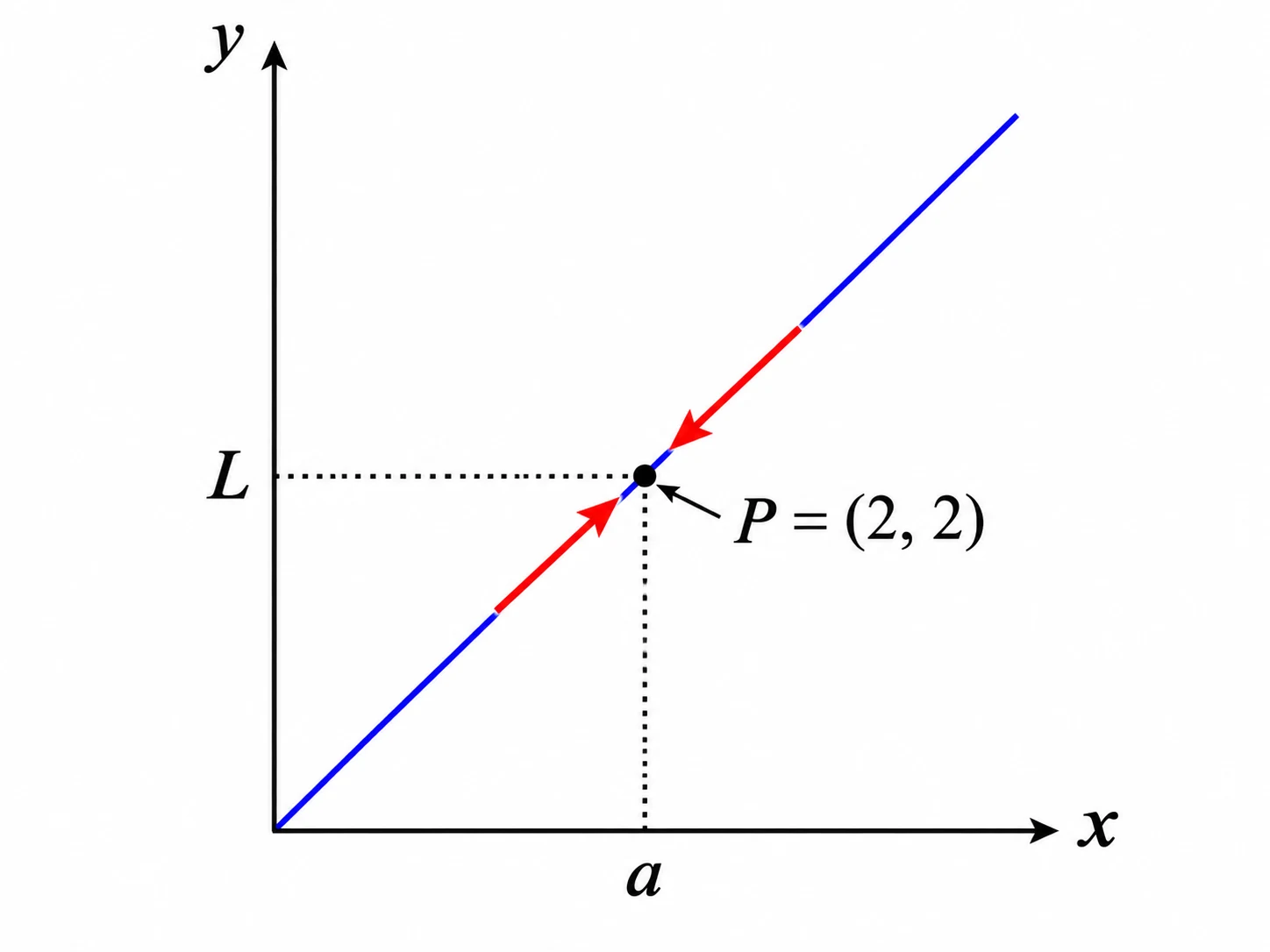
Try it yourself
Limits from both sides
Approach an input from smaller values to find the left-hand limit, . Approach from larger values to find the right-hand limit, . A finite two-sided limit exists only if these are equal. This distinction matters most for piecewise functions: a graph can approach two different heights at the same input. The value plotted exactly at does not decide whether the limit exists. Read the curve on either side first, then check any filled dot at the input.
Finding limits algebraically
Try direct substitution when the formula is continuous at the input. If it produces , that is an indeterminate form, not an answer. Factor and cancel a common factor where , or rationalise an expression containing a square root. For example, for , so its limit at is . Cancelling is valid for finding the nearby behaviour, but it does not automatically define the function at the missing input. When simplifying, keep track of the original domain.
Continuity and removable holes
To test continuity at , check three things: is defined, exists, and the two are equal. If the limit exists but is missing or different, the discontinuity is removable: redefining one value repairs it. If left-hand and right-hand limits disagree, the break is a jump and changing only cannot fix it. A continuous curve has no interruption at the point in question, but an isolated filled dot at another height changes continuity without changing the limit.
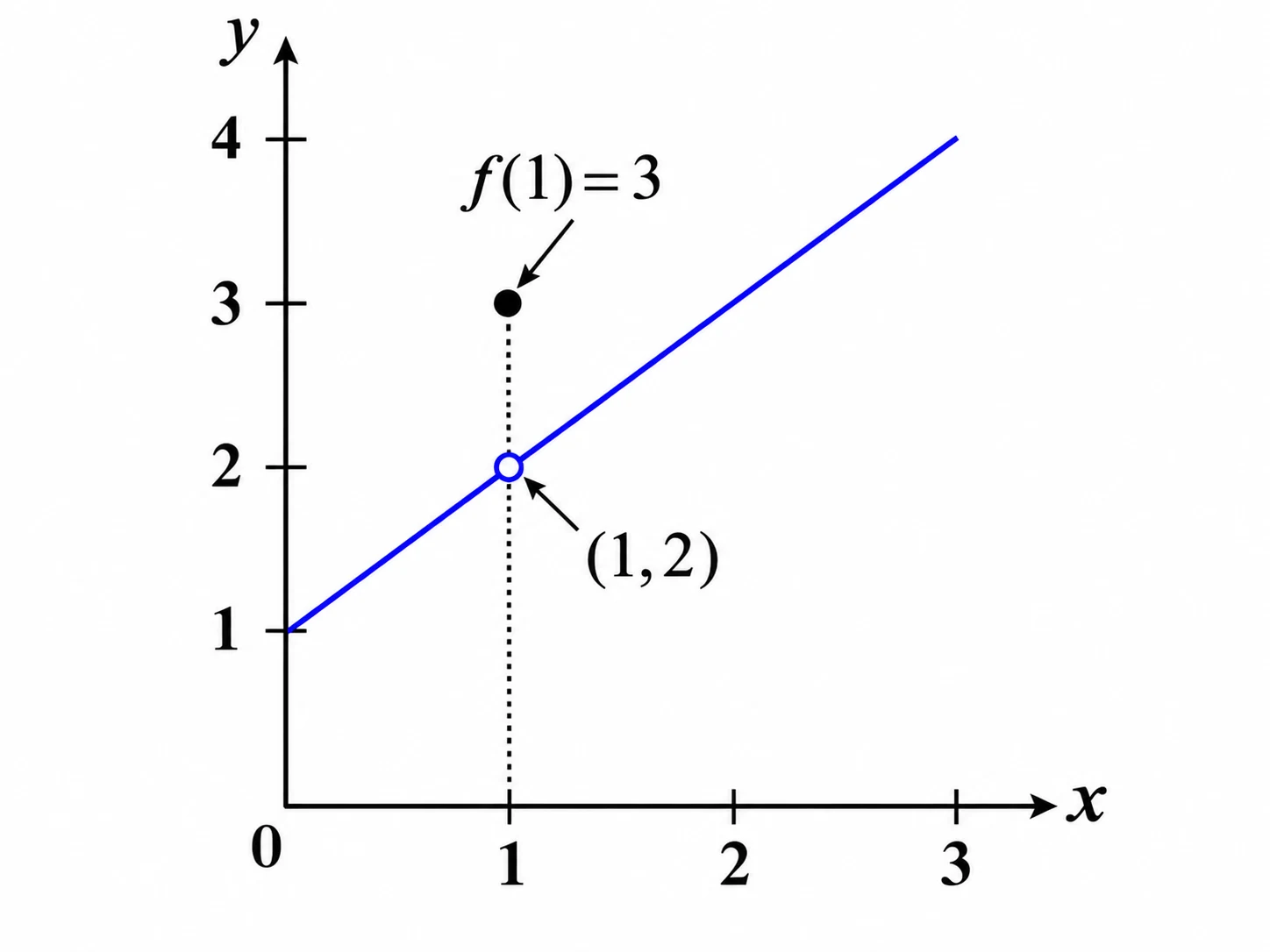
Worked example: Repairing a hole in a function
The function is defined by
Find . Determine the value of that makes continuous at , and decide whether would be continuous.
Show the solution
Step 1: Simplify near the point. For , factor the numerator:
This equality applies near , even though the original quotient is not used at .
Step 2: Find the limit.
Step 3: Apply continuity. At , the definition gives . We need , so .
Step 4: Check the alternative. If , then but the limit is still . The graph has a removable discontinuity.
Answer: and for continuity. is not continuous.
Common mistakes
Calling the limit.
Treat as a signal to simplify or use another limit method.
Looking only at the filled point.
Inspect values approaching from the left and the right before checking .
Cancelling a factor and forgetting the hole.
State the condition and check the original definition at .
Assuming matching one-sided limits imply continuity.
Also check that is defined and equals their common limit.
Check your understanding
1. Find .
2. Let for and for . What is ?
3. For when and , which makes continuous at ?
Still not sure? Talk it through.
Waypoint Mentor's tutor explains this out loud, works through your own problems on a whiteboard, and checks you've got it. Free to start.