Net present value and internal rate of return
Economics · First-year university economics · about 10 min
A dollar received in the future is generally worth less than a dollar received today because money has an opportunity cost. Net present value and internal rate of return help evaluate whether a project's future cash inflows compensate for its initial cost and the return investors require.
The key idea
Net present value discounts all cash flows to time zero:
Here is the signed cash flow at time , is the discount rate per period, and is the final period. The IRR is a rate that makes NPV zero.
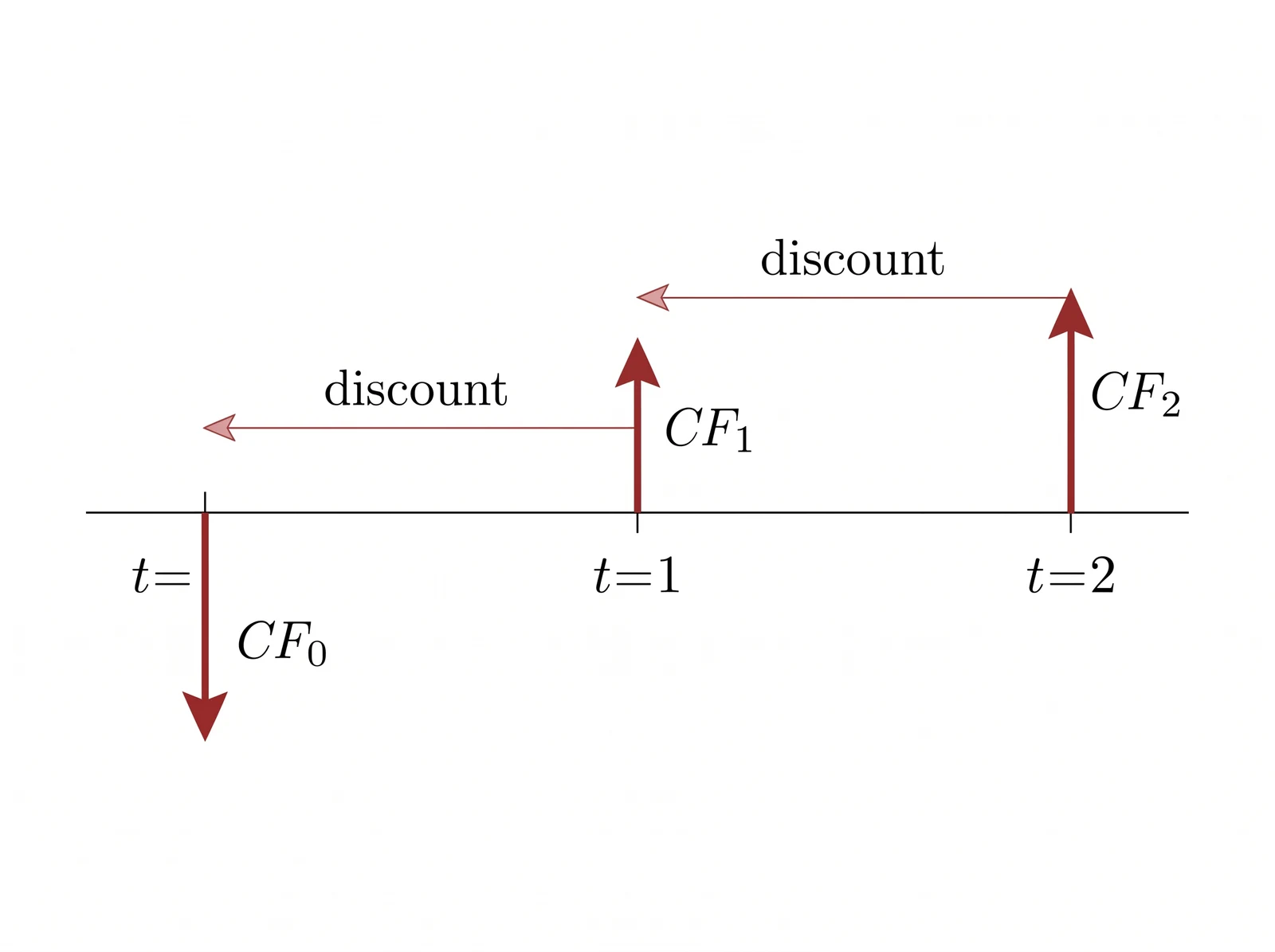
Discount cash flows consistently
A cash flow at the end of year has present value when is an effective annual discount rate. At time zero there is no discounting. Enter costs as negative cash flows and benefits as positive ones. If annual periods are used, the discount rate must also be annual. Do not discount an end-of-year-one receipt by two years or confuse a cash inflow with accounting profit. NPV includes the initial investment and measures the estimated value added in currency units.
Understand the decision rules
For an independent project, a positive NPV at the required discount rate supports acceptance under the model's assumptions; a negative NPV supports rejection. IRR solves . For a conventional project with an initial outflow followed only by inflows, NPV usually falls as increases and there is one positive IRR when total undiscounted inflows exceed the initial outflow. A project with multiple sign changes can have more than one IRR or no real IRR, so NPV is a more dependable primary decision measure.
NPV versus IRR
IRR is a percentage return indicator, while NPV estimates absolute value added. When projects are mutually exclusive, selecting the higher IRR can conflict with selecting the project creating more value, especially when scales or cash-flow timing differ. Compare alternatives using NPV at the appropriate opportunity-cost rate. Neither measure guarantees the forecast cash flows will occur, so investigate assumptions about costs, operating life, risk and discount rates. In an exam, a cash-flow timeline is an excellent way to avoid timing mistakes before calculating either measure.
Worked example: Two-year equipment investment
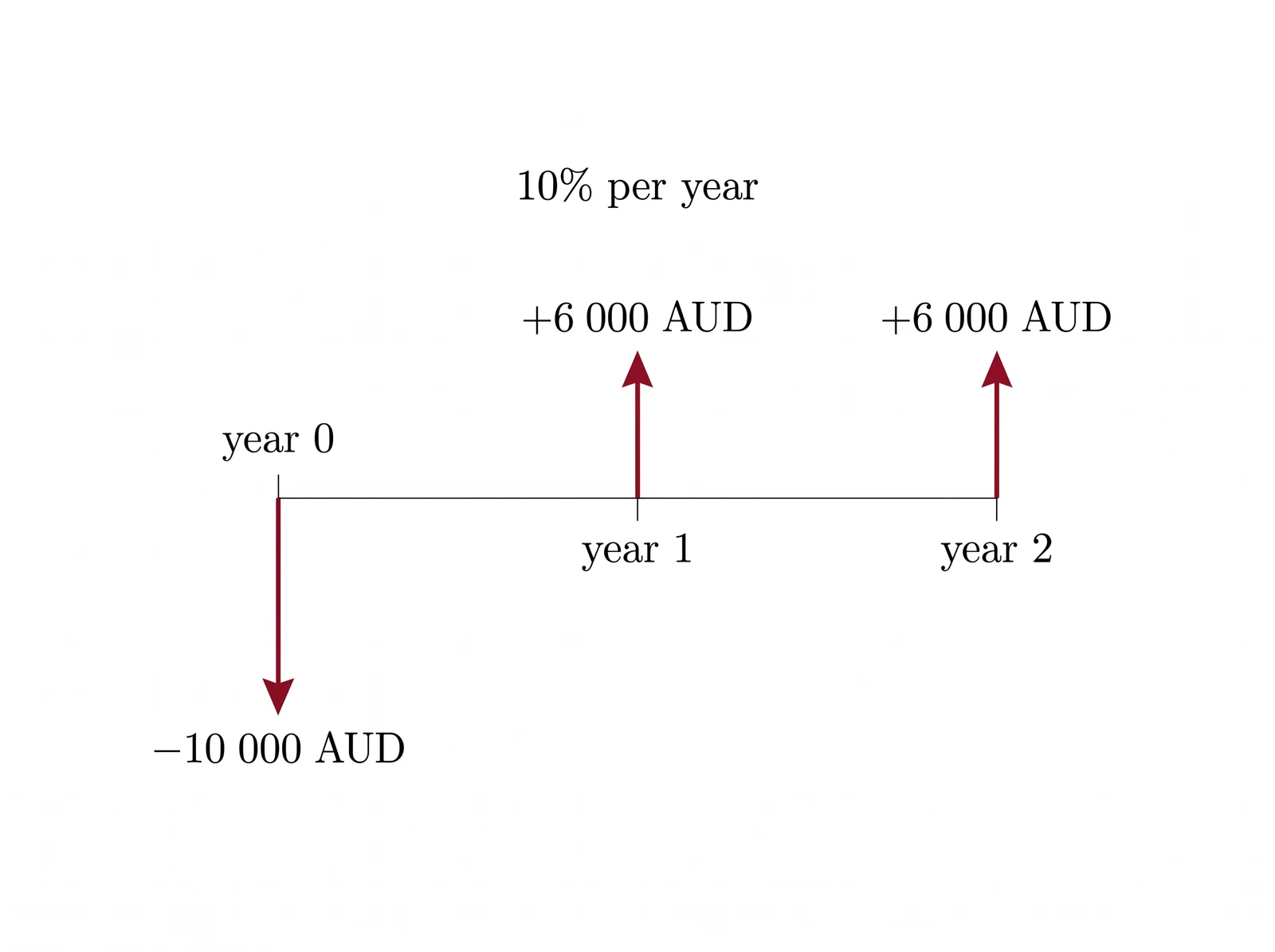
An investment costs today and returns at the end of each of the next two years. If the required annual return is , calculate NPV and the project's IRR. State the NPV decision at the required rate.
Show the solution
-
Write the signed cash flows: , and (in AUD).
-
Discount each future receipt at :
- Add signed present values using unrounded figures:
- For IRR, set NPV to zero. With ,
Answer: NPV is approximately and IRR is approximately . Accept the project by the NPV rule at a required return.
Common mistakes
Discounting the initial payment
A time-zero cash flow is already expressed in present value; do not divide it by a discount factor.
Mixing annual and monthly rates
Use a rate consistent with the time interval on the cash-flow timeline.
Assuming the highest IRR always wins
Use NPV for mutually exclusive projects when scale or timing differs.
Assuming every project has a unique IRR
Check signs and patterns of cash flows. Non-conventional projects can have multiple or no real IRRs.
Check your understanding
1. What is the present value of received in two years at a effective annual discount rate?
2. A project costs now and pays at each of the next two year-ends. What is its NPV at a discount rate?
3. For an independent project, what does a positive NPV at the required return normally indicate?
Still not sure? Talk it through.
Waypoint Mentor's tutor explains this out loud, works through your own problems on a whiteboard, and checks you've got it. Free to start.