Work, energy and power
Physics · Senior school physics · about 10 min
Work tells us how a force transfers energy over a distance, energy helps us track changes in motion and height, and power tells us how fast energy is transferred. These ideas often solve motion questions more directly than resolving every force over time.
The key idea
The net work done on an object equals its change in kinetic energy:
Here is mass, and are initial and final speeds, and is the sum of the work done by all forces.
Work depends on direction
For a constant force and straight displacement , the work done is , where is the angle between force and displacement. A force along the motion does positive work; a force opposite it does negative work. A perpendicular force does no work. Work is measured in joules: . The work-energy theorem uses net work, so include gravity, resistance and any applied forces as appropriate. Avoid multiplying a force by the total path length if that force does not act along the path.
Track kinetic and potential energy
Kinetic energy is . Near Earth's surface, gravitational potential energy relative to a chosen reference height is . If only gravity does work, . With resistance, mechanical energy decreases by the positive magnitude of the energy dissipated. Equivalently, , where is the work of non-conservative forces and is negative for friction. Energy is conserved overall, but some mechanical energy becomes thermal energy. State the reference height consistently.
Power measures the rate
Average power is energy transferred divided by elapsed time, . Its SI unit is the watt, with . For a moving object, the instantaneous power delivered by a force is . The force must be taken along the velocity direction for positive delivered power. A resistive force does negative mechanical work, but the rate of energy dissipated is usually reported as a positive number. Check what the question means by power before assigning a sign.
Worked example: A cart descending a resistive ramp
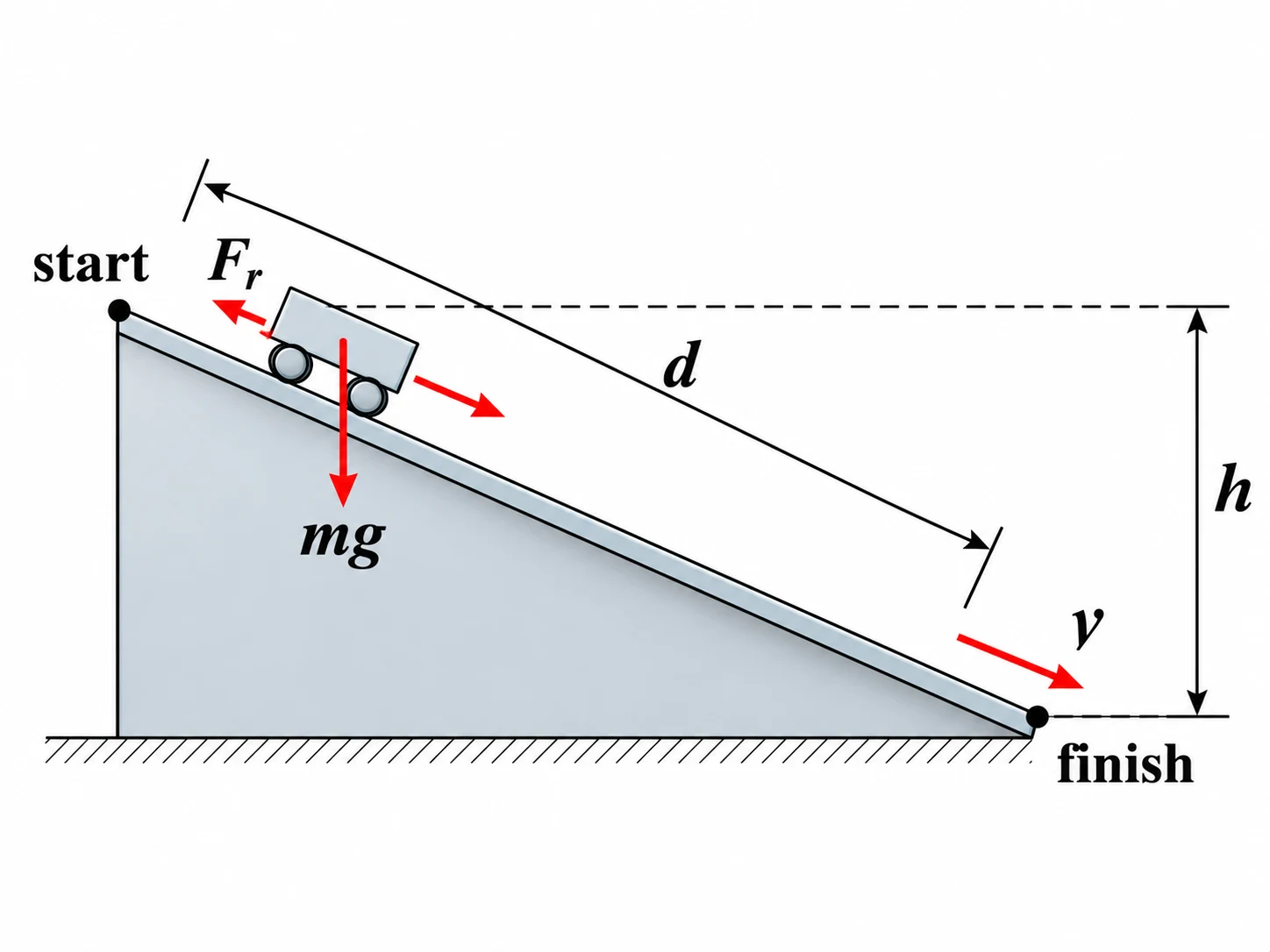
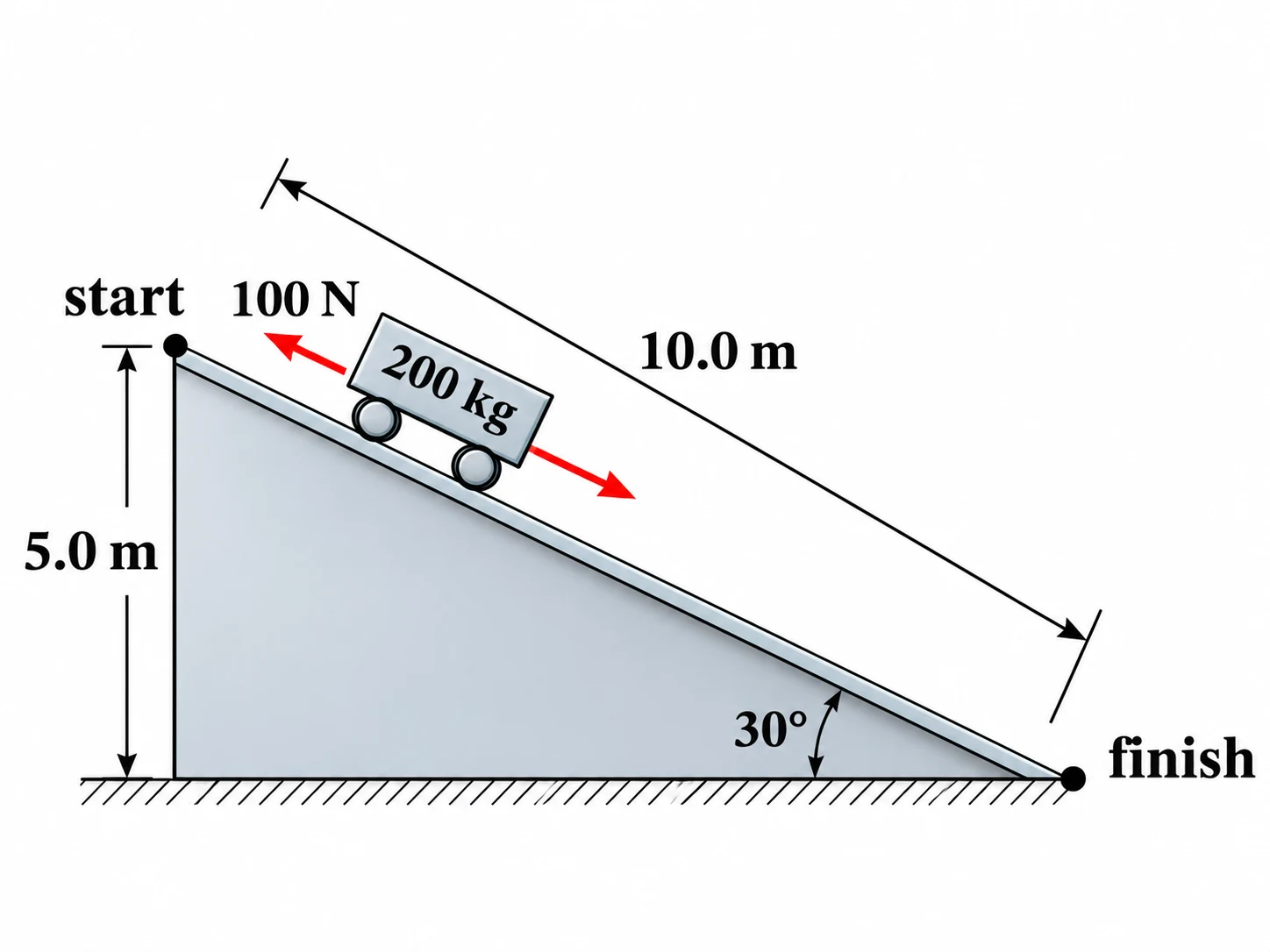
A cart starts from rest and travels down a straight ramp with a vertical drop of . A constant resistive force acts up the slope. The descent takes . Using , find the speed at the bottom and the average rate at which resistance dissipates mechanical energy.
Show the solution
Choose the bottom of the ramp as zero gravitational potential energy. Resistance acts opposite the motion.
- Gravity supplies potential energy equal to
Thus gravity does of positive work.
- Resistance does negative work along the ramp:
- The cart starts from rest, so the net work becomes final kinetic energy:
- The positive rate of energy dissipation by resistance is
Answer: bottom speed and average energy dissipation rate .
Common mistakes
Assuming work is always positive
Use the angle between force and displacement. Opposing resistance does negative work.
Conserving mechanical energy despite friction
Include the non-conservative work term or subtract dissipated energy.
Using path length instead of vertical drop in
Use the change in vertical height for gravitational potential energy.
Confusing energy with power
Energy is in ; divide by time in seconds to obtain average power in .
Check your understanding
1. A constant force acts at to a straight displacement. How much work does it do?
2. A object speeds up from to . What is the net work done?
3. A machine transfers in . What is its average power?
Still not sure? Talk it through.
Waypoint Mentor's tutor explains this out loud, works through your own problems on a whiteboard, and checks you've got it. Free to start.