Part II: Dynamics · Topic 5 of 8 · 20 min read
Particle Kinematics
Describe motion geometrically before introducing the forces that produce it.
What you'll learn
Relate position, velocity and acceleration through differentiation and integration.
Solve problems with time-dependent acceleration or piecewise motion.
Resolve two-dimensional projectiles into independent x and y motion.
Use normal/tangential components to explain curved-path acceleration.
Understand the concepts
Kinematics describes motion
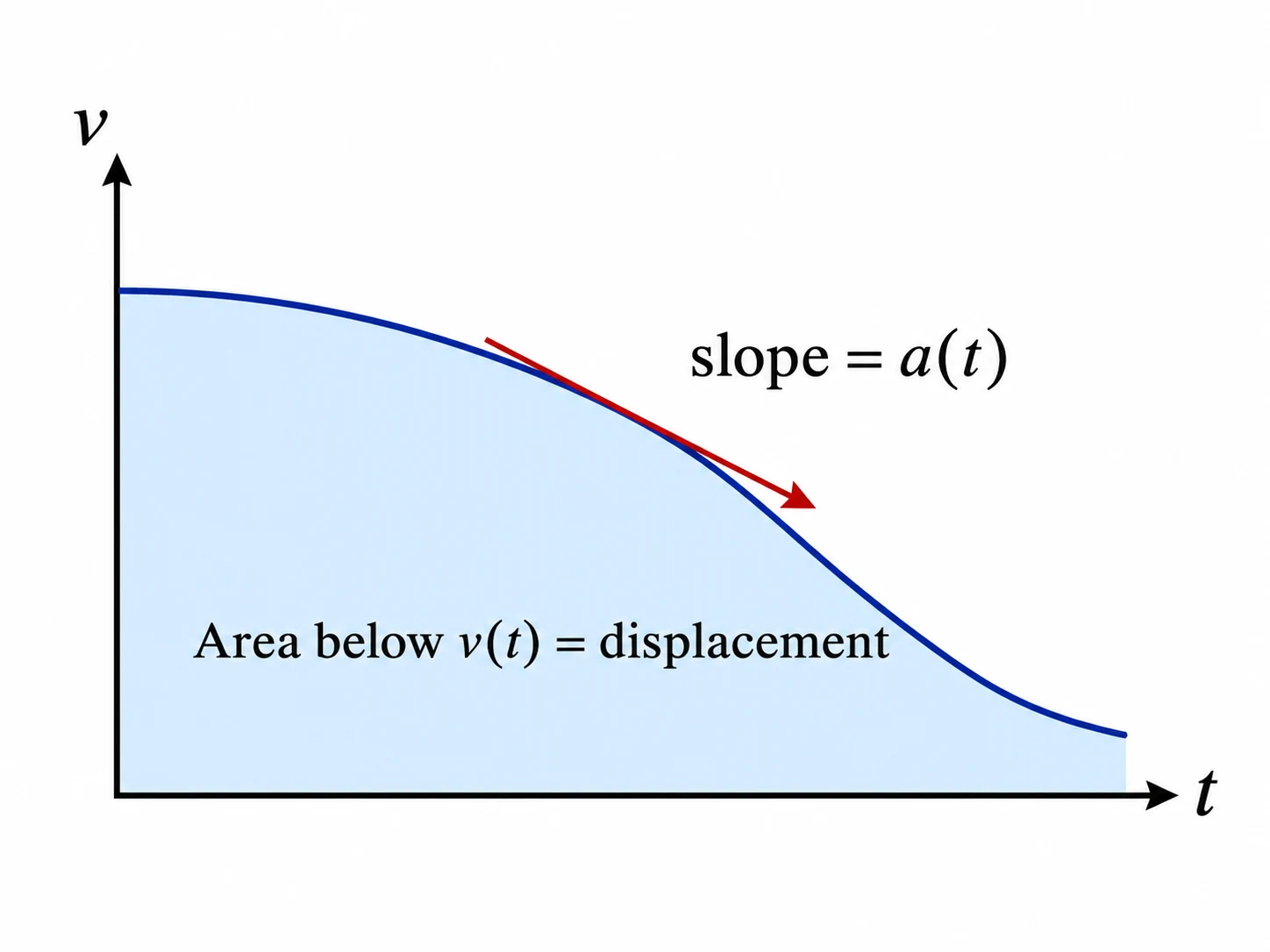
Position locates the particle; velocity is its time derivative and acceleration is the derivative of velocity. A negative acceleration component does not always mean that the speed decreases.
One coordinate can hide the picture
The integral constants are fixed by initial conditions. Plotting , and helps establish when a particle reverses direction or momentarily stops.
Assumptions and sign conventions
Particle model (size and rotation neglected).
In projectiles, air resistance is neglected unless specified.
Constant- near Earth; stationary Cartesian axes unless otherwise specified.
Normal/tangential unit vectors follow the instantaneous trajectory.
Equations that matter
Step-by-step method
Sketch the trajectory and choose signed coordinates.
List initial conditions and decide whether acceleration is constant, a function of time, or a function of position.
Differentiate/integrate with consistent units and apply initial conditions immediately.
For projectile motion, use one time coordinate in both axes and remember only at the peak.
For curved motion, determine instantaneous speed and curvature before forming tangential/normal acceleration.
Worked example: Time-dependent braking
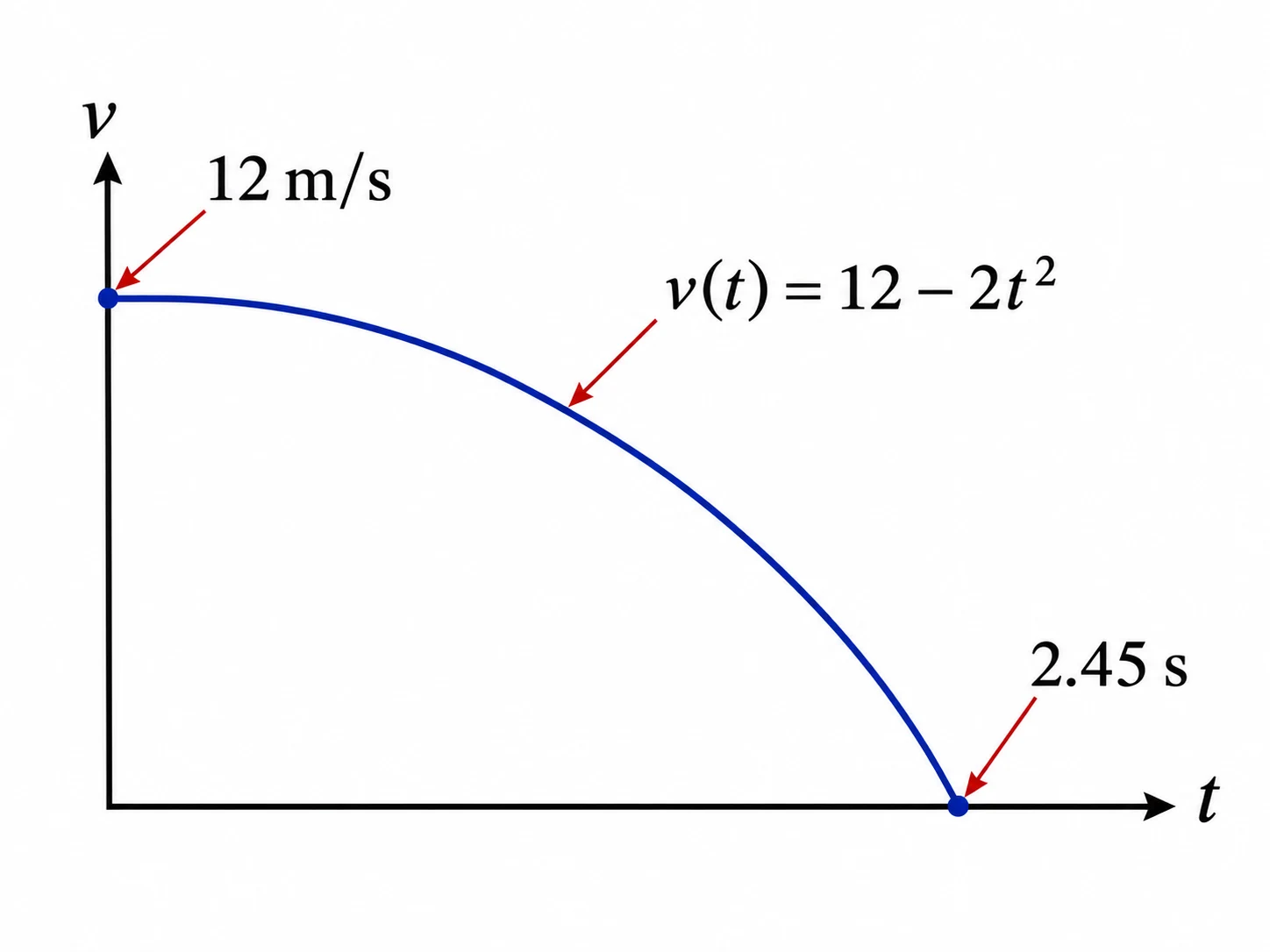
A testing capsule enters a resistive medium at along a straight axis. It experiences acceleration ( in seconds). Find the time and distance travelled before it first stops.
Common mistakes
Using constant-acceleration formulas for that changes with time.
Setting acceleration, rather than vertical velocity, to zero at a projectile apex.
Confusing scalar speed with signed velocity.
Treating normal acceleration as pointing outward from a curve.
Check yourself
Can an object accelerate while maintaining constant speed?
At a projectile apex, which velocity and acceleration components are zero?
When does displacement differ from total distance travelled?
Ready to try it yourself?
Related: Rigid-Body Kinematics
Independent Waypoint Mentor learning material. Not affiliated with or endorsed by any university.