Part I: Statics · Topic 1 of 8 · 17 min read
Force Systems & Equilibrium
Isolate the body, model the loads, then balance forces and moments.
What you'll learn
Draw a complete and labelled free-body diagram (FBD).
Resolve forces into Cartesian components and determine the moment of a force.
Identify ideal pin, roller, cable and fixed-support reactions.
Replace a distributed weight by its correct resultant and location.
Understand the concepts
Forces are vectors
A force has a magnitude, direction and point of application. Resolve an inclined force before imposing equilibrium; the horizontal and vertical components can create different effects.
An FBD is a model, not decoration
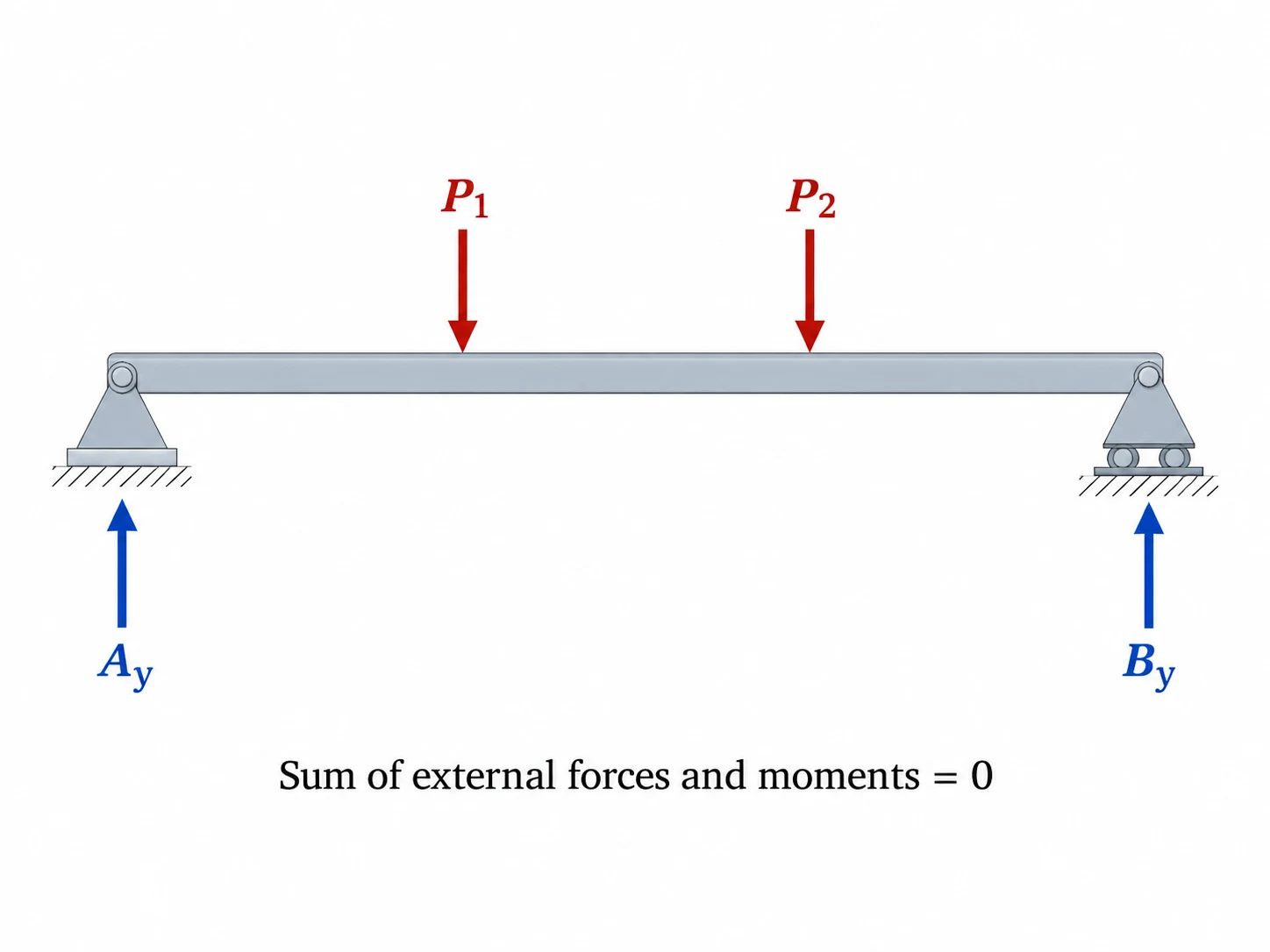
Isolate exactly one body or assembly. Remove each support and replace it with the reactions it can transmit. Include every external applied load and the weight of the chosen body.
Moments measure turning effect
A moment about point is the signed perpendicular tendency to rotate about . A force passing through has zero moment about , even if the force is large. A pure couple has the same moment about every point.
Try it yourself
Assumptions and sign conventions
Planar, rigid bodies at rest or in constant-velocity translation with no acceleration.
Supports are idealised unless stated; support friction is excluded for frictionless rollers.
Take right, up, and counterclockwise (CCW) moments positive.
For gravitational loading use and unless specified.
Equations that matter
Step-by-step method
Choose the body or assembly and draw a titled FBD with axes.
Replace supports with the physically permitted reaction components, and convert masses to weights.
Resolve angled forces; replace distributed loading with an equivalent resultant only when finding external equilibrium.
Take moments about a point eliminating unknowns, solve remaining force balances, and assign real directions to negative answers.
Verify all three equilibrium residuals and include units.
Worked example: Two loads on a maintenance walkway
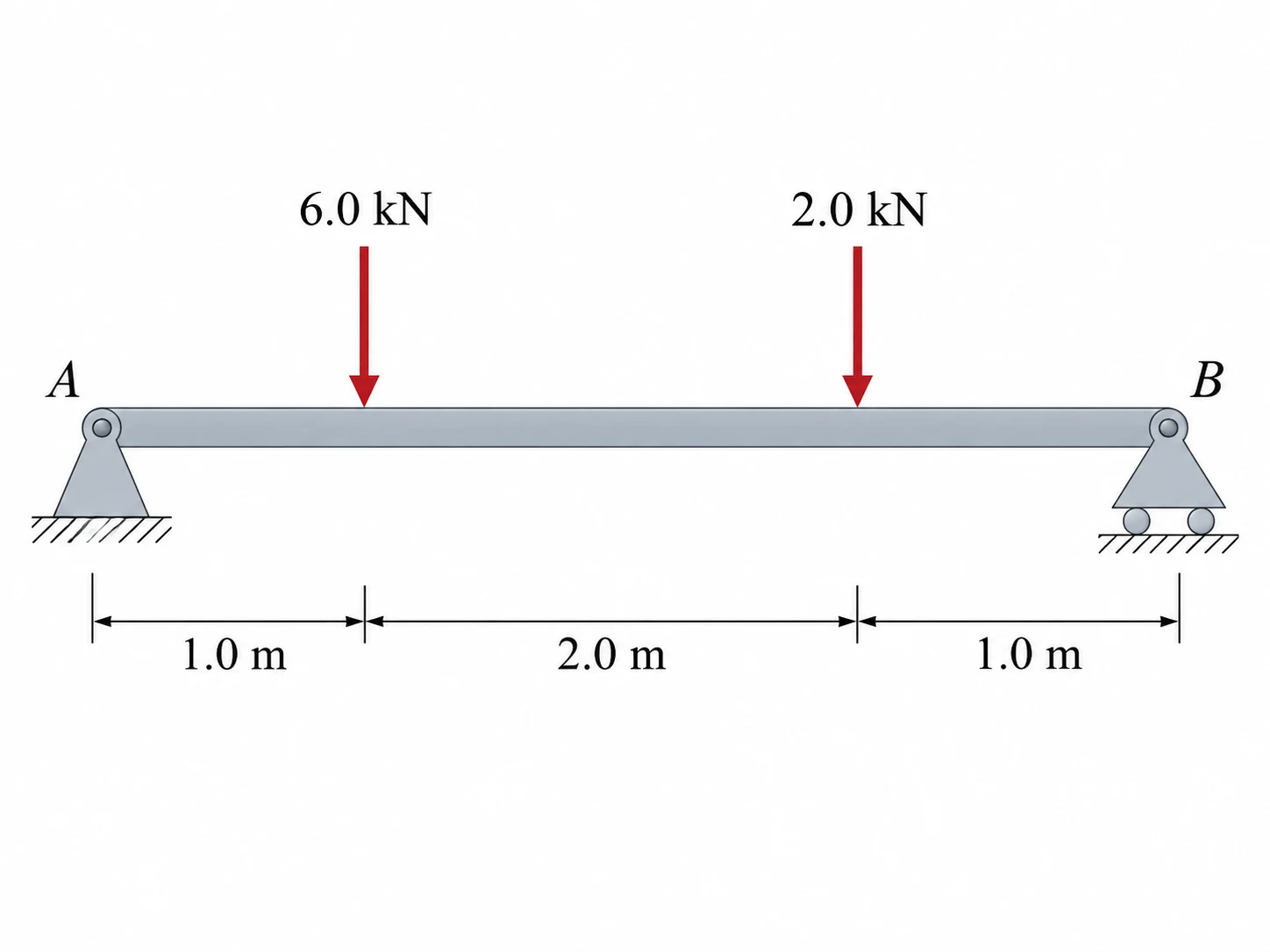
A simply supported walkway has a pin at and roller at . Vertical loads of and act and from . Find .
Common mistakes
Using a pin reaction at a roller.
Treating a mass in kilograms as a force in newtons.
Using distance along a force rather than the perpendicular moment arm.
Forgetting the beam self-weight when it is given.
Check yourself
What force can a frictionless roller transmit?
Why does taking moments about a pin often simplify the solution?
How do you locate a nonuniform load resultant?
Ready to try it yourself?
Related: Frames, Machines & Pulleys · Distributed Loads, Shear & Bending
Independent Waypoint Mentor learning material. Not affiliated with or endorsed by any university.