Part I: Statics · Topic 3 of 8 · 17 min read
Frames, Machines & Pulleys
Choose the right subassemblies and enforce action-reaction consistently.
What you'll learn
Distinguish two-force from multi-force members.
Draw separate FBDs of interacting machine components.
Analyse ideal cable and pulley tensions and torque balance.
Use internal pins and bearing reactions to solve multi-body equilibrium.
Understand the concepts
Start by deciding what to isolate
An entire machine assembly can hide internal pin forces. Break it into strategically chosen rigid bodies. Equal and opposite interaction forces appear on neighbouring bodies, never twice on the same FBD.
Two-force members are a shortcut
If a member has forces only at two pins and no applied couple or other load, those forces are collinear, equal and opposite. You can replace their two reaction components by one unknown axial force.
Cable and pulley physics
In one massless frictionless cable running over ideal pulleys, tension is constant. Distinct cables can carry distinct tensions. A compound drum has different moment arms for different cable forces; torque equilibrium uses each cable radius.
A pin transmits force but no couple
An ideal internal pin carries opposing x- and y-force components on the connected rigid bodies. An external pin usually supplies two reaction components.
Count your unknowns
For each isolated planar rigid body there are up to three independent equations. Clever selection of bodies, moment centres and two-force links makes the algebra manageable.
Try it yourself
Assumptions and sign conventions
Planar rigid components; ideal pins and frictionless sheaves unless otherwise specified.
Massless inextensible cables and negligible pulley bearing friction when ideal pulley assumptions are stated.
Cable forces act along the segment away from the attachment point.
CCW moments positive; internal action-reaction pairs are equal and opposite.
Equations that matter
Step-by-step method
Draw a clear overall diagram and identify candidate two-force members.
Choose a component FBD that removes or reduces unknown internal forces.
Apply pulley tension/torque rules only to the correct cable and pulley.
Use moments about a pin before solving reaction components.
Transfer joint forces to adjacent component FBDs with opposite signs.
Check each component equilibrium separately.
Worked example: Cable-stabilised horizontal lever
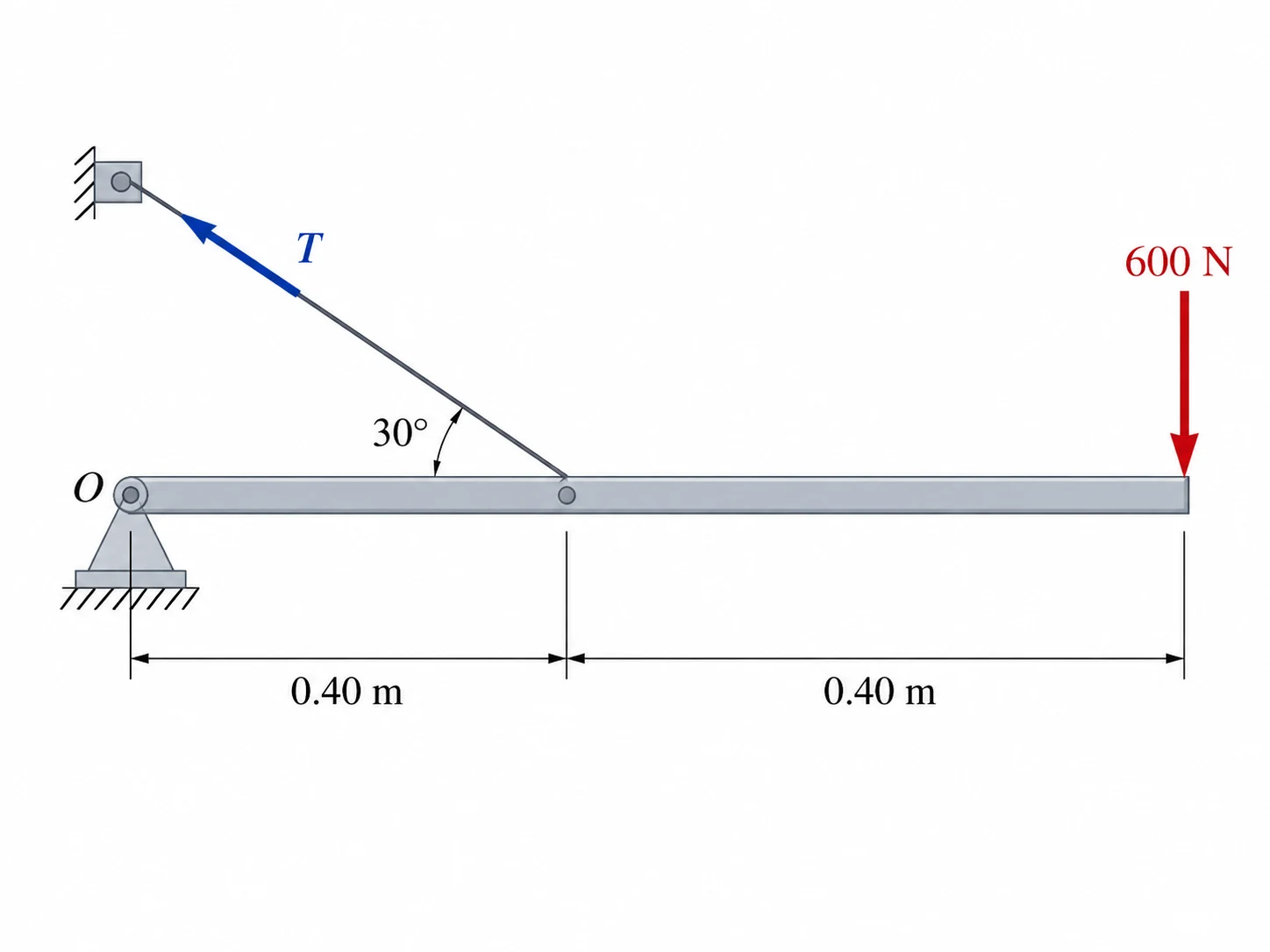
A horizontal light lever is pinned at and extends to the right. A downward load acts at its tip. A cable attaches from and slopes upward to the left. Determine cable tension and pin reactions.
Common mistakes
Mistaking a two-force member for a multi-force member carrying an external load.
Assuming different cables automatically have the same tension.
Drawing both sides of an internal pin on one body.
Using the large radius instead of the actual cable-contact radius in a pulley moment.
Check yourself
How does the cable force direction differ from a compressive link?
When can tension be the same on both sides of a pulley?
Why is a component-by-component FBD often better than a whole assembly?
Ready to try it yourself?
Related: Force Systems & Equilibrium · Mass Moments & Rigid-Body Dynamics
Independent Waypoint Mentor learning material. Not affiliated with or endorsed by any university.