Part II: Flow and Conservation · Topic 5 of 8 · 23 min read
Control-Volume Momentum
Compute fluid forces and reaction loads using momentum balance.
What you'll learn
Choose a control volume and outward normal directions.
Distinguish pressure forces from forces exerted by solid walls.
Resolve momentum flux by Cartesian components.
Calculate action-reaction forces and ideal power transfer.
Understand the concepts
Momentum is a vector
Flowing mass carries velocity and therefore momentum through a control surface. A change in flow direction can require a large force even when the inlet and outlet speeds are equal. Resolve forces separately in the chosen axes rather than subtracting speed magnitudes.
Control-volume forces
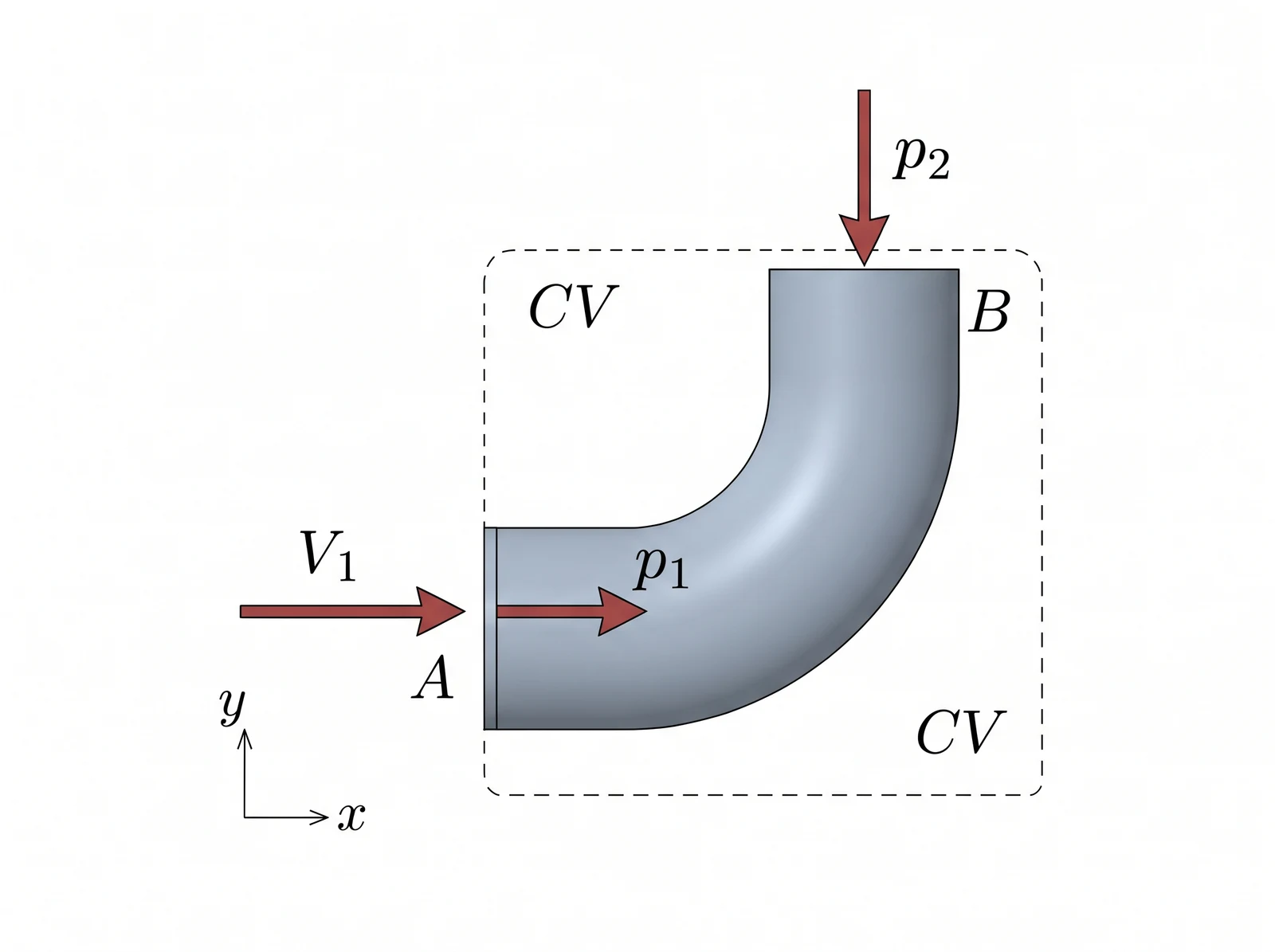
Pressure acts inward on each control surface where fluid crosses the boundary. Solid surfaces exert forces on fluid; these are not necessarily equal in direction to the force of fluid on the equipment. A free-body diagram should distinguish each of these.
Steady momentum balance
In steady one-dimensional analysis, net external force equals the difference between outgoing and incoming momentum flow rates. For a single stream of constant mass flow, this becomes . Momentum and pressure forces use newtons.
Assumptions and sign conventions
Steady flow with stated uniform section velocities.
Pressure uniform across each specified inlet/outlet plane.
Momentum correction factors are taken as unity.
Any neglected friction, gravity component or air pressure is explicitly stated in the problem.
Equations that matter
Step-by-step method
Draw a closed control volume with inlet and outlet normal directions.
Calculate every mass flow rate and velocity component.
Add pressure and wall forces consistently before applying the vector equation.
Solve each Cartesian force component and reverse signs if the equipment load is requested.
Check force dimensions and whether the resulting load direction matches the momentum change.
Worked example: Reaction from a perpendicular jet
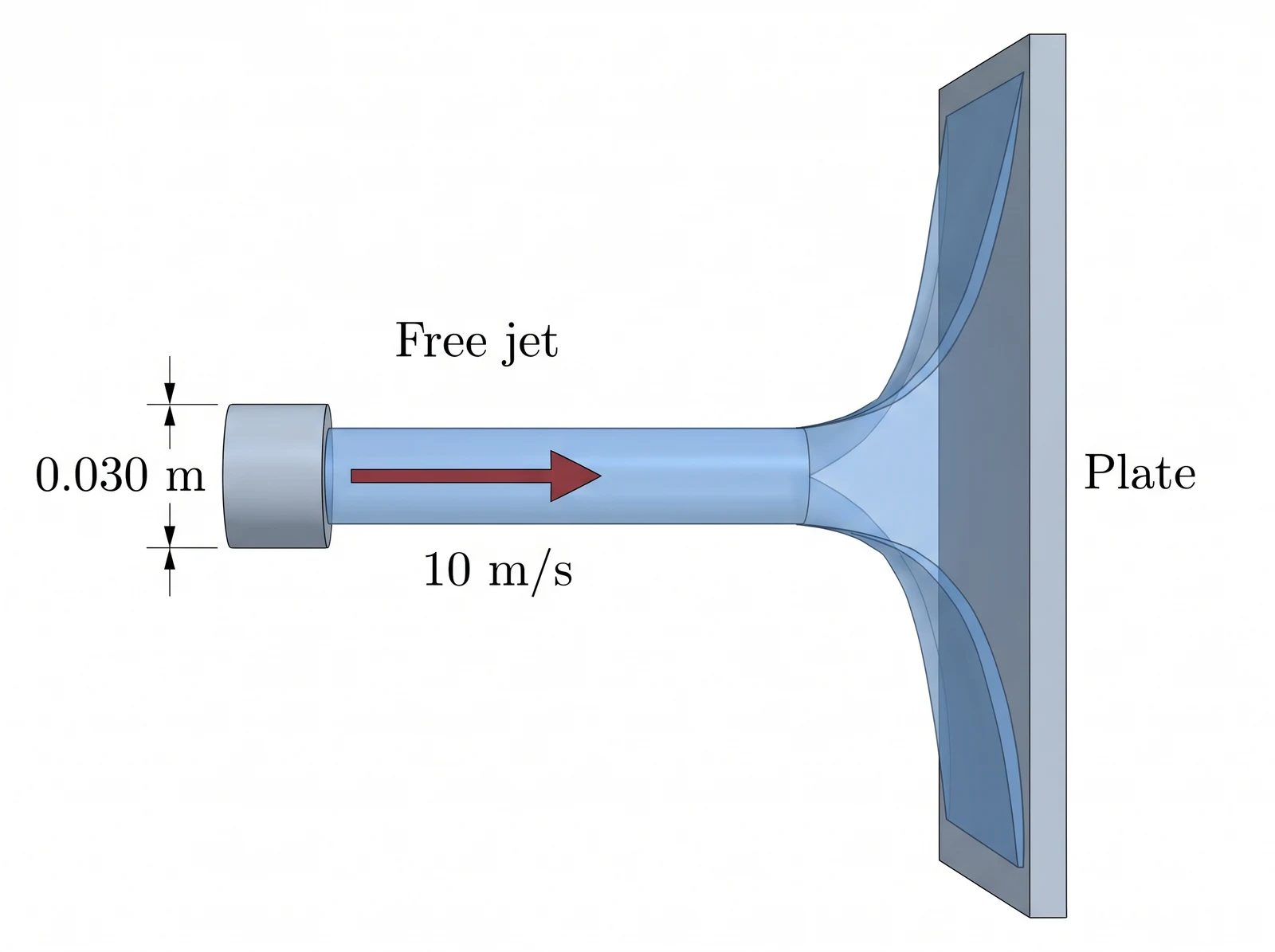
A water jet of diameter and speed strikes a fixed flat plate perpendicularly. It spreads parallel to the plate with negligible remaining velocity normal to the plate. Determine the normal force on the plate for .
Common mistakes
Forgetting pressure forces at a non-atmospheric pipe section.
Using all positive speeds instead of signed vector components.
Reporting the wall-on-fluid force when asked for fluid-on-wall.
Assuming the exit jet always maintains the inlet direction.
Counting the total mass flow once for each outlet when it already represents the combined flow.
Check yourself
Can equal inlet and outlet speeds still produce a large reaction?
Which way does pressure act on an inlet control surface?
Why must you reverse the force after solving for the fluid?
What changes the sign of angular-momentum flux when two tangential jets are reversed?
Ready to try it yourself?
Related: Internal Flow and Pipe Losses
Independent Waypoint Mentor learning material. Not affiliated with or endorsed by any university.